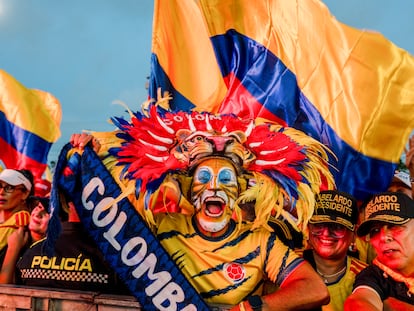
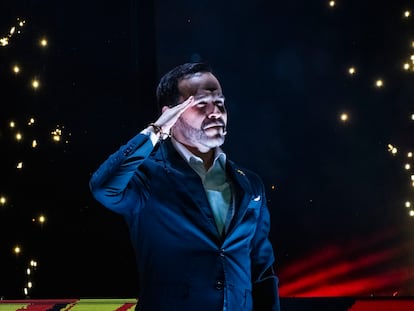
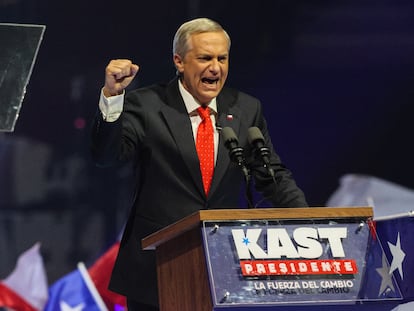
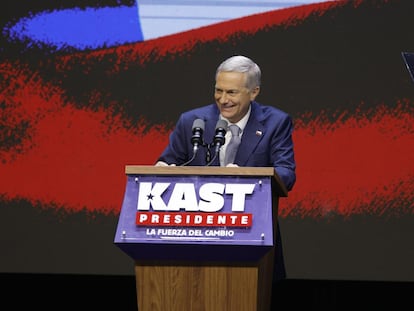
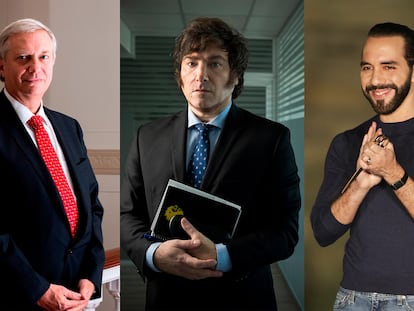
The election of Abelardo de la Espriella as Colombia’s president marks the latest advance of leaders and movements that are reshaping the political map of the region. With the notable exceptions of Mexico and Brazil, the right is gaining ground and threatening to roll back many of the political and social advances of recent decades
Conservationists warn that the species’ habitat in Chile’s Maule region could disappear if plans for an electricity interconnection proceed
Right-wing governments are now in power in 12 countries in their various forms, as hardline security policies, rollbacks of women’s and minority rights, and alliances in Trump’s orbit gain ground
A German foundation is taking the pulse of the region, which has become the main stage for the power struggle between the two superpowers
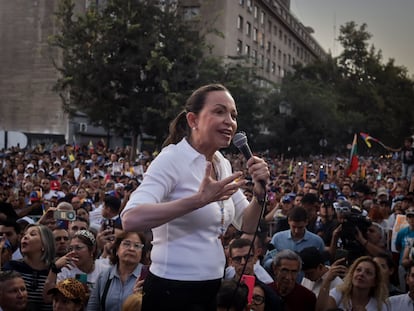
The opposition leader and Nobel Peace Prize laureate attracted a crowd of over 15,000 people to a demonstration in Santiago, where she had traveled to attend José Antonio Kast’s inauguration
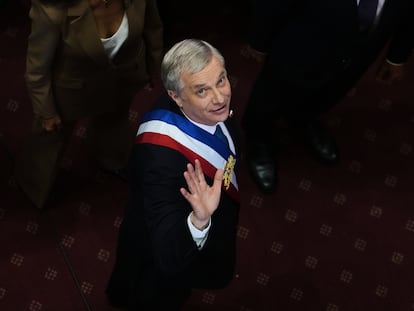
The president received the presidential sash from leftist Gabriel Boric, marking the start of a new political stage focused on security, the economy and immigration
The new president, an ally of far-right leaders worldwide, has promised an emergency government focused on law and order, and economic growth
At the center of the dispute is a Chinese undersea cable project that drew strong objections from the Trump administration
The Latin America and Caribbean International Economic Forum 2026, organized by CAF in collaboration with Grupo Prisa, brings together seven heads of state in an informal ‘Latin American Davos’
The Chilean far-right president-elect announces the 24 people who will make up his government team starting March 11
The president of Chile, who will leave office on March 11, is an unusual figure in his political sphere. EL PAÍS spoke with him in three meetings. He will work from the opposition and could run again in four years
The far-right leader is the first president in a democratic era to have supported the military regime. Although he avoided speaking about pardoning human rights abusers in 2025, he visited them in prison in 2017
The forces of the radical, populist and nationalist right have moved from the fringes to center stage, and they are expanding globally with an organized network that challenges the liberal consensus
The Venezuelan diaspora in the region generates more than $10.6 billion, according to the IOM, but 30% still live without legal status
The leaders of Brazil, Mexico and Colombia have responded in very different ways to the return of the far right to the South American country, which held a runoff vote on Sunday
The ultraconservative candidate, representing the right wing, obtained 58.1% of the vote. His opponent, Jeannette Jara, a communist activist and standard-bearer of the left, secured 41.3%
The memory of state repression has divided Chilean society ahead of the presidential runoff on Sunday, in which the far-right candidate, José Antonio Kast, is the favorite
Jeannette Jara, from the ruling party, obtained 26.8%, compared to 23.9% for José Antonio Kast in a first round where right-wing forces collectively achieved majority support in a country increasingly concerned with transnational crime
Christian groups and think tanks are weaving together a network with nodes in Washington and Budapest. Meanwhile, Madrid is gaining importance as a bridge to far-right movements in Latin America
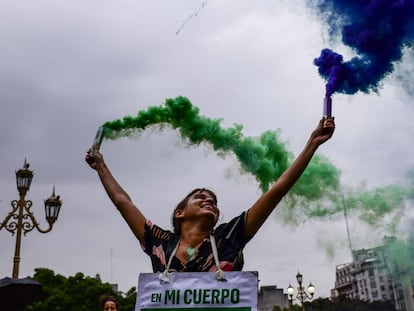
The region’s far-right leaders are waging a battle against the gains made by the feminist movement
The South American country’s political actors have all staked their positions on the new constitutional text, causing some internal divisions within the parties
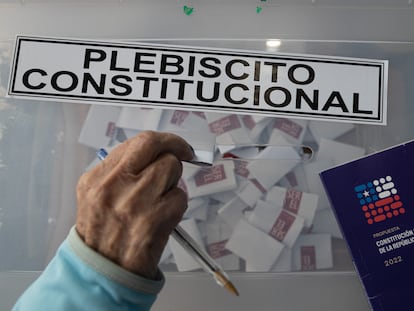
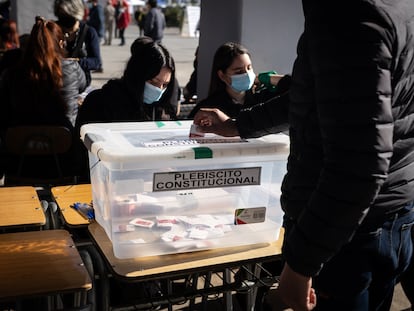
A national referendum will be held on Dec. 17 to either approve or reject the document. This is Chile’s second attempt to put an end to the Constitution of 1980, which came into effect during Pinochet’s dictatorship
Surveys from the most recent elections in Argentina, Poland, Brazil and Spain confirm that women vote less for extreme parties, as noted by many academic studies
The leader of the Independent Democratic Union, a major conservative political party in Chile, analyzes the relationship between his bloc, the traditional right and the far-right Republican Party led by José Antonio Kast
The 57-year-old lawyer with nine children leads the Republican Party, which on Sunday became Chile’s leading political force. Critical of same-sex marriage and abortion, in 2007 he tried to ban the emergency contraceptive pill
The right-wing formation led by José Antonio Kast garnered the highest number votes, since the country’s return to democracy in 1990 with 35%, turning the political chessboard around