
Kast wins in Chile and the far right takes the presidency for the first time since the return to democracy
The ultraconservative candidate, representing the right wing, obtained 58.1% of the vote. His opponent, Jeannette Jara, a communist activist and standard-bearer of the left, secured 41.3%


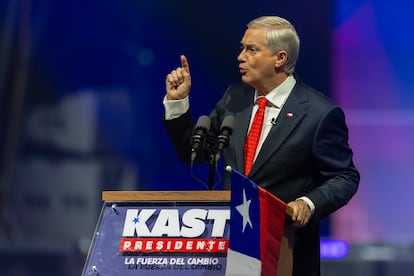
Chile elected its next president on Sunday: José Antonio Kast, a 59-year-old lawyer and leader of the far-right Republican Party, won with 58.1% of the vote, with 99% of the ballots counted. His opponent in the runoff election — the communist Jeannette Jara, a 51-year-old lawyer and left-wing candidate — garnered 41.3%, the worst result for progressives since the return to democracy in 1990.
The victory marks the arrival of the first leader who has not distanced himself from the dictatorship of Augusto Pinochet (1973-1990) to La Moneda Palace, where he will succeed Gabriel Boric, a leading figure of the new left, who will step down at the age of 40. Kast’s victory not only consolidates the conservative shift in the country, but also in much of South America, and puts Chile’s institutional framework in the test, since it remains unclear how radical the policies Kast plans to implement from March 11 will be.
In any case, his phone call with President Boric was cordial in tone. “At some point, you too will come to know what the loneliness of power means,” Boric told him. Kast, for his part, thanked Boric for the call, invited him to “a very orderly transition,” and asked to “count on his opinions” starting on March 11.
Later, at his first rally in the district of Las Condes, Kast, in a conciliatory tone, praised his rival Jara (“I recognize her courage”) and said that there are good and bad people on both the right and the left. “Chile does not move forward divided,” he said.

Jara had earlier quickly acknowledged her defeat: “Democracy has spoken loud and clear. I just spoke with President-elect José Antonio Kast to wish him success for the good of Chile,” wrote the left-wing candidate. Boric, speaking from the La Moneda Palace, flanked by government spokesperson Camila Vallejo and Interior Minister Álvaro Elizalde, delivered a message to the nation in which he urged his successor to build bridges.
Kast, who won with the support of the other two major right-wing factions — the traditional right and the far-right Libertarian Party — and did so comfortably, as the polls predicted, with a 16-point lead over Jara. He has promised order and security in response to the main concerns of Chileans: crime and irregular migration.
The election results confirm that Chile can no longer be understood in terms of the opposing sides of the 1988 referendum, when Chileans rejected Pinochet’s continued rule at the polls. Chile has moved beyond the “Yes” and “No” division of that referendum — that is, between dictatorship and democracy, perpetrators and victims — which has shaped Chile’s political landscape for the past 35 years. Today, Chile is better understood in terms of the divisions that emerged from the social uprising of October 2019 and the first attempt to amend the Constitution, which was rejected in September 2022 by a vote of 62% to 38%: restoration versus refounding, the latter being the path pursued by the left, pushed by radical sectors. It was an irrecoverable blow for Boric’s government, which was just beginning its first year in office.
It is the first time that a far-right president, nostalgic for the Pinochet regime, will arrive at La Moneda. Since the return to democracy, the right-wing Sebastián Piñera governed on two occasions (2010–2014 and 2018–2022), but he was a rara avis within his political camp: he voted “No” to Pinochet in the 1988 plebiscite, came from a Christian Democratic family — identified in Chile with the center-left — and enjoyed independence from economic interest groups because he was a millionaire, albeit a first-generation one. During his administrations he took significant steps, such as speaking of the “passive accomplices” of the dictatorship, referring to civilians who supported the regime, which caused a political earthquake among his allies.
Kast, by contrast, supported the “Yes” option in that plebiscite and throughout his public life — he served for 16 years as a lawmaker for the doctrinaire Independent Democratic Union (UDI) party of the traditional right — has not broken with the Pinochet regime. He defends the dictatorship (in 2017 he said that if Pinochet were alive he would vote for him, although in 2021 he stated that anyone who had violated human rights, whether military or not, did not have his support). In this campaign, his third attempt, he chose not to focus on the recent past or on his positions against abortion, same-sex marriage, or on initiatives he had previously put forward, such as eliminating the Ministry of Women. He has promised to focus on governing through an “emergency government.”

He will be in power for four years, until March 2030, on a promise of order and security, in a society concerned about rising homicide rates — the rate has doubled over the past 10 years, although it remains below that of most Latin American countries — and new forms of crime. Chile is the sixth most fearful country in the world, according to Gallup’s 2025 Global Security Report. Public fear is higher than in all Latin American countries except Ecuador, even though most of those countries have higher levels of insecurity.
Unlike the left, which was slow to take on the challenge of curbing crime and organized criminal networks that hit the poorest hardest — this was not a priority for the Boric government when it took office — the far right has centered its discourse on radical measures, such as building a mega-prison in the Atacama Desert. The public, resistant to normalizing public insecurity because it was not part of everyday life in the past, has largely backed Kast, who at the same time promises tough measures against the roughly 330,000 undocumented migrants currently living in Chile, most of them Venezuelans. During the campaign, Kast has counted down daily the days remaining until he takes office — days which, he says, are also the time left for undocumented foreigners to leave the country.
Kast will pursue what he calls an emergency government to tackle what he considers Chile’s three main crises: crime, irregular migration, and low economic growth. He promises to tighten the state and cut $6.5 billion in public spending — though he has not explained how — while it remains unclear whether he will push restrictions on individual freedoms that Chile has gained in recent decades, such as access to abortion under three circumstances. His main target during the campaign has been the Boric government, an administration he has labeled “inept,” among other criticisms. His campaign manager, Martín Arrau, in the run-up to Kast’s likely victory, has worked to temper the high expectations surrounding a candidate who has promised radical change from the current government. “If anyone expects everything to change on day one, it’s not going to happen,” he said a week ago.
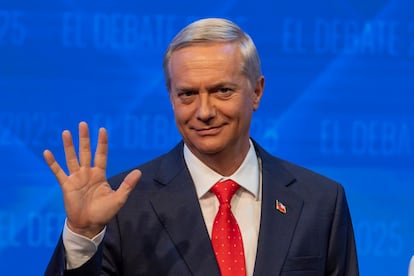
He will not have a majority in Congress, although his party grew considerably in the Chamber of Deputies, while the left will primarily exercise opposition from the Senate, where it still holds sway. The current governing coalition, meanwhile, is beginning a long dark night in which it will have to rethink a political project that fails to inspire the social groups it claims to represent. On Sunday, Chile’s popular sectors have once again shown that they are with Kast, over whom a major question looms: does he want to govern like Italy’s Giorgia Meloni, Brazil’s Jair Bolsonaro, Argentina’s Javier Milei — or as a blend of all three?
The academic Stéphanie Alenda believes it is too early to say the election results mark a new trend, but rather as “the clearest expression of the exhaustion of a political cycle and of the failure of traditional forces — left, center, and right — to offer credible responses to a country that in recent years has been marked by overlapping crises of order, governability, and expectations.”
Alenda argues that Kast did not emerge out of nowhere: his candidacy capitalizes on the fears and persistent discontent that conventional politics has been unable to process. His victory, she explains, should therefore not be interpreted as majority support for a coherent ideological project — aligned with radical conservatism and market liberalism — nor as a nostalgic vindication of the Pinochet regime.
Six years after the social uprising — which the left mistakenly interpreted as a cry for equality and against the neoliberal model — and four years after Boric’s election, a bet on change and on a new political generation, millions of Chileans have once again swung the pendulum and, on Sunday, voted predominantly for Kast.
Sign up for our weekly newsletter to get more English-language news coverage from EL PAÍS USA Edition









































