
A communist and a far-right candidate will compete for the presidency of Chile
Jeannette Jara, from the ruling party, obtained 26.8%, compared to 23.9% for José Antonio Kast in a first round where right-wing forces collectively achieved majority support in a country increasingly concerned with transnational crime


The next president of Chile, who will govern the South American country between 2026 and 2030, will be either the communist candidate Jeannette Jara or the far-right representative José Antonio Kast, leader of the Republican Party. This was decided by Chileans on Sunday, after the first round of a presidential election where voting was mandatory for the first time.
With 99% of the votes counted, Jara, the candidate of President Gabriel Boric’s administration, garnered 26.8% of the vote, well below what the polls had projected. Kast came in second with 23.9%, a narrow margin that makes him the favorite to win, given that conservative forces have collectively secured majority support.
In a surprise result, the third most-voted candidate was the right-wing populist Franco Parisi, who secured 19.7% of votes in his third attempt to reach power. In doing so, he surged ahead of both the radical libertarian Johannes Kaiser, who obtained 13.9%, and the big loser of the day, the mainstream conservative Evelyn Matthei, who came in fifth (12.4%), in what amounts to a great failure for the Chile Vamos coalition.
“I congratulate Jeannette Jara and José Antonio Kast on advancing to the second round,” said President Boric, speaking from La Moneda Palace and flanked by his Interior Minister, Álvaro Elizalde, and his spokesperson, Camila Vallejo.
The results, in which the right-wing forces collectively hold a significant majority, align with the scenario repeatedly shown in the polls: on December 14, the approximately 15.7 million voters who are required by law to cast their ballots will have to choose Boric’s successor from between two extremes of the political spectrum.
Although the left-wing Jara came in first, the combined votes for Kast, Kaiser, and Matthei total 52.23%, giving Kast a strong position for the runoff. Adding the support of Parisi, a populist and an opponent of Boric, would bring the total to 70.64%, although there is no evidence that Parisi voters will automatically transfer to the right in the runoff. On Sunday night, Parisi refused to back either one of the two top presidential hopefuls: “I have some bad news for the candidates: earn your own votes.”
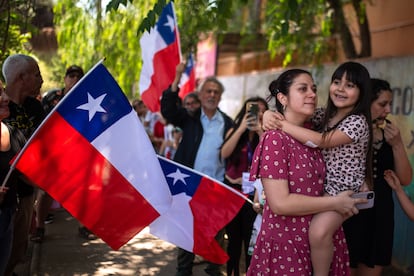
The difference between Jara and Kast, of around three percentage points, was not what the left had hoped for. Polls had consistently shown that the 51-year-old public administrator would garner the most support on November 16, but by a margin of between five and nine points over Kast. Her main challenge was not winning this first round — the ruling coalition had rallied around Jara’s candidacy — but rather securing a majority that would allow her to win the runoff on December 14.
Suspending Communist Party membership
According to the polls, which have generally made accurate projections, Jara would lose to Kast, a 59-year-old lawyer, especially with such a narrow margin over the Republican candidate. Therefore, she must start sending strong signals to the moderate electorate. The first expected gesture is that Jara will suspend or freeze her membership in the Communist Party, where she has been registered since she was 14, a move that is already generating considerable resistance. Furthermore, a change in her team is expected, with the addition of figures who can provide some reassurance to the political center.
As expected, Kast overtook Parisi, Matthei and Kaiser. This is the third time the far-right candidate has run for president. In the 2021 election, he won the first round but lost the runoff to Boric, the current president. A staunch conservative on issues such as abortion, Kast has promised an “emergency government” for Chile with priorities focused on security, economic growth, slimming down the state administration — he aims to cut $6 billion in spending over 18 months — and irregular immigration.
Kast already has the express support of Kaiser, with whom he has pledged a joint electoral pact for Congress, as well as that of Mattei, who went to visit him at his headquarters. Kast will also be joined by much of the traditional right wing, grouped in the Chile Vamos coalition. The pragmatic right wing is expected to join forces to prevent Jara from coming to power on March 11, when Boric will leave the government having just turned 40 years old.
The signals that the two candidates send in the coming hours will be key to garnering additional support. Jara has fallen short even of the historical support enjoyed by Boric’s government, a loyal 30%, but insufficient for a majority. In fact, during the campaign she has had to distance herself from the president and his administration, even though she herself was Minister of Labor until just a few months ago. Jara’s mission is monumental, because the political winds in Chile are currently blowing in favor of the right like never before, and, as has been the case for the last 20 years, the presidential election is won by the opposition bloc.
Volatile voters
Chile has once again held elections without a hitch, as has been the case since the return of democracy in 1990. In addition to electing Boric’s successor, voters renewed the entire Chamber of Deputies (155 members) and nearly half of the Senate (23 of the 50 senators from seven regions, excluding the capital district). This is the first time since 1990 that citizens have elected a president of the Republic with mandatory voting and automatic voter registration.
Chilean society has been volatile in its electoral preferences. After the social uprising of 2019, with unprecedented waves of violence that brought the government of moderate right-wing president Sebastián Piñera to its knees, voters approved a constitutional path to replace Augusto Pinochet’s 1980 Constitution, which, however, bears the signature of socialist President Ricardo Lagos due to the reforms made in 2005.
Then, they elected a drafting body dominated by the far left and, when President Boric’s government had barely been in office for six months, they rejected the text supported by the ruling coalition by a vote of 62% to 38%. It was a resounding failure that forced the government to adapt to the new circumstances and curb the high expectations with which it took office in March 2022. Afterwards, a second process was opened to prepare a new Constitution, where drafters mainly from the far right made significant contributions, but in 2023 Chileans again rejected the proposal by 55% to 42%.
This is what’s known as the Chilean pendulum. The decisions seem contradictory, but they aren’t: society remains angry and, above all, deeply disillusioned with political institutions. Therefore, for two decades they have punished incumbents and favored the opposition, as if trying to believe in change, which never truly arrives. Governments, in turn, have to deal with a fragmented Congress and have serious problems securing majorities and passing legislation. Chileans, who trust neither the government, the parties, nor parliament, have participated listlessly in elections where, for the first time, their vote was mandatory. Polls show that Chileans were more worried than hopeful about these elections and that more than half agree with the statement, “It doesn’t matter who’s in government, I’ll still have to go out to work every day.”
This is the Chile that the next president will inherit in four months, when he or she takes office on March 11. A country with a fickle electorate that doesn’t maintain its support for long, and which is above all fearful of the emergence of transnational organized crime. This is part of the social landscape that explains why the prevailing winds are pushing for extreme rhetoric like Kast’s and, in turn, the difficulties faced by the left.
Sign up for our weekly newsletter to get more English-language news coverage from EL PAÍS USA Edition









































