
David Petraeus, the US general who oversaw the transition in Iraq: ‘In Venezuela there will be innumerable mini-crises’
The former CIA director tells EL PAÍS he hopes that Trump’s threats against Greenland ‘are just a negotiation strategy’
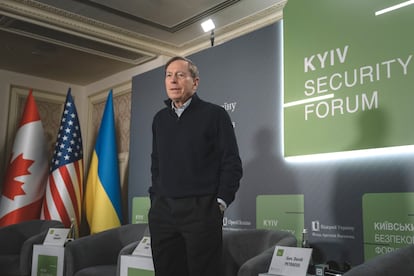

U.S. General David Petraeus (Cornwall-on-Hudson, New York, 73 years old) knows what it means for the United States to oversee a country. He was the architect and commander of Operation Surge, the strategy that significantly increased the U.S. military presence in Iraq in 2007 to counter the growing radical insurgencies. His success earned him a promotion to chief of the Central Command, in charge of U.S. forces in the Middle East. In 2011, Democrat Barack Obama appointed him director of the CIA. In 2016, Republican Donald Trump considered him for Secretary of State in his first term.
Thirteen months after the Republican leader’s return to the White House, this counterinsurgency expert and Princeton PhD in economics reviews global geopolitics in an interview with EL PAÍS in Washington. Weighing each word and carefully choosing his phrases, he welcomes the relative entente between the United States and China, which he considers fundamental to the future of the world; he believes that Ukraine “is in a better position vis-à-vis Russia thanks to what the EU, NATO, and the United States have done this year,” and suggests increasing pressure on Moscow through sanctions to force the Kremlin to negotiate.
Petraeus assesses that Iran is in a much weaker position, facing massive protests against the regime, its economy and nuclear program ailing, its radical allies in the Middle East significantly weakened, and Syria no longer in its sphere of influence. In the Americas, the new year began with the U.S. military operation in Venezuela that captured Nicolás Maduro, whose appearance before the courts he considers an improvement for the Western Hemisphere.
Question. After the operation in Venezuela and leaving a U.S.-backed government in charge — that of Delcy Rodríguez — Trump is now threatening to strike at Iran as well. Isn’t that biting off more than he can chew?
Answer. I think the U.S. has considerable capacity to keep multiple plates spinning at the same time. And in fact, we have allies and partners, if we appreciate them sufficiently, who will help us keep all these different plates spinning. The plates represent threats and issues we have to address. There are more plates now than has been the case, certainly since the end of the Cold War, maybe even since the end of World War II. And those plates are more complex in general.
Q. Looking ahead, which of these plates, of all those spinning, should Trump pay most attention to?
A. The U.S. and Western relationship with China. That plate is bigger than all the other plates put together, because it is the most consequential relationship in the world, and frankly, it’s the biggest challenge in the world. We have to try to put a floor on that relationship and some guardrails on the sides of it.

Q. Many observers thought the threats against Maduro were a negotiation strategy…
A. Maduro was given a chance. What was reportedly offered to Maduro was essentially exile. He had a couple of different options, one of which I think was Turkey. But Maduro spurned that, and he’s probably going to spend the rest of his days in a U.S. penitentiary. Keep in mind, we’ve done this in the past. Remember General [Raoul] Cedrás in Haiti. I believe former president [Jimmy] Carter and former general [Colin] Powell, I think, were on the ground and persuaded Cedrás an hour before the first brigade of the 82nd Airborne Division was going to jump on Port au Prince. Or the operation to capture Manuel Noriega in Panama in 1989.
Q. As director of the CIA or a military commander, would you have recommended this intervention in Venezuela?
A. It’s a little bit hard to say, because I don’t know the other options that were considered. And, more importantly, I’m not certain of the desired end state. We’ve heard Secretary of State Marco Rubio and the president talk about a transition. Does that mean transition to the government [led by opposition candidate Edmundo González Urrutia] that was elected by a two-to-one margin in the 2024 election? Or does it mean a new democratic election with the winner installed in government? I’m not certain I’d like to see one or the other of those achieved, but that’s going to take some enormous negotiation with the regime, which is essentially still in power, but with former vice president Delcy Rodríguez instead of Maduro. But they are demonstrating considerable pragmatism, striving to create the conditions to enable major energy companies to invest in Venezuela. Interestingly, it appears that the population is okay with the current situation. Delighted to see Maduro gone, delighted to see the United States taking a much, much more active role in how Venezuela is governed. But also, of course, uncertain about what the ultimate outcome will be.
Q. Trump has explained his support for Delcy Rodríguez in Venezuela by recalling what happened in Iraq. He says that back then, the layoffs in the administration led to the radicalization of many of them and the rise of the Islamic State. And he doesn’t want something similar to repeat itself.
A. I don’t think that’s inappropriate actually, having been part of the invasion of Iraq and having seen the chaos that ensued. But I should note, there was an assumption provided to us that the vast majority of government would actually stay in place. That obviously did not pan out. And look at the other results of regime change that we’ve brought about, or that were brought about during the Arab Spring. Libya is still essentially in a civil war. Tunisia, which was the shining example of a good transition to a democratic government, now appears to be in the grip of an increasingly authoritarian regime. Yemen is essentially in a civil war, even with internal wars within the two main factions. In Syria, the fall of Bashar al-Assad’s regime was a very positive development, but we’re quite a ways from seeing what we hope to see in Syria, which is government which represents all of the people and minorities. The outcome in Afghanistan is obviously very unfortunate. But there have also been success stories: Grenada in 1983, Panama, the Dominican Republic in 1965. And I would say Iraq, despite everything. I was there for the first time in well over 13 years, and it occurred to me that every one of their former prime ministers is still alive, and they’ve just had reasonably free and fair elections.
Q. Do you think the United States will be able to avoid deploying troops in Venezuela? Is it possible to oversee from a distance?
A. I don’t think there’ll be boots on the ground, assuming there’s a continued pragmatic approach by the now-president and the regime figures, some of whom are going to have to leave at some point in time. Interior Minister Diosdado Cabello has a lot of blood on his hands, and there’s a $10 million bounty on his head. The Defense Minister also has a reward for his apprehension. But you can do this in a negotiated way. They will look at the example of what happened to Maduro and realize it’s probably better to take the deal that is offered. But it’s going to very challenging, there are going to be innumerable mini-crises on the path to whatever the eventual outcome is, one that, I hope, results from free and fair elections.
Q. As a former military leader, do you consider the U.S. operation against suspected drug-running boats in the Caribbean legal?
A. I am keenly aware that there is a significant debate about that. I think it’s a very close call frankly, but it is not something that I’m going to decide without seeing the videos for myself. It would be presumptuous of me to take issue with those who have followed me in uniform without actually sitting down and understanding what the legal basis is.
Q. When discussing geopolitical risks, you alluded to the importance of having allies and treating them well. But Trump has threatened to annex Greenland.
A. Greenland is a location of enormous geostrategic importance and presumably one where we might want to reopen some of the many bases that we had during the Cold War era, when the Greenland-Iceland-UK triangle was an important area of NATO’s defense strategy. The question is: do you actually need to own Greenland, or can you achieve your interests without going that far? I would subscribe to the latter, given the importance of NATO. I hope this is really just a negotiating strategy.
Sign up for our weekly newsletter to get more English-language news coverage from EL PAÍS USA Edition









































