
Edmundo González: ‘We continue the fight to restore the popular will in Venezuela’
In an interview with EL PAÍS on the occasion of the first anniversary of the controversial election, the man who ran for president but was forced into exile in Spain says there is ‘something dark and suspicious’ in the recent prisoner exchange between the Maduro regime and the US
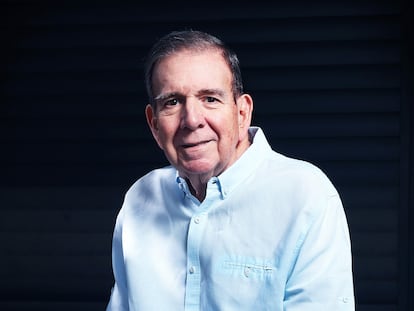
The life of Edmundo González Urrutia, 75, has taken a tremendous turn in the last year. The presidential elections held in Venezuela on July 28, 2024 awarded the majority of votes to the opposition candidacy that he led, according to the voting tallies that were made public by the opposition but which Nicolás Maduro’s regime never recognized. Despite being recognized as the winner by more than a dozen countries around the world, González, a career diplomat, ended up taking refuge in two embassies in Caracas (first in that of the Netherlands, then Spain) before finally going into exile in Madrid. From the Spanish capital he is leading efforts to ensure that the will of Venezuelans as expressed at the polls last year is respected.
González is well-known on the streets of Madrid. “President, President!” a Venezuelan delivery rider shouts when he spots him on the sidewalk. Minutes later, another of his fellow countrymen approaches to greet him and thank him for “everything you’ve done.” The opposition leader gives a shy smile, clasps the speaker’s hands in acknowledgement, and silently prepares to continue on his way. González confesses that these displays of support, after a few difficult months, are pure oxygen for his movement.
Question. What purpose did the elections of July 28 of last year serve?
Answer. Those elections were a goal that, evidently, wasn’t achieved because we weren’t competing under the same rules. With democratic rules, what happened wouldn’t have happened. This is a regime that has given up on any kind of democratic coexistence and has no limits. We continue our fight to restore the popular will as it was expressed last July, and we will achieve it any day now. Every step is a step forward.
Q. Do you think there has been progress in recognizing this popular will?
A. Of course. When you look at the number of countries that have recognized us, as well as the declarations and agreements that have been made throughout this year, you can see that the international community clearly supports our candidacy. We are competing with a government that has no limits and is increasingly isolated.
Q. But internally Maduro does maintain control of the country, regardless of your international recognition.
A. Much is said about the support of the Armed Forces. But I won in every voting center that operated on military facilities. In every one. That’s the most convincing proof that they are aware that they have lost the popular legitimacy they once had.
Q. What is your role as one of the leaders of the movement against the Chavista regime? Do you consider yourself a moral figure? A bridge that serves as a link with other countries?
A. Of course. María Corina [Machado] is a national leader whom they did everything possible to silence. They didn’t allow her to run in the elections and placed every obstacle in her way, and she [Machado was replaced by González Urrutia at the top of the list of the Unitary Platform so the opposition group could still run] won by a landslide. She’s had to go into hiding. It’s not easy, of course. Living in this situation requires a very strong capacity for resilience. And that’s what we’re working on. Every time I go abroad and meet a foreign leader or president, what they give you is encouragement, a lot of encouragement.
Q. But there was a time when there seemed to be international mediation, a group of countries trying to push for recognition of the vote results. That seems to have declined. What happened?
A. The negotiations continue. I think there are many governments that are aware that this was a massive fraud and, for that reason, have stopped recognizing Nicolás Maduro’s regime. We are doing everything we have to do. From the outside, me, and from the inside, María Corina, with all the limitations that this entails.
Q. Have you found support from the Spanish government to extend the cause of international recognition for your electoral victory last year?
A. I have had contact with all political sectors in Spain, starting with the government. A few days after arriving, I had a very frank and pleasant meeting with the prime minister. I then had two very pleasant informal conversations with Foreign Minister [José Manuel] Albares. And I visited all the political party leaders in the Congress of Deputies.
Q. And hasn’t that support been a little diluted since then?
A. The support remains, of course. I’ve been invited to political events by the parties on various occasions. And I saw Prime Minister [Pedro] Sánchez in Barcelona in October.
Q. Was that the last time you spoke with him?
A. We also spoke in the Dominican Republic and by phone.
Q. And what did he say to you?
A. He’s always been very kind and supportive. He told me, “You’re free here to make all the contacts you want.”
Q. The European Union has given you broad support, but it hasn’t recognized you as a legitimate president. Did you expect more?
A. You always have to hope for the best. And that’s what we’re still working on.
Q. How do you assess the recent prisoner exchange between Venezuela and the United States? Is it a success for the regime or for those who have been released?
A. I think it’s a success for those who were released. The government insists on denying that it had conversations, for example, with [U.S. State Secretary] Marco Rubio, who was a key player in the negotiations. Now, there are things that are truly strange, like the case of that character, a murderer of three people in Spain. How did that man end up there? It’s something very dark and suspicious.
Q. What could be behind it?
A. I don’t know, but I don’t think it was a naive move. There has to be an explanation for that, because someone with that background...
Q. Don’t you think that this could set a negative precedent for using prisoners as bargaining chips?
A. That’s what the government has done, using hostages as bargaining chips. They also have what’s been called the revolving door: they free 10 and immediately arrest another 15.
Q. The matter of political prisoners concerns you personally. What do you know about your son-in-law, Rafael Tudares?
A. We haven’t had a single word from the authorities. What we know is from remarks by people who have seen him at El Rodeo, where he’s in prison. My daughter has gone there. “He’s not here.” That’s the response. She goes regularly, every week, and they tell her, “No, he’s not here.” That’s a form of torture too. It’s been almost nine months since we’ve seen him.
Q. It’s a way to intimidate you politically.
A. Of course. It’s an action directed particularly at me, to break me.
Q. What do you think of Donald Trump’s treatment of migrants, many of them Venezuelan and with their papers in order?
A. It’s a very difficult dilemma to accept. There may be people who have had run-ins with the law. But most of them are workers who have contributed to the progress of the region, who have lived there for many years, who have integrated into American society. But many honest people will have to return and try to rebuild their lives.
Q. And can Marco Rubio be an interlocutor there?
A. He has been in the past. We’ve had conversations with him about that and other topics. He’s always been very helpful and understanding about the Venezuelan situation.
Q. Would you meet with Trump?
A. If it is proposed, I don’t see why not.
Q. Venezuela is holding new municipal elections this Sunday. Does it make sense to participate in the elections again?
A. We agreed not to participate because these are not free, fair, or transparent elections. It’s practically an arrangement the government made to save face and sell itself as a democratic government.
Q. With the ballot box closed, what options remain?
A. Keep fighting. This is a fight between good and evil. It’s very unbalanced because whoever has all the tools at hand, whoever is in power, uses them without any qualms. And they use them in every way, from moral issues to break us, to material ones, like sending us to prison.
Q. Is this a battle that should be fought in the streets?
A. It has happened. In the past, we have fought in the streets, but we are prepared to wage this civic battle through the channels imposed by the rules of democracy.
Q. After all the pressure you and your family have been under, would you run for office again?
A. Well, that will be decided by the popular mandate, but I am committed and I will go all the way, until we manage to recover freedom and democracy in Venezuela.
Q. Don’t you regret it?
A. Absolutely not. I would do it again with the same energy. Even more so.
Sign up for our weekly newsletter to get more English-language news coverage from EL PAÍS USA Edition









































