
María Corina Machado: ‘The only thing Maduro has left is terror’
The Venezuelan opposition leader, who lives in hiding, says in an interview with EL PAÍS that she expects ‘much more’ from the international community and argues that the presidential elections held a year ago will sooner or later force the fall of the Chavista regime: ‘It was a citizen mandate’
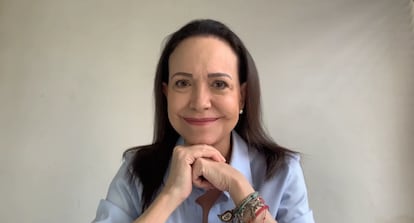

María Corina Machado, 57, has been in hiding for almost a year. Nicolás Maduro’s regime forced her to retreat to a secret location after the presidential elections of July 28, 2024, which marked a turning point in Venezuela’s recent history. Chavismo, which claimed victory without providing any evidence to certify it, accelerated its decline, deepening its absolute control over all aspects of the state. At the same time, the majority sector of the opposition maintains that Maduro and his entourage were exposed to the world by rejecting the voting records that were made public and showed a resounding victory for the opposition candidate Edmundo González Urrutia.
The veteran diplomat was forced into exile in Madrid due to persecution by the authorities while his main supporter, Machado, holds the reins of the opposition structure from Venezuela. The most prominent leader of the anti-Chavista forces speaks to EL PAÍS via video call. Behind her, the same bare wall seen in every one of her appearances since late August of last year. In her words, the same horizon: “Sooner or later, Maduro will go.”
Question. One year later, what message do you think the July 28 elections left?
Answer. July 28th changed the history of Venezuela forever. It was the result of an epic feat that, for me, is one of the greatest victories of democrats over autocrats this century. For 26 years, Venezuelans have faced a regime that has evolved into a fierce tyranny that is not a conventional dictatorship, because it has become a criminal structure that has been destroying everything: institutions, the economy, infrastructure, families. July 28th was the result of years of struggle, of organizing by millions of people who gave their all. And we not only managed to overwhelmingly defeat Maduro, but what we demonstrated then is a milestone. And obviously, Maduro will go. Sooner or later, we will remove him because that was a citizen mandate.
Q. But both then and now, Chavismo remains firmly in power. How do you explain this to the Venezuelans who fought that battle, as you say, for years?
A. I think it’s harder to explain to the outside world because we Venezuelans have always understood that this was much more than an electoral or political struggle. It’s an existential struggle. It wasn’t just about confronting another dictatorship or corrupt system. Maduro has declared war on us, a war we didn’t want because we’re democrats. When we went into the electoral struggle, we knew the conditions weren’t conventional. For years, we saw the regime’s fraud and learned to combat its electoral engineering with electoral intelligence. They had weapons, and we had the people.
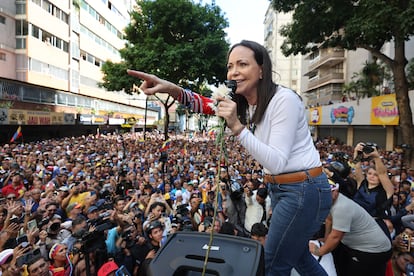
Q. What have you done since then?
A. These last 365 days have been luminous, amid all the horror we are experiencing, in the sense that the greatest courage, resilience, discipline, and intelligence of Venezuelan society have come to the surface. First, we have maintained intact our will to fight despite the repression, the torture and the deaths. We have become a clandestine organization because they are persecuting and hunting us. Second, we have managed to get the entire world to recognize Edmundo González’s victory as president-elect. No one doubts it. But we have also succeeded in getting Maduro to see what he is: a human rights violator who has committed crimes against humanity and who, according to the Inter-American Commission on Human Rights, engages in practices classified as state terrorism. And that is how these criminal organizations begin to crack and ultimately collapse.
Q. But you are in hiding, Edmundo González had to go into exile in Spain, and Chavismo maintains complete control.
A. The regime had two options: accept defeat, and we offered them the possibility of negotiations with incentives and guarantees, but they rejected it. They chose to move to another battlefield, a battlefield of bullets, torture, prisoners, and deaths. All Maduro has left today is terror, a regime of terror sustained by impunity. In recent days there have been more than 35 disappearances while a prisoner exchange they boasted about was taking place. Why are they doing this? First, because they believe there will be no consequences, and here I feel the international community owes Venezuela. And second, the regime fears us, because even if you don’t see mass protests in the streets, they know there is a country in turmoil. This process is irreversible, and July 28th will be the catalyst for Venezuela’s freedom.
Q. And do you have any horizons for it?
A.I’m putting it on the table and working to keep it as short as possible, but since this fight is about the lives of millions of Venezuelans, our children, our country, I’m not putting any limits on it. We’re willing to do whatever it takes, for as long as it takes, but I can tell you that this regime has never been so isolated, so vulnerable as it is today, and we’ve never been so determined to achieve our goal.
Q. You’ve said that the international community owes Venezuela a debt. After the presidential elections, there was an attempt at mediation that quickly fell apart. Did you want more pressure from the European Union and the United States?
A. I can assure our allies who have given so much for Venezuela that it’s something we will remember. We will always remember those who have raised their voices: the European Parliament, so many countries around the world, in Latin America, the United States, Canada, and Spain. While we appreciate all these demonstrations, and there are countries in Europe that are particularly committed, and we appreciate it, we expect much more. Nobody can say anymore, ‘Oh, I didn’t know.’ There is an investigation at the International Criminal Court, which, by the way, should have yielded results by now, into the crimes against humanity that have been committed here. What more needs to happen?
Q. And the United States?
A. Yesterday [Friday] a statement finally came out from the U.S. Treasury Department saying that the Cartel de los Soles, of which it places Nicolás Maduro at the head, is being sanctioned as a Specially Designated Global Terrorist. It is the first time in this century that a head of state has been designated by the United States as the head of a drug cartel. No one can look the other way anymore. This is no longer about ideological elements of the left and right; this is on a whole other level.
Q. The Donald Trump administration has also reopened the door to Chevron’s oil company operations in Venezuela.
A. I think we should ask Chevron. The dilemma is Chevron’s. What they’re saying here is that Maduro is the head of a cartel. Who is usurping power in Venezuela, who controls PDVSA [the state oil company], who controls the various companies of those operating in Venezuela? In the end, history will be ruthless. And Maduro will be gone.
Q. On what basis do you believe this?
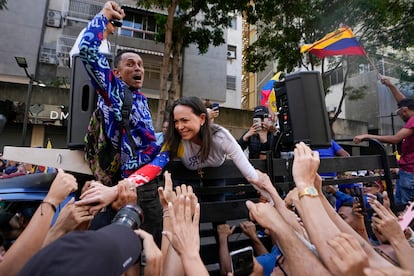
A. Every day we work harder, with more willpower, with more energy, with more people and with more allies. It’s hard, extremely hard, and I live with the threat hanging over my head, because they’ve made it very clear to me that if they find me, they’ll make me disappear.
Q. The prisoner exchange between the United States and Venezuela a few days ago also allowed for the release of political prisoners.
A. Every Venezuelan who is released from prison is a victory, a victory for truth, justice, and freedom. I’ve spoken with some of them, and we’ve cried together. Do you know what distresses them? That their time in prison meant not being able to fight alongside the Venezuelan people for freedom. I’m amazed, proud, and that’s what makes me absolutely certain that Venezuela will be free. These people have already decided.
Q. In the parliamentary and regional elections in May, there was a split in the opposition, with one group deciding to run against the majority. Do you see a realignment of positions possible in the medium term?
A. On May 25, the regime made a move to try to bury and erase what happened on July 28, but the country disobeyed, so there was almost no division within the democratic forces. There is a cohesion of genuine democratic forces with the people of Venezuela and the mandate of July 28.
Q. How do you feel after almost a year sheltered in a secret place?
A. I decided to dedicate my life to the freedom of Venezuela. While this is extremely hard, being completely locked up, without talking to anyone, without seeing anyone, without touching, hugging, kissing, caressing or even seeing my children, my husband, my mother, my colleagues, it has also allowed me to be completely focused on our work. We are ready.









































