
Murderer who slipped into prisoner exchange deal with Venezuela is walking free in the US
Dahud Hanid Ortiz was serving a 30-year sentence for a triple crime he committed in Spain in 2016. After repatriating him, the Trump administration let him go
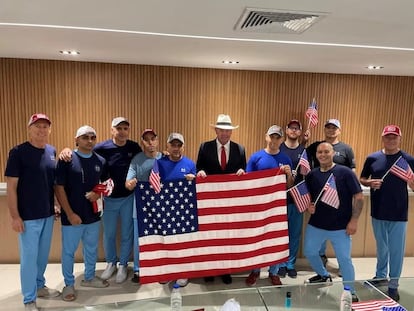

Dahud Hanid Ortiz, a U.S. citizen repatriated from Venezuela as part of a three-way prisoner exchange with El Salvador, disappeared last week after he landed in Texas on a flight chartered by the Donald Trump administration. He was waving a small American flag and smiling broadly, mingling with the rest of the group: nine other prisoners returned thanks to the efforts of the State Department, which sold this “homecoming” as the long-awaited return of “political prisoners.” The truth is that Ortiz was serving a lengthy prison sentence in Venezuela for the brutal murder in 2016 of three people in Madrid, Spain.
On Thursday, The Washington Post and The New York Times revealed, citing anonymous sources, that the convicted criminal is still at large in the United States. They also implied that nobody was tracking him and that his whereabouts are therefore unclear. This was not the first time that Ortiz, who was a Marine for 17 years and served in Iraq, where he was decorated before being expelled from the corps, had tried to sneak into a prisoner swap with the United States. The Times cited another source who claims that he is now in Orlando, Florida.
The group of prisoners included tourists that activists defending democracy in Venezuela claim Nicolás Maduro’s regime uses as bargaining chips. Eight of those 10 men are considered “wrongfully imprisoned” by the State Department. Ortiz had been behind bars for just over six years and nine months, following his arrest for a crime that received widespread media coverage in Spain, where he is known as “the Usera killer” because of the district of the Spanish capital where the crimes took place.
The State Department did not immediately respond to EL PAÍS’ request for confirmation sent on Thursday evening (Washington time). The night before, Venezuela’s Interior Minister Diosdado Cabello said on his weekly program Con el mazo dando that Venezuelan authorities had warned U.S. officials traveling to Caracas for the prisoner exchange that they were taking away a convicted criminal. “I even said at the airport that they were asking for a murderer. They are taking a convicted murderer with them,” Cabello explained.

An official version from Washington is yet to emerge, or how the move will be justified by the Trump administration, which has been engaged in a brutal campaign against illegal immigration for months, justifying it on the need to expel the worst criminals from the country.
Expelled from the Marines
According to court documents consulted by EL PAÍS, Lieutenant Ortiz, who was living at the U.S. base in Schweinfurt, east of Frankfurt, where he married Irina Trippel, was court-martialed and expelled from the Marines in 2015 for using a fraudulent address in New York to claim housing benefits for his family, who were with him in Germany.
The following year, Ortiz, 54, carried out the massacre in Madrid out of spite. In June 2016 he traveled from Germany to Spain in a car borrowed from his mother-in-law. He was consumed by jealousy over his ex-wife’s new relationship with a 36-year-old lawyer named Víctor Salas, who had a law office in the Spanish capital.
On Wednesday, June 22, at around 2:30 p.m., he arrived at Salas’ law office, but did not find him there. A few hours later, he had murdered two of Salas’ employees, Elisa Consuegra Gálvez, 31, and Maritza Osorio Riverón, 51, as well as a client who had stopped by to pick up some papers. The client was 42-year-old taxi driver Pepe Castillo Vega. Apparently, Ortiz thought that this unfortunate man was the man he was looking for. He then set fire to the office and fled.
Ortiz reappeared the next day in Germany. His ex-wife had no doubt that he was guilty. He flew from Germany to Venezuela, his country of birth, before an international arrest warrant was issued against him. It arrived exactly one year after he committed his horrific crimes.
In Venezuela, he lived with relatives in Puerto Ordaz, on the banks of the Orinoco River. In 2018 he was arrested, but Caracas denied Spain’s extradition request. In January 2024 he was charged with “aggravated murder committed with malice.” His lawyers’ appeals failed to secure his release.
A year and a half later, in what appears to be a diplomatic fluke, a phenomenal mess, or simply a botched job, Ortiz achieved last week what he had unsuccessfully sought in court. Meanwhile, the lawyer Salas has spent the entire week in Madrid sounding the alarm: a murderer, who described himself in a letter sent after the killings as “a horrible human being,” is on the loose again.
Sign up for our weekly newsletter to get more English-language news coverage from EL PAÍS USA Edition









































