
The hell of Module 8 in Nayib Bukele’s mega-prison: ‘They would beat us over anything’
Migrants deported from the US to El Salvador and now returned to Venezuela tell EL PAÍS about four months of continuous punishment and total uncertainty about their fate


Several of the Venezuelans who were sent back home from the Terrorism Confinement Center (Cecot) in El Salvador were left with scars on their wrists and ankles. Kneeling with their hands behind their backs or walking crouched down with their hands and feet in handcuffs was part of the daily routine during their four months in President Nayib Bukele’s mega-jail. The Donald Trump administration had sent them there, resorting to an old law against foreign enemies; it was a hellish stop in their irregular deportation process from the United States.
Subdued and cowering. That’s how the entire world saw them in the videos released by the Salvadoran government. And that’s how they remained for much of their stay at Cecot, an impenetrable facility supposedly built to imprison gang members and terrorists as part of the war against gangs launched by the Latin American president, which resulted in the declaration of a state of emergency in March 2022. As a result, 2% of that country’s adult population is behind bars. The 252 Venezuelans are among the few people who have been able to tell their story, although when they arrived at Cecot they were told they would never leave.
During one of the worst 131 days of his life, 26-year-old Ángel Bolívar Cruz was dragged out of his cell on his knees. They took him to the “pit” (others call it “the hole,” others “the island”), kicked him in the chest, and stepped on his handcuffed hands. It left a mark on his wrist. Then they beat him with a hose, hitting him on his back, and left him alone in the dark. He was in the pit at least twice. Once, because he wanted to take another shower to cool off from the heat they were experiencing daily due to the enormous lamps in the space where they were held. Another time, because he actively participated in one of the two revolts organized by Venezuelans to demand better treatment. “They gave us all welcome blows when we arrived,” says Ángel, who was detained in the United States for lacking documentation on December 23, 2024, in Dallas, while working as a delivery driver. “But they beat me too much.”
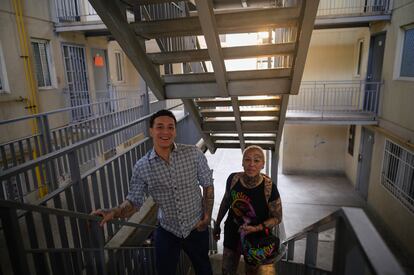
The beatings could be triggered by anything. “We were locked up 24 hours a day, and the only way to pass the time was to talk to each other, but raising our voices, or being late in returning the food bowl meant punishment. They beat and punished us over anything,” says Ysqueibel Peñaloza Chirinos, 25. On May 13, the young prisoners rebelled. From their cells, they saw one young man getting hit so hard his eyebrow split open. They began shouting and throwing water outside, where the guards were stationed. In the midst of the fury, two inmates managed to break the locks and ran out to stop the young man from being beaten further. The guards responded by firing buckshot and tear gas at the people locked inside. Several of them still have marks on their skin. Those who escaped from their cells received three days of beatings, Ysqueibel recalls.
Ludo with tortillas
The Venezuelans were held in Module 8, a hellish warehouse with 32 cells where they were locked up ten by ten. They were still better off than the Salvadorans, who were crammed into groups of more than 100 in the same space, according to what the guards themselves told them, to make them feel lucky. They weren’t allowed to cross a line painted inside their cells, a little over a meter from the bars. Doing so brought punishment, but when they did, they could see the only opening in the hermetic warehouse that allowed them to tell whether it was day or night.
They slept on tin beds where they scorched from the cold at night. Cameras were constantly trained on them. Guards watched from above and, from inside, enforced silence. Tortillas and beans were their only food. They were occasionally given fruit juice. Food was served by Salvadoran prisoners. “They all seemed like slaves,” says Yeison Hernández Carache, 25, who arrived at Cecot with his 30-year-old brother, Darwin. “I remember a very old man who was a prisoner, and he collected the garbage and couldn’t even carry the bag.”
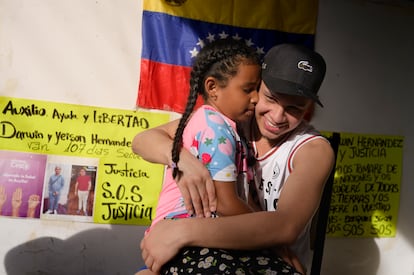
Yeison also has a mark left on his left leg. When they were on their knees, the guards would step on them with their boots. Every day at 3:00 a.m., they counted the prisoners, as if escape were possible. They forced them to bathe. One of the group was designated by the guards to wake the rest up with the shout “Bath!” Yeison did this several times. He also had to deliver bad news: “Search position!” he shouted, miming how he did it, as if they were in a battalion. Once again, they were on their knees, to be searched and beaten by hooded and armed men dressed in black.
Amid the strict order imposed by the blows, they also found ways to pass the time. Darwin rolled the tortilla dough they were given into cubes, and with soap, they drew a board on the floor to play ludo. They had Bibles. Every other day, they listened to a sermon from a Salvadoran prisoner who was an evangelical pastor.
Ángel is almost completely tattooed. His mother Silvia, a professional tattoo artist, inked much of his body before he migrated to New York in 2023, crossing half a continent. Yeison and Darwin, on the other hand, don’t have any. Many Venezuelans were deported to Cecot because of their tattoos, which the United States government considered evidence of belonging to the Tren de Aragua criminal gang. For the brothers, not having them also became suspicious. “They made us show them our private parts because they couldn’t believe we didn’t have any,” Darwin says. One of the complaints repeated by the Venezuelans who were at Cecot is that they were forced to strip naked, photographed, and, while naked, some were beaten. In a nationally televised appearance, President Nicolás Maduro presented the recorded testimony of musician Arturo Suárez, interviewed by official media. He said Salvadoran guards took him to solitary confinement, beat him, and forced his pants down to force him to show them the pearl implant he has in his penis.
A few days after the United States expelled the Venezuelans to El Salvador, Secretary of Homeland Security Kristi Noem visited the Cecot facilities. “She came into the hallway with some gringos in uniform carrying bags and rifles,” Darwin recalls. “It was a surprise; we didn’t know who she was, and she didn’t say anything to us, so we couldn’t talk. We were afraid.” Later, Democratic congressmen visited them. “You could tell they were opposition members. They did approach us and filmed us, and some of us made a hand signal for help.” The Red Cross visited the site twice for humanitarian efforts. “I thought I would never see my family again,” Darwin admits.
Neighbors, migrants, prisoners and returnees
For both the families and the prisoners, the negotiation between the three governments was secret. Today, it is known that it included an exchange of U.S. prisoners, including one convicted murderer, the release of more than 50 political prisoners, and possible easing of oil sanctions. On the day it was finalized, July 18, after a failed attempt in early June, rumors began to spread, and several homes in the Bicentenario neighborhood, a working-class area south of the industrial city of Valencia, two hours from Caracas, began to blow up balloons and make banners to welcome them home. The imminent arrival was postponed several times. Theories came and went: how they would bring them back, how they would warn the families. The confirmation came after Maduro announced it Monday night on his television program.
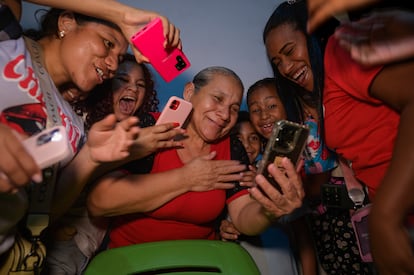
Brothers Yeison and Darwin Hernández Carache, Ysqueibel Peñaloza Chirinos, and Bruce Contreras Cedeño arrived in this community of houses built by their own people, of grandmothers and barefoot children who spend their afternoons on plastic chairs outside their homes. They have been neighbors since childhood and reunited as migrants in the United States, some after passing through other countries. They were detained on February 8 in a raid in North Carolina while testing equipment to record a music video. They were sent to El Salvador and returned home in the early hours of the morning in patrol cars of the Sebin, the Venezuelan intelligence services. These are the coincidences that can happen after the massive exodus of more than 20% of the population that Venezuela has experienced.
At Cecot, they found out they were leaving when they were told to take a good shower. “Chele [the Salvadoran word for boy], you’re getting out of here,” one of the Salvadoran inmates working at the prison whispered to them. Ysqueibel endured the four months by trying to go unnoticed, and thus avoided being taken to the pit. Now, he says, the hardest thing he’s experienced has been not having communication with his family in the last few months. When he was detained in the United States, his family spent $100 a week so he could make calls and buy food at the prison. They were seen on Friday at the airport, where part of his extended family of siblings, cousins, and grandchildren were waiting for him with a banner that read “Todos amuñuñados por tí” [All together for you].
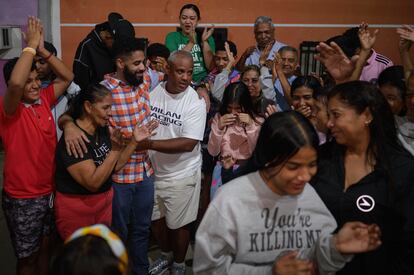
Ysqueibel had balloons placed at three houses in Valencia: his father’s, his mother’s, and his grandmother Marina’s. He arrived in the area after spending three days in Venezuelan government custody. Authorities interviewed the new arrivals with polygraph tests, gave them medical exams, and issued identification documents. The Peñalozas are a migrant family. Ysqueibel’s grandparents left Barranquilla and Santa Marta during the years when everyone was leaving Colombia. They moved to Venezuela, where they made a life for themselves, and his grandfather showed the trade of refrigeration technician to his father, a trade that Ysqueibel also learned. He supported himself in Chile, where he lived for almost four years before trying his luck in the United States. This week, he returned to his father’s work.









































