
Free showers and lawyers for crack addicts in Brazil
President Lula da Silva’s government aims to expand the Care Station, a pilot project tested in the city of Fortaleza. By the end of the year, 400 more units are set to open

At first glance, they’re just a group of men chatting. They sit in a circle under an awning to escape the scorching sun of Fortaleza, Brazil. The scene would hardly raise an eyebrow in normal circumstances, but there’s something unusual: they all have their feet soaking in pink basins of warm water, with a few leaves floating on the surface. The scent of basil fills the air.
There’s a second surprise: one of the men is wearing an electronic ankle monitor with a flashing blue light. Reinaldo, 55, explains that he’s serving a seven-year sentence for failure to render aid. For these men, this foot bath offers a priceless moment of relaxation; a balm for heels and soles chafed by the asphalt. This is one of the services that brings them to the Care Station, a center designed for unhoused individuals and/or those who are addicted to drugs. It serves as an entry point to a range of public services that they would otherwise rarely access.
Reinaldo falls into the first category. He proudly recounts that he quit drugs in 2015. However, after a brief pause, he adds: “I still smoke tobacco.”
The Care Station – a government-led initiative – is unique in a context of war on drugs marked by the United States’ decision to equate drug trafficking with terrorism and combat it with illegal strikes against alleged drug smuggling boats, the growing power of the cartels and increased consumption.
What began 16 months ago as a pilot project in the city of Fortaleza, located in Northeastern Brazil, has grown to 11 units nationwide. And, by the end of the year, there will be 409 Care Stations spread across Brazil, explains Nara de Araujo – head of Prevention and Social Reintegration at the federal government’s National Secretariat for Drug Policy – in an interview with EL PAÍS.
The Centers for Access to Rights and Social Inclusion (CAIS) – which the secretariat conceived in collaboration with the Ceará state government – are “a bridge to public policies on health, social assistance and so on, to try to include those people who, historically, have not had access to them, due to issues such as structural racism, gender [and] violence,” De Araújo explains from Fortaleza, the state capital.
One recent Monday – as Brazil warmed up for Carnival – the original Care Station, a green shipping container located a couple of blocks from the epicenter of the crack cocaine epidemic in Fortaleza, in a favela with sea views called Moura Brasil, was bustling with activity. Some users arrived walking in a zigzag pattern, almost unable to stand.
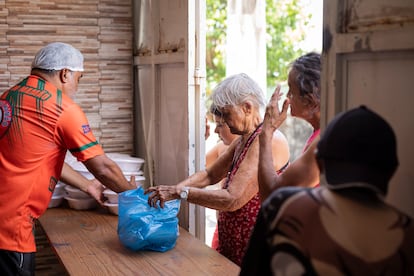
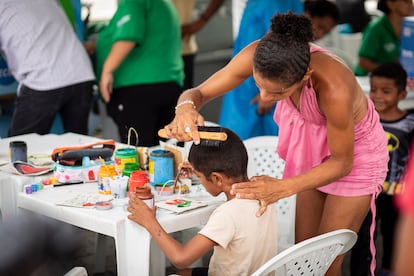
First things first: fresh water to quench their thirst, followed by a shower. The center also offers legal services, a washing machine, psychological treatment, conversation, affection, a toilet, paper and paintbrushes.
After getting out of the shower, Savio puts on deodorant and cologne, grabs some condoms and crosses himself. He then takes a small bag filled with his possessions out of his locker and returns to the streets.
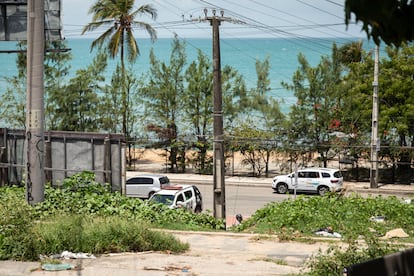
This oasis for the most destitute drug users is located in Fortaleza, the capital of Ceará, a state known for its beautiful beaches and high-quality education. However, for months now, the area has been embroiled in a brutal war between Brazil’s major drug cartels, as they fight for control of trafficking routes. Last year, the clashes triggered a surge in murders and gave rise to a new practice: the forced eviction of residents from entire neighborhoods. Ceará is a strategic point for the drug trade due to its port, airport and proximity to Europe and the United States.
The original Care Station is based in Moura Brasil, a favela that falls in Comando Vermelho territory (as evidenced by the giant initials spray-painted along the narrow alleyways). This criminal organization controls drug sales and imposes its law on the local residents, using an iron fist to maintain order and prevent police intervention, thus allowing the illegal business to flourish. “CV gives you three chances,” a resident explains. The first violation of the rules results in a beating with a plank.” A second offense leads to another beating (or, if you have connections, exile from the territory). A third offense means death.
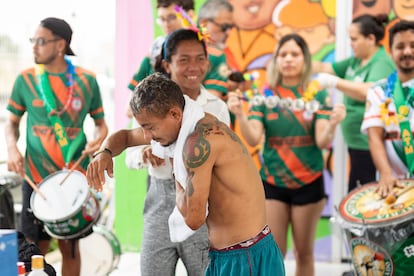
That’s the dark underbelly of Moura Brasil. The favela has 6,000 residents and is just steps away from a surfing beach. There, you can find the skeleton of an oil tanker that ran aground 40 years ago. Like many shantytowns, it’s a combination of several worlds: it has a vibrant community movement and a Carnival troupe called Turma do Mamão (they just won their fifth title, to the pride of the locals). There’s an open-air film club, the Revival Evangelical Church, which provides food to residents, a community garden and a nickname that the neighbors detest, adopted from an old brothel, Oitão Preto. In this year’s Carnival, several of the participants in the homeless shelter project paraded with the troupe. They wore costumes made by hand at sunset by the sea.
The promoters of the Care Station – an initiative supported by COPOLAD, the Cooperation Programme between Latin America, the Caribbean and the European Union on Drug Policies – emphasize that there was extensive dialogue with the neighborhood’s residents before its installation. The project arose in response to the homelessness crisis following the Covid pandemic. Fortaleza – with 2.6 million inhabitants – has 10,000 homeless residents. Across Brazil, the number exceeds 300,000.
Caio Sá Cavalcante, the head of drug policy for the state of Ceará, highlights that the station receives approximately 100 users daily. It has provided 58,000 services since 2014 and currently has 1,800 registered users. Its annual budget is 1.8 million reais, or $340,000. “The Ceará [state] government is trying to combine significant investment in public safety and intelligence with visible and intensive actions to combat drug cartels and violence, along with [implementing] social protection programs,” Cavalcante emphasized, during a press trip organized by COPOLAD in Fortaleza.
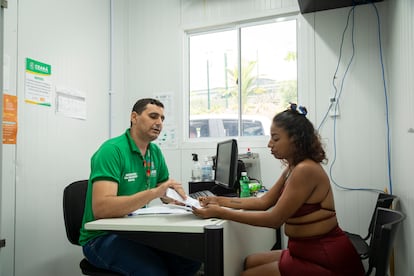
One of the most appreciated and novel services is the center’s lawyer, who advises users on whether they have any outstanding legal issues. Sitting down with the attorney Danilo in his office for a confidential conversation is a relief. For these men and women, going to the Public Prosecutor’s Office to inquire about their case isn’t an option: they fear being arrested again.
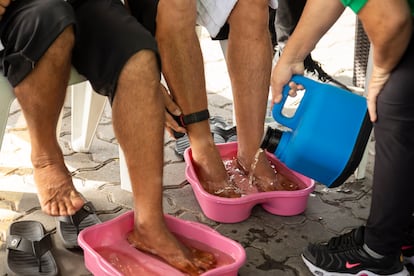
Reinaldo eagerly awaits the judge’s review of his case. He now knows that there’s a possibility he’s finished serving his sentence with an ankle monitor and could soon simply be required to sign in with the court once a month. He says that this would eliminate the stress of always having to find a power outlet to charge the device. The stigma also weighs heavily on him, because, of course, the flashing ankle monitor is always visible.
Irene, 32, has eight children and a granddaughter. She’s been homeless for three months. She arrives at the lawyer’s office in the Care Station, her silky hair fresh from a shower. She needs to renew all her documents, which remained at her ex-husband’s house after she left him. Half of the children stayed with him, while the other half reside with her mother.
Irene says that she especially enjoys painting, because it occupies her mind. For a while, she explains, she escapes the anguish that has haunted her ever since her teenage daughter was murdered. She also momentarily escapes the countless urgent needs of her precarious existence.
From the Care Station, individuals are referred to the outpatient clinic, social services and mental health services, if they wish to use these resources.
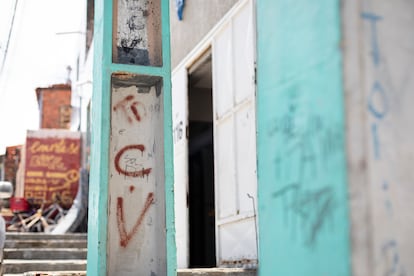
The peak time for the flow of visitors is in the afternoon. However, there’s already activity before lunchtime: on this street, next to a colonial-era building, people buy crack cocaine. They consume it in nearby shacks, in private, so that nothing spoils the high for which many have lost their children, their partners and every possession they once treasured.
Támila, 37, now only comes to the Care Station to say hello. She says that she managed to break free and turn her life around after losing two homes to cocaine and crack. She describes addiction as “a lion that I kill every day.”
“The best thing about this place? That I was never rejected here,” says Liandra, 25, who has just received her first paycheck as a worker at the Station. She got the position after a selection process that took place when she was still living on the streets. Her family kicked her out of the house because of her sexual orientation. “As soon as the paycheck came in, I rented a room. I’m very happy,” she says, smiling.
Among the professionals at the Care Station, Alzeni Vicente stands out. The official title for her position is “harm reduction specialist,” but everyone knows her as Aunt Alceni (a term of respect in Brazil), or “the blonde from the [shipping] container.” Her tasks include venturing into the favela to talk about the services that the center provides: she offers them to those who are agitated and looking for a fix, or for money. She explains what’s available to them.
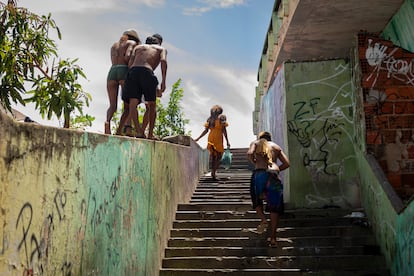
She emphasizes that the time users spend at the center is valuable. “When we get them to come here, we’re already reducing harm; they’re already taking care of themselves.” This is because they’re not using drugs.
When asked if she speaks to them like a mother, a sister, a friend, or a colleague, she replies: “I speak to them as a human being. When they arrive, I call them by their name.” And they find that to be rare and important.
Sign up for our weekly newsletter to get more English-language news coverage from EL PAÍS USA Edition









































