
Belém, a furnace of a city that lost trees to host COP30
The Brazilian city that hosted the climate summit illustrates the challenges faced by Global South cities in adapting to the effects of global warming
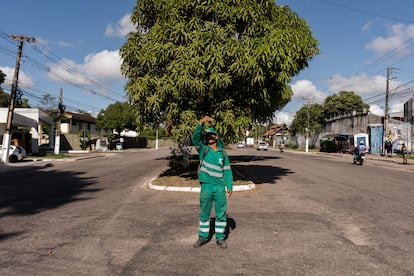

With his blend of bully diplomacy, flip-flopping, and climate denial, U.S. President Donald Trump knows how to strike where it hurts. “They ripped the hell out of the Rainforest of Brazil to build a four-lane highway for environmentalists to travel. It’s become a big scandal,” he posted on Truth Social, just hours before the official opening of COP30, the year’s most important gathering for setting global climate policy, which was held in Belém, Brazil. Trump, who declined a personal invitation from Brazilian President Luiz Inácio Lula da Silva and didn’t even send a delegation to Belém, focused on the unfinished works for the Avenida Liberdade to discredit the summit.
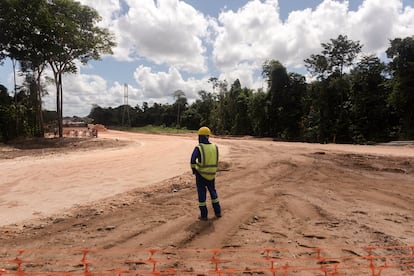
The highway is an old project that local authorities revived and included among new infrastructure efforts aimed at easing traffic during the event, which drew up to 50,000 visitors to this city at the mouth of the Amazon River. The project has been controversial because it crosses a natural reserve, involved cutting down trees, and still is not operational. Some residents argue it wasn’t necessary, since it only leads to a high-end shopping mall that already has two other access points. One recent morning, excavators were still at work, clearing a path through the trees.
Ercila do Socorro Coelho, 59, a retired cook, is certain that if tree clearing continues, temperatures in Belém — the capital of Pará, a state long at the top of deforestation lists — will become even more unbearable. Deforestation rates in Pará, which is larger than France, have dropped sharply thanks to political will and more resources.
Coelho doesn’t understand much of the acronym-laden jargon used by climate negotiators, but her life has been a masterclass in the devastation caused by floods and heat. “I hardly walk in the street anymore. As the doctors recommend, I try to go out between 8 a.m. and 10 a.m., and after that, only by bus,” she explains.
She describes some everyday scenes: “When it rains, the pavement steams. I get home and go straight to the shower. You put water on the stove and it’s boiling in no time. At midday, the tap water is scalding hot,” she lists, sheltered in the shade of a building.
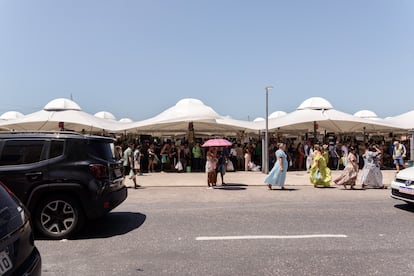
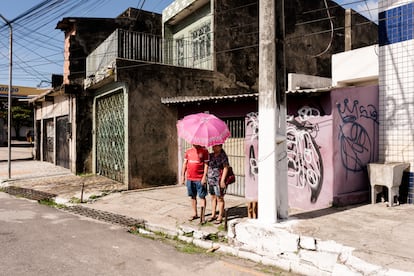
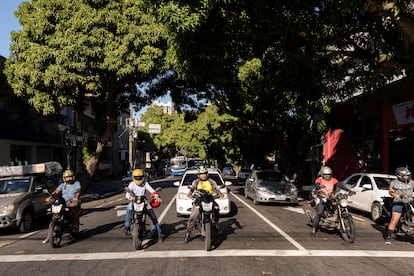
Belém is an oven for its 1.3 million residents and visitors alike, despite being surrounded by water and nestled in the largest tropical rainforest in the world. The city experienced 212 days of extreme heat (37.3ºC, 99ºF) last year — five degrees above the average of the past decade, according to Mongabay, an environmental news outlet. No other Brazilian capital sees as much rainfall. When torrential rains coincide with high tide, much of the city floods because it is below sea level. Coelho’s neighborhood is among the most flood-prone. Residents ironically nicknamed it Terra Firme (Solid Ground), a name that even appears on maps.
Despite the numerous projects inaugurated with COP30 in mind, Belém’s infrastructure remains precarious. The sanitation network is minimal, 60% of residents live in favelas, and traffic jams are a huge problem. To ease the strain on the roads, city officials were given leave during the entire summit, which ran from November 10 to 21.
This situation makes the COP30 host city a symbol of the 1,000 challenges faced by many cities in the Global South, which endure the daily impacts of problems rooted in industrialization in the Global North — whether in the form of tornadoes, hurricanes, or typhoons. Although extreme, Belém’s situation is quite common. About 35% of Brazilian cities (1,900 municipalities) are at risk of environmental disasters such as landslides, floods, and torrential rains, according to a federal government study. Around 20 ministries are working together with civil society on a national plan that includes adaptation and mitigation measures.
Brazil and other developing countries are calling on wealthy nations for money and technology to adapt to an increasingly hostile planet. “It is necessary to pay more attention, allocate more resources, and have more political will to prepare vulnerable countries for the effects that are already being felt,” Maurício Lyrio, the leader of the Brazilian negotiations at COP30, told the newspaper O Globo.
For Wendel Andrade, 38, a specialist in natural resource management and local development at the Talanoa Institute in Belém, adaptation should not take a back seat to mitigation and emission reduction. Andrade denounces “the severe loss of vegetation” that the COP30 host city has suffered in recent years, as well as authorities’ and residents’ disregard for trees.
Speaking as a researcher and resident of Belém, he says: “For many people, trees mean dirt, leaves, a hiding place for criminals, a place where the homeless urinate, an obstacle to getting the car into the garage… When in reality, a tree is an essential natural machine for living well. It is a cistern that stores water, provides shade, and offers thermal comfort.”
And although other Brazilians know it as the City of Mango Trees, for the dense, tree-lined streets dotted with mangoes that cool the streets in wealthy neighborhoods, Belém has four times fewer trees per square meter than the U.N. recommends.
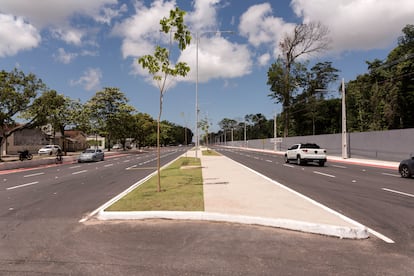
Near the works on the Avenida Liberdade, another highway — the Marinha — has just opened to traffic, which also involved clearing a large strip of vegetation, residents explain. Where trees once provided pleasant shade perfect for picnics, there are now three lanes in each direction, one for parking, and another for bikes. Small trees have been planted, but it will take years before they provide any real shade. In two months, Belém’s “winter” will arrive, the season with the most rain and a slight drop in temperature. Then residents will see how the new highway holds up.
Andrade, from the Talanoa Institute, denounces that “when the world talks about nature-based solutions, Belém is reproducing an outdated model, with environmentally unsuitable projects,” such as cutting down trees or adding layers to the asphalt. He warns that the city “is a ticking time bomb” because in the future, the problems created by the current construction projects will have to be addressed.
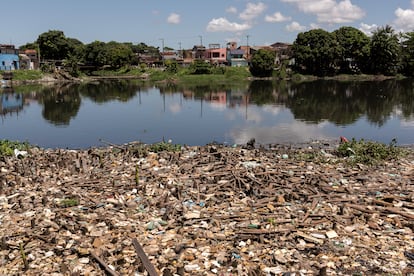
“We need a robust reforestation plan, and above all, we must not remove mature trees,” says Andrade, who also points out the need to improve the management of the waste that clogs the canals. “It makes no sense to ask for money for adaptation if we continue to waste it.”
The Coalition for Disaster Resilient Infrastructure (CDRI), an alliance of governments, U.N. agencies, businesses and universities, estimated the enormous climate-related losses from last year: storms ($173 billion), floods ($33 billion) and earthquakes ($18 billion).
In Belém, fans are a constant part of daily life. “In my house, we have five for four people,” explains Cintia Andrade, 33, a sales consultant. Her face lights up when she talks about the newly introduced municipal buses. They have air conditioning, a huge relief for passengers before had to depend on whatever breeze came through the windows.
In Belém, they like the air conditioning nice and cold, and as soon as night falls, the city comes to life. People go to the gym, they go shopping. On Sunday at 11 p.m., hours before the opening of COP30, there were long lines of customers doing their weekly shopping at a centrally located 24-hour supermarket.
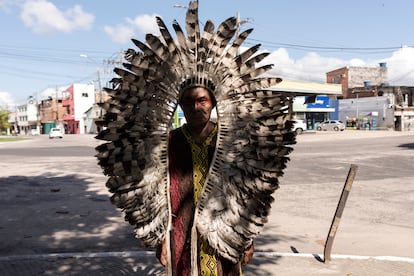
Ninahua Hunikui, an Indigenous man from Acre, is having a leisurely breakfast at a street stall in Belém with several relatives who traveled with him from his village to participate in COP30. They came to demand that their land be officially demarcated and thus receive legal protection — a claim he says he has already presented in France and Switzerland. On his way to the public event, he wears a spectacular headdress made of harpy eagle and macaw feathers, and his face is painted with black jenipapo and red urucú dye.
He says that in his village, which is home to 205 people, the impact of the climate is also evident: “Our water sources are drying up because of the deforestation by white people. In the 1970s, we traveled by boat, now you almost have to push with the small canoes,” the chief explains in Portuguese.
Hunikui, who is a teacher and doctor, adds: “They’re also destroying my medicines.” He’s referring to the plants the rainforest has provided for his people since time immemorial to heal their ailments. He traveled to Belém seeking the protection the law can offer, and with the intention of sharing, with anyone willing to listen, his recipe for saving the planet.
Sign up for our weekly newsletter to get more English-language news coverage from EL PAÍS USA Edition









































