
The rise and fall of Cuba’s revolutionary epic
The humanitarian crisis is far older and more structural than anything that could be caused by a month‑long fuel blockade
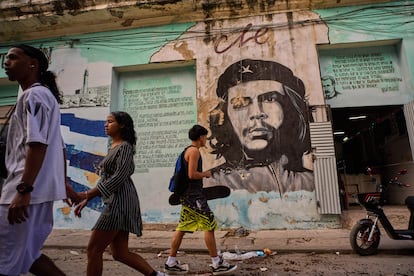
The Cuban Revolution was more successful at exporting its epic narrative than any other tangible commodity. Not even sugarcane, tobacco or rum can compare. The face of Che Guevara transformed into left-wing merchandise, the stoic image of Fidel Castro with a cigar in his mouth defying the 600 assassination attempts orchestrated against him by the CIA, and the slogan that Cuban education and healthcare are the best in the world have been an important part of the global progressive ideation from 1959 to the present. Sartre, Beauvoir, Maradona, Guayasamín, and García Márquez are just some of the renowned figures who succumbed to the heroic myth of an island that, along with its bearded leader, built a precarious but socialist and happy paradise right under the nose of the Yankee empire.
Cubans (or most Cubans) also bought into (or for a time believed in) a Caribbean epic that resonated with them. From childhood, in schools, they have been taught that they must emulate the Guevara legend. “We will be like Che” is a slogan that every Cuban has shouted every day of their school years. And then there is the cult of Fidel Castro, who the island’s official press insists did not die in 2016, speaking only of a “physical disappearance,” as if his spirit were still leading the country. For someone unfamiliar with Cuban reality, but informed enough to know that Castro himself declared atheism constitutional until 1992, this mysticism must seem strange. But it isn’t: the only mysticism permitted by the Revolution has been that of the Revolution itself, one that naturally extends to its “eternal leader.”
The Cuban writer (and staunch anti-Castro activist) Guillermo Cabrera Infante, writing from exile in his book Mea Cuba, stated: “Castro is, like God in Cuba, everywhere.” Other Cubans felt the same way. This gift of ubiquity helped Fidel Castro gain an almost divine reputation. The “Comandante” could be in every place at once to attend to the needs of his people, but also to watch over and punish them. He, who was also the Revolution incarnate, thus ensured that he was loved and feared in equal measure. However, that relationship between the leader and the masses was neither as subjective nor as romantic as the revolutionary myth portrays it.
The birth and collapse of the myth of the Cuban revolutionary epic is one of the topics on which Alina Bárbara López Hernández, 61, a graduate in Marxism and History with a PhD in Philosophical Sciences and a member of the Cuban Academy of History, has written most extensively. She is also the founder of CubaxCuba, a platform conceived as a “laboratory of civic thought,” where other Cuban intellectuals, mostly aligned with the democratic left, collaborate. However, for the Havana regime, Dr. López Hernández is yet another enemy, and for this reason, its repressive apparatus has harassed, detained, and even physically assaulted her repeatedly over the past five years.
For López Hernández, the construction of the revolutionary epic was nothing more than a contractual process devised by Fidel Castro, through which citizens relinquished their civil, political, economic, and artistic freedoms in exchange for a state with social responsibility. “The state gave the vast majority access to a free public health system and a social security system that, while not of the quality many believe, was nonetheless good. Furthermore, it successfully managed public safety and maintained control over crime,” the Cuban intellectual explains in a phone call from her home in Matanzas, Cuba.
However, Fidel Castro’s social pact had a problem: without economic freedoms, among others, it was impossible for “Cuban-style” socialism to produce enough to maintain its economic sovereignty and its ideological war against the United States. Reluctant to modify the pact, the bearded leader forced a change of course and restructured the economy so that it would always depend on some external ally. That ally was, first, the so-called Socialist Bloc of Eastern Europe, and later, Chavista Venezuela.
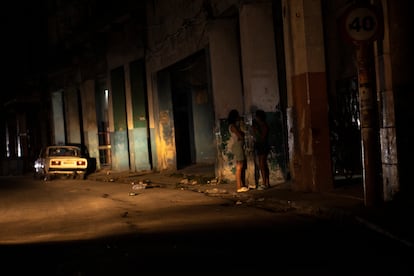
With the fall of real socialism and the disintegration of the USSR, the Cuban economy lost its foundation and collapsed. The first part of the 1990s, remembered in Cuba as the Special Period, was a difficult time for the revolutionary myth. The Castro regime, which until then had strived to distribute scarcity, now had to distribute misery. “But even in the midst of that debacle,” says López Hernández, “the State maintained a certain degree of social responsibility. Fidel was an intelligent politician and knew that to demand total obedience, you had to give something in return.”
Perhaps nothing better illustrates the strength of the Revolution’s social pact at that time than the popular protest of August 5, 1994, known as the “Maleconazo.” On that day, hundreds of people took to one of Havana’s main thoroughfares to march, chanting anti-government slogans. It was the first time the regime had been challenged in this way since 1959. The repressive forces responded with violence, and some report at least a dozen citizens injured. However, the event lasted only as long as it took Fidel Castro to appear before the demonstrators and magically transform the protest into a march in support of him. The revolutionary epic was thus inextricably linked to the epic of its patriarch. Fidel Castro ensured this, which is why they died together.
In 2008, with Fidel Castro ill and removed from power, and with his brother at the helm of the country, the contractual rules of the Revolution changed. “Raúl Castro is a military man accustomed to ‘command and control,’ and he wasn’t interested in maintaining Fidel’s approach. With him, the idea of the State’s social responsibility changed. The government began to disengage from social security, many subsidies were cut, workers’ cafeterias were closed, and several almost neoliberal measures were taken that dealt a severe blow to the poorest families,” says the Cuban intellectual.
Raúl Castro promised reforms that were supposed to translate into economic freedoms. However, he was only able to implement a few (such as the recognition of private property) and not without considerable obstacles and subsequent setbacks. What the younger Castro did achieve was to turn the country’s economy, a portfolio he himself had managed for almost half a century, into the property of the military. To this end, he consolidated the power of GAESA, a military-corporate conglomerate headed by his son-in-law, General Luis Alberto Rodríguez López-Calleja (who died in 2022). According to estimates by the Elcano Royal Institute for International and Strategic Studies, between 2016 and 2022 GAESA went from controlling 22.6% of the strategic sectors of the Cuban economy to managing 70%, including almost everything related to tourism, and from controlling 8% of the island’s finances to dominating 95%. With Fidel Castro’s death, the epic narrative was emptied of reality. Since then, the Revolution has done nothing but appeal to a supposedly glorious past of social equality while, in reality, it has been committed to social cuts, the monopolization of the economy by the military elite, and political repression.
“The Cuban system has accumulated blunders and flagrant violations of civil and political rights. This has caused a clear fracture in the consensus surrounding the romanticized view of the Revolution,” notes Julio Antonio Fernández Estrada, a prominent jurist and historian who also works as a journalist for the independent Cuban media outlet El Toque, from his exile in Madrid. He explains that the accumulation of these blunders dates back to the first decade of the Revolution. One of the most remembered was the case of censorship and repression against the poet Heberto Padilla, which marked the beginning of a veritable witch hunt against artists and intellectuals not fully aligned with the regime’s interests, a period known as El Quinquenio Gris (the Gray Five-Year Period).
The Padilla case caused a huge schism within the international left-wing intelligentsia that supported Castro, but it wasn’t the only one. “Many people on the left have been getting off the bandwagon of the Revolution, metaphorically speaking. This also happened with the Mariel boatlift in the 1980s, the 1994 Cuban Rafter Crisis, and the summary execution of three young men who hijacked a boat in 2003 to emigrate to the United States,” Fernández Estrada elaborates.
With the pact broken, there was no reason for citizens to continue accepting the absence of civil, economic, and political rights. This, coupled with a precarious situation that has only worsened under Miguel Díaz-Canel’s government, spurred civil society to increasingly challenge the regime. In response, the Revolution intensified and hardened its repressive mechanisms. The popular protests of July 11, 2021, which resulted in over a thousand political prisoners, dozens of injuries, and at least one death at the hands of the police, clearly illustrate the current decline of the post-Castro Cuban regime.
“But some of that revolutionary romanticism remains, at least on the part of a sector of the international left. That left remains loyal to the Cuban government, not to the people, and continues to justify everything with the U.S. embargo, which is now becoming more real,” Fernández Estrada says, alluding to the tariffs that the Trump Administration threatened to impose on January 30 on anyone who supplies crude oil to the island. “This situation has once again created a shield around the Cuban Revolution. Many people have revived that special regard because all they see now is a starving population in need of help, but they don’t realize that the humanitarian crisis in Cuba is much older, more sustained, and more structural than anything a month-old oil blockade could cause.”
Sign up for our weekly newsletter to get more English-language news coverage from EL PAÍS USA Edition









































