
Che, Fidel and Christopher Columbus
Statues come and go on the streets of Mexico City, whether people put them up or authorities take them down

Interventions in public spaces are not things to be taken lightly, nor are the names assigned to the streets of towns and cities. In Mexico City, however, the laxity is evident just by taking a stroll: the same applies to the commercial stalls scattered in every corner as to the hospitality businesses that invade the sidewalks without a care in the world. Statues also adhere to this anarchy. Anti-monuments are common on Paseo de la Reforma, one of the city’s main thoroughfares. These are symbols that people place overnight in memory or vindication of painful causes, such as femicides, the deaths of children in a school fire, or the miners who were buried underground in an accident. No one dares to remove them because no one had done justice to these victims before. It is understandable.
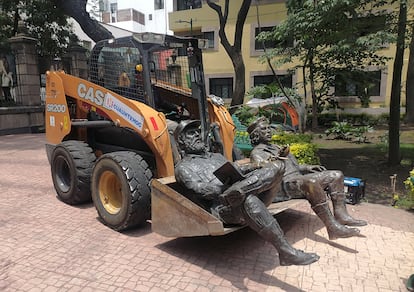
The authorities continue the same arbitrary approach. One morning, a citizen wakes up to find the statue of Christopher Columbus has disappeared from its plinth; another day, without warning or explanation, Fidel Castro and Che Guevara are hoisted onto the back of a heavy machine, cigar and all, and transported to who knows where. This is what recently happened to the Cuban dictator and the guerrilla leader, by order of the mayor of the Cuauhtémoc district, Alessandra Rojo de la Vega, who cited a lack of permits and other administrative requirements when they were installed back in 2017. De la Vega must have considered this a priority in her public policies.
Naturally, it hasn’t come cheap. From one corner, some Cubans protested, considering the two guerrillas part of the city’s historical memory, because they spent a good chunk of their time in the Tabacalera neighborhood plotting the revolution against the wretched Bautista. From the other corner, it was the president of the Republic herself who smiled at her political adversary’s gesture, and asked her for the two bronze men in order to take them to another park.
Claudia Sheinbaum knew she couldn’t address this issue without being reminded that she herself had overthrown Columbus under cover of darkness, so the president already had her speech prepared, and no one needed to bring it up. She said on July 17 that her case was different, that the adventurer (also a slave owner, depending on who you ask) had been given a different place of residence. Oh, and what’s more, this was done by popular demand, as many people, especially Indigenous people, had requested it at the municipal offices, she added. Well, the Cuban statues had also been defaced on occasion by those who didn’t like seeing their mugs. And there must have been quite a few of those, given who wins elections in that municipality.
Reconciling tastes, ideologies, traditions, memories, whims, and obsessions isn’t easy. How could it possibly be? Democratic difficulties are made of this fragile and fickle material. It would be simpler to have clear laws or properly consult the population on these matters. Or to reach consensus between parties, or to explain things clearly without beating around the bush. There are policies that require thoughtful debates in parliament, naturally. The case of statues, however, is somewhat more manageable; there’s no rush, consultations can be held, and everyone can try to steer their own course by presenting their arguments.
Otherwise, any day now we’ll have a big fight over the statue of Josip Broz Tito, which also stands on Paseo de la Reforma, under the trees and among the plants. Some will say the former Yugoslavian leader was a hero of the resistance against the Nazis, and others will simply call him a dictator. And perhaps both are right, but then what do you do with the statue?
The same thing happens to these monuments as with Nobel Peace Prizes: it would be better if they were awarded 50 years after the candidate’s death, lest the winner should fail to live up to the prize later in life, leading the whole of Sweden and part of humanity to choke on their accolades. And by then, if memory holds, they should be sculpted in bronze and minted in coins. If the authorities want.
Sign up for our weekly newsletter to get more English-language news coverage from EL PAÍS USA Edition









































