
My return to a Cuba I no longer recognize
No one believes in the revolution anymore. The Díaz-Canel government does not inspire any affection or respect. The country produces almost nothing, and Trump has imposed new sanctions just when Cubans couldn’t imagine life getting any worse
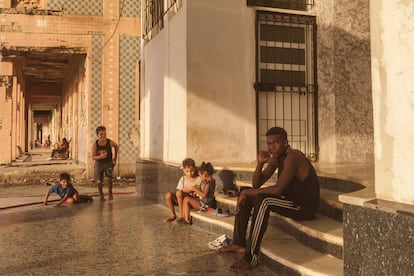
I have just been back to Cuba after seven years. I had not been there since April 2018. Over the previous four years, when I spent much of my time there, Raúl Castro and Barack Obama re-established diplomatic relations and embarked on a process of openness and improvement that triggered an atmosphere of enthusiasm and hope. Cuba became fashionable: luxury stores opened in Parque Central; Chanel held its annual fashion show at El Prado, Fast and Furious filmed an episode of its saga on El Malecón; Madonna celebrated her 58th birthday at La Guarida, and the Rolling Stones, whose music had been banned for decades, gave a concert for 300,000 people at the Ciudad Deportiva. Mick Jagger shouted from the stage: “It seems that times are changing!” And the crowd called back “Yes!” Cubans who had rebuilt their lives abroad returned to start a new business on the island. Obama visited Havana and its inhabitants came out to greet the limousine that ferried him around. Even the most nihilistic allowed themselves to imagine they were finally on a different track.
On November 25, 2016, Fidel died and nine days of mourning were decreed, with alcohol and all celebrations prohibited. On December 4, he was buried in the cemetery of Santa Ifigenia under an immense rock brought from the Sierra Maestra, steps from the mausoleum of José Martí.
But things did not go as expected. The good vibes evaporated. Trumpism in Florida and conservative Fidelism in Cuba prevailed. Then came the pandemic, the absence of foreign aid, the San Isidro Movement, the protests of journalists, artists and writers outside the Ministry of Culture, those of July 11, 2021 – the largest since the 1994 El Malecón protests – the song Patria y Vida by the group Gente de Zona, relentlessly terrible economic management, the Social Communication Law that ended up banning private ownership of any media, a food crisis that has the government asking the United Nations World Food Program for powdered milk, and a collapse of the energy system due to lack of fuel and poor maintenance of generators that cause permanent blackouts. Every day, everywhere at some point or another, there is a power cut.
***
There are very few people in Havana. According to the economist and demographer Juan Carlos Albizu-Campos, between 2022 and 2023 the island’s population fell by 18%. This meant a drop of just over 11 million to about 8.5 million. Currently, there is a bit of life around Obispo, but nothing compared to 10 years ago, when it was bustling with tourists. Today you can count them on the fingers of one hand. Several of its shops are closed and there’s little to buy in those that remain open. In the Plaza de Armas, they stopped selling books and antiques. A duo of old men sings Bésame Mucho without an audience. The terraces that brought the Plaza de la Catedral to life no longer exist. At the door of the Bodeguita del Medio, two women in traditional dress smoke cigars and wait to pose with visitors. One of them, no younger than 70, offers me oral sex. On the opposite wall, a struggling artist exhibits canvases bearing Che’s face. “Until victory always. Homeland or death,” one reads. An old woman in a wheelchair passes by and asks me for money for food. So many Cubans have taken to begging. Some offer discontinued coins and bills with the faces of the heroes of the Revolution in exchange for help.
***
There appears to be more old people than young on the street. “The fundamental clay of our work is YOUTH, in it we place our hope and prepare it to take the flag from our hands,” says Ernesto Guevara on a poster on Teniente Rey Street. On the edges of San Miguel Boulevard you can find old men lying on the pavement. Those who trawl the garbage are called drifters. It is far more difficult nowadays to find the attractive boys and girls who made Cuba famous for its beauty. Many have left with the help of strangers.
***
In the Plaza Vieja, at the end of last year, the German artist Martin Steinert installed a sculpture entitled Wood Cloud. There are hundreds of slats arranged to catch the light and make it look like a wooden cloud. Havana residents have filled these slats with messages: “Be free no matter what they say;” “Peace and prosperity for my Cuba;” “I love you, but I leave you;” “Down with the dictatorship;” “What revolution are they talking about, if they don’t allow any change?” and “Wow, I hate them.” There are also hearts pierced with declarations of love and dated autographs.
***
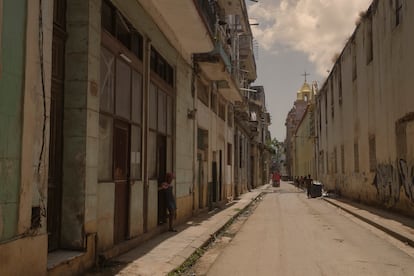
In Old Havana, there are plenty of dilapidated buildings. According to official data, 35% of the country’s homes are in poor condition. Weeks before passing through, a building collapsed in Santos Suárez and around the same time another five houses in Guajay fell down, another one in Compostela and a balcony on Calle Muralla. It is common to find concrete debris and accumulated garbage in various corners of the streets. Weeks can go by without any collection and there are parks, such as Carlos Aguirre, that have been directly converted into garbage dumps. I reached the Carlos Aguirre park after wandering through Centro Habana: Neptuno, Perseverancia, Lealtad and San Rafael to Infantas, and found people offering pairs of old shoes, worn T-shirts, nails, rusty wires and sweet dough among the pillars. A trade in junk.
***
If there is one thing that has characterized this revolutionary island, it is security. Drugs have always existed, but in very exclusive circles, unlike in other Latin American countries. While walking through Cayo Hueso, however, more than once I was warned not to talk on my cell phone in case it was snatched. The writer Pedro Juan Gutiérrez told me that he was reinforcing the doors of his apartment on the 8th floor of Galeano, very close to El Malecón. Around there, the consumption of a new drug known as El Químico has become rife. The dose, contained in a piece of impregnated paper, costs less than a dollar and consists of carbamazepine and other benzodiazepines, as well as animal anesthetic, formaldehyde, fentanyl and phenobarbital. According to a man called Josué, “It’s like a shot of energy that fills my whole body with cramps. There is a moment when I only feel my heart beating and my ears get clogged. It makes a lot of people speed up, but I like to walk slow.”
***
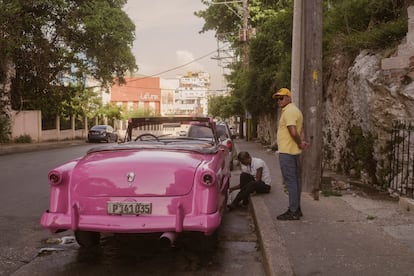
Meanwhile, in parts of Havana a bourgeoisie is emerging. It is made up of the owners of small privately-owned companies (mipymes) that have replaced the state as providers of goods and services. While many Cubans live with scarcity, this merchant class is growing. It is as if two different eras coexist, most obvious in the various forms of transportation: carts, pedal taxis, gringo cars from the 1950s, Soviet Ladas, electric tricycles trundle alongside brand new vehicles. There are more new cars than before, many of them Chinese. There are also restaurants with international prices where the food is good and plentiful. Once frequented by successful artists and musicians, as well as foreigners, they now host the owners of these small businesses and their families.
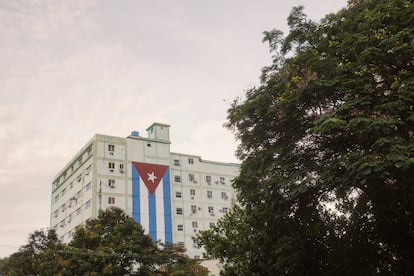
The economy is highly dollarized and it is not difficult to exchange dollars on the black market at almost three times their official price. In the best-stocked stores, you pay directly in dollars. New immense and uninhabited hotels have shot up, owned by the state but managed by private companies: a 42-story building on 23rd Street, a few steps from the Coppelia, managed by Iberostar, and the immense Gran Muthu Habana Hotel near Fifth Avenue attract the most attention. I ask why they are being built now if there are no tourists and, although no one really knows, some claim these projects were started during those years of openness and hope. They were then interrupted by domestic politics, the triumph of Donald Trump and the pandemic. Others suspect they involve shady business deals in which members of the government are involved. In the absence of a free press, all news is based on rumor, and one widely spread is that obtaining permits depends on corrupt characters such as El Cangrejo (The Crab), whose name is rarely uttered, but indicated by the twiddling of fingers.
***
“Don’t take notes in public,” a friend tells me as I take out my pen and paper. I was about to jot down what he had just told me – the rumor that Miguel Díaz-Canel has bad aché – or energy. According to my friend, as soon as he took office, a tornado swept through Havana, then the Saratoga Hotel exploded, and three months later the oil deposits of Matanzas burned. “Put that away,” he told me. “Don’t be crazy.” It was the first time I had returned to Cuba after publishing Journey to the End of the Revolution. A plainclothes officer had pulled me aside at the airport to remind me that I was arriving on a tourist visa and, as I was able to confirm a few days later “they have you in their sights.”
“The population of this city is no longer the same,” said my friend, who has lost many of his own friends to the exodus. Havanans migrate abroad in search of better opportunities just as rural Cubans migrate from the provinces to Havana. Those who arrive from the East are called Palestinians. They are recognized by their accent, skin color, cultural level, extreme poverty and rootlessness.
***
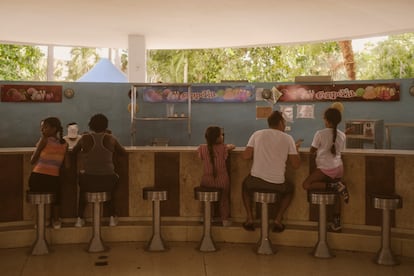
I return to the Vedado neighborhood where I used to stay years ago: the Paseo de los Presidentes, the Habana gallery, the little market on F Street which is now empty and on whose counters are scattered some sad examples of garlic, peppers, onions, yucca and beets. In the background, a glass display case shows four or five unappetizing cuts of beef and pork; and in a darkened corner of the courtyard, there’s a 20-year-old woman selling strawberry, chocolate, caramel and soursop ice cream worthy of the best Italian gelateria, but served in rudimentary plastic cups. Just as these great ice creams survive, if you look hard enough, you can find the best jazz on the continent amidst the din of the reparto, the local variant of reggaeton. The Presidente Hotel hasn’t changed either, although its terrace is empty. A decade ago, Cubans would gather on the sidewalk of 2nd Street to pick up the Wi-Fi signal available to the hotel’s guests and communicate with relatives abroad. Today, most pay for phone plans that allow them to do so without too much trouble.
***
No one believes in the Revolution anymore. The Diaz-Canel government does not inspire either affection or respect among Cubans. Almost nothing is produced in the country. Donald Trump’s administration, for its part, constantly imposes new sanctions that tighten the blockade; Airbnb was banned from operating in Cuba. Humanitarian parole and family reunification programs have also been terminated, and sanctions have limited access to artificial intelligence for universities while also prosecuting possible investors in the national Biopharmaceutical industry.
There is hardly any talk about what is happening in Cuba in the international media, except in local political debates where its ideological enemies mention it as a negligible abstraction. Its flesh-and-blood inhabitants, meanwhile, are unable to imagine the next step in this story, how much worse it can get. Where once the “new man” was conceived, hopelessness now reigns.
Sign up for our weekly newsletter to get more English-language news coverage from EL PAÍS USA Edition









































