
Colombia makes its first inventory of the 500-million-year-old ‘sea ghosts’
Pelagic ctenophores are a type of gelatinous animal that gets carried along by water currents. The country has now registered 15 of these species– six for the first time
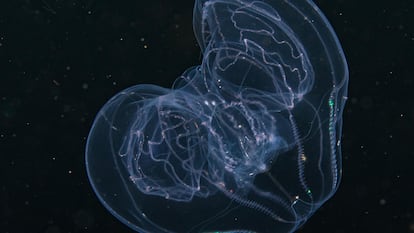

It is as if they were designed to go unnoticed. Pelagic ctenophores, a type of gelatinous plankton that gets carried along by currents, are apparently transparent, sometimes tiny, and made up of more than 90% water. Also known as sea ghosts or comb jellies, this ability to camouflage themselves is an advantage for them but an obstacle for science. Little is known about the life of ctenophores. If they are taken out of the sea, they fall apart, and photographing them is an epic feat that few experts have achieved.
“Besides being beautiful, it was visually captivating,” says Juan Mayorga, a researcher with National Geographic’s Pristine Seas program, who was part of the mission to explore uncharted areas of Colombia’s waters in 2022. There, together with a group of scientists and photographers, he was able to capture images of the elusive animals and thus take a step toward building what has just become the country’s first inventory of sea ghosts or comb jellies – a species that resembles the jellyfish.
The photos and videos taken during the expedition, together with additional research, show that a total of 15 ctenophores have been recorded in Colombia. In eight of the cases, it was possible to identify the species, according to the study published in the journal of the Colombian Academy of Exact, Physical, and Natural Sciences; six have been recorded for the first time.
The existence of these so-called sea ghosts is somewhat paradoxical. Although they are believed to have first emerged in the Cambrian period, approximately 540 million years ago, making them one of the oldest known species, Colombia had not been able to compile an approximate list of the species that glide through the Caribbean and Pacific.
“Ctenophores always show up in plankton samples when plankton nets are dragged,” says Cristina Cedeño Posso, lead author of the study, marine biologist and researcher at Invemar. “But they are very damaged and difficult to preserve. They disintegrate in alcohol and degrade very quickly in formaldehyde, turning into a white mass.”
“When Cristina saw the images we brought back, she took the initiative,” says Mayorga. “She said, ‘Wow, there’s a lot of valuable information here that we can use.’” In science, some things also happen by coincidence.
Although Pristine Seas carried manned submarines and cameras capable of descending 600 meters below the ocean’s surface, the team also wanted to dive in open water. There, diving to a depth of between five and 40 meters from the surface, they encountered gelatinous plankton, either near the Malpelo Fauna and Flora Sanctuary or above the National District for Integrated Management of Underwater Hills and Ridges in the North Pacific Basin. “We never expected it to become a scientific contribution, we were really just photographing it because it was beautiful,” says Mayorga. The expedition not only helped Colombia to protect 30% of its marine areas, but also provided scientific material that can be analyzed for many years to come.
The second step was to dig through all the available information to see what other records existed. Cedeño led this effort, scrutinizing other published scientific studies, undergraduate theses, research projects, and freely accessible databases. She and her team also looked at citizen science initiatives, such as iNaturalist, which has collected information on reports of gelatinous plankton in Colombia since 2009, and the Gelatinous Animals Research Project (PIAG Medusozoa), which Cedeño herself leads. “I started it about 20 years ago to teach people what gelatinous plankton groups are,” she says. “I can’t be at sea all the time, but people who dive and students can make reports.” A total of 58 records of ctenophores were found for Colombia: 28 in the literature, eight thanks to citizen science, and 18 photos from the Pristine Seas expedition.
To understand what was being seen, an expert eye was needed. At first glance, you might think sea ghosts are jellyfish, but ctenophores have no sting and do not move with the same rhythm. Instead, they move using cilia which could be described as legs, arms, hairs, or combs, hence the name, comb jellies.
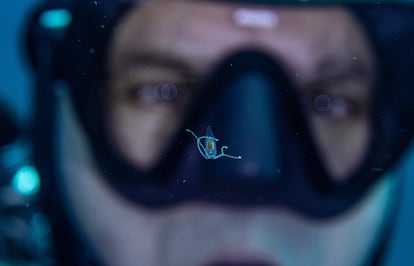
“When I received the videos, it was fantastic,” says Cedeño who works out of Jorge Tadeo Lozano University. “Because it’s very different to be able to observe them in all their positions, swimming, pausing the videos. Every time a ctenophore turns, it’s a different perspective.”
The results go beyond this list of species: Beroe forskalii, Ocyropsis maculata, Ocyropsis maculata immaculata, Cestum veneris, Leucothea pulchra, and Thalassocalyce inconstans. They are a first step toward better understanding an animal that, despite its abundance and antiquity, has only 200 species recorded globally.
Sign up for our weekly newsletter to get more English-language news coverage from EL PAÍS USA Edition









































