
A jellyfish the size of a school bus: The new scientific discovery in the Argentine Sea
The ‘Stygiomedusa gigantea’ was recorded at a depth of 250 meters. Its four arms can reach up to 10 meters in length
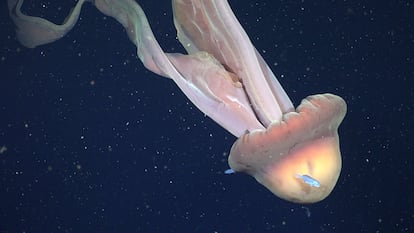
Argentina’s deep sea holds more biodiversity than scientists previously thought. An expedition that traveled from the north of Buenos Aires province to Tierra del Fuego, the country’s southernmost point, observed the world’s largest known Bathelia candida coral reef, worms, sea urchins, snails, anemones, and a specimen that captured the public’s attention: a rare phantom jellyfish that can grow as large as a school bus.
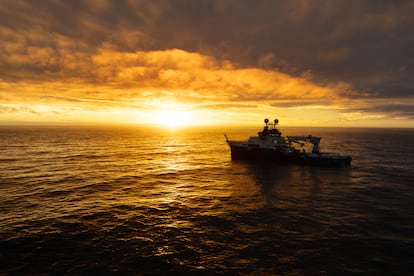
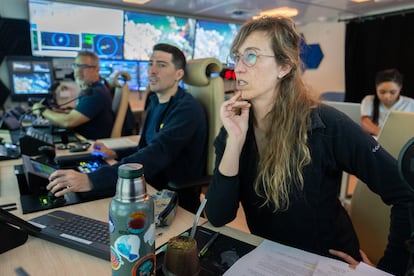
The expedition, led by Argentine scientists from the University of Buenos Aires and the National Scientific and Technical Research Council (CONICET), departed aboard the research vessel Falkor and explored the entire continental shelf of the country between December and January. This vessel, belonging to the Schmidt Ocean Institute, is the same one that hosted another scientific campaign last year in the submarine canyon off Mar del Plata (250 miles from Buenos Aires), which went viral with its live broadcasts on social media.
Back then, the star was the now‑iconic “big‑butt starfish,” a specimen of Hippasteria phrygiana found on the seafloor. This time, the spotlight went to Stygiomedusa gigantea, commonly known as the giant phantom jellyfish. In the image captured by the scientists, you can see juvenile fish (Centrolophus) swimming around its enormous bell at a depth of 250 meters. According to the team, its bell can reach up to one meter in diameter, and its four arms can grow as long as 10 meters. It does not have stinging tentacles, but uses its arms to trap prey such as plankton and small fish.
“We didn’t expect to see this level of biodiversity in the deep waters off Argentina, and we’re thrilled to find them so full of life,” said María Emilia Bravo, the scientist leading the expedition. “It was incredible to witness all the biodiversity, the ecosystem functions, and the connectivity unfolding together. We opened a window into our country’s marine life, only to discover that there is still so much more left to find,” she added.
Covering roughly 0.15 square miles — about the size of Vatican City — the Bathelia reef documented by the expedition’s scientists is a cold‑water stony coral habitat that shelters other organisms such as fish, crustaceans, and octopuses. Recognized as an indicator species of a Vulnerable Marine Ecosystem (VME), Bathelia candida has been recorded throughout the southwestern Atlantic, with the largest concentrations off the coast of Argentina. Until now, however, scientists hadn’t understood its full extent; during this expedition they found reefs even farther south than its previously known range.
“With each expedition to the deep sea, we discover that the ocean is teeming with life, as much as the land and perhaps even more so, since it contains 98% of this planet’s living space,” said Jyotika Virmani, executive director of the Schmidt Ocean Institute. “We have had the privilege of working with leading scientists on three expeditions in Argentine waters and look forward to seeing their research continue to advance, generating new knowledge and inspiration.”
The team also observed trash in some areas, including fishing nets, bags, and a VHS tape in perfect condition thanks to the durability of plastics. The label on the tape is in Korean, but the team does not know how it reached Argentine waters or how old it is.
Sign up for our weekly newsletter to get more English-language news coverage from EL PAÍS USA Edition









































