
Trump’s plan to ban diesel exports aggravates Europe and Latin America’s energy crisis
Facing record-high diesel prices at home, the Republican president is making a move before the November midterms. The resulting price spiral will have a negative impact outside the US
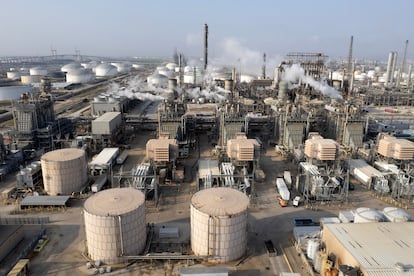
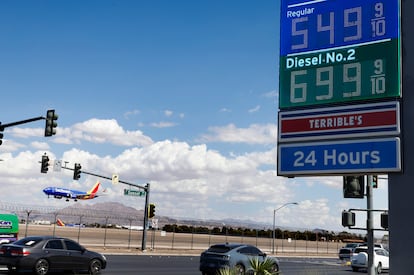
The United States and its energy industry are making a killing selling crude oil and its derivatives to the rest of the world. The world’s largest economy is filling part of the gap left by supply cuts from Gulf countries due to the war in Iran, and from Russia due to Ukrainian attacks on its refineries. But everything has its limits, and the breaking point was reached on Tuesday, September 22, when diesel surpassed $6.50 a gallon at U.S. pumps.
Shortly after this threshold was crossed, President Donald Trump publicly expressed his support for banning diesel exports for the first time, in order to bring down the price of the fuel at home. The measure would have a massive impact on an energy market that has already become a pressure cooker. And Latin America and Europe, the main buyers of American diesel, would be the hardest hit.
“I’ve said let’s not send out the diesel,” the American president declared on September 22, after a meeting with Ukrainian President Volodymyr Zelensky on the sidelines of the UN General Assembly General Debate in New York. Trump now has the power to further exacerbate the energy crisis that he himself unleashed back in February, by launching the war against Iran. The spike in energy prices has significantly impacted the wallets of his own constituents.
On Wednesday, September 23, Politico offered more clues about how the White House would implement such a measure. Apparently, the Trump administration plans on imposing a 90-day export ban, according to five sources familiar with the matter. And this is no longer merely a threat, but a plan with a clear timeframe. The ban would last until the end of the year, the peak season for diesel demand in North America and Europe.
With the November midterm elections just around the corner – and with the large majority of polls showing the Republicans losing – the temptation to ban diesel exports also faces significant obstacles. There are divided opinions on the matter, even within the White House itself, and there’s significant opposition from the powerful U.S. oil lobby. There’s also the expectation that reduced diesel production will ultimately drive up the prices of other fuels, such as gasoline, in the domestic market. But Trump seems more concerned with sending a signal to his voters. It’s an almost desperate attempt to reverse a trend that’s extremely worrying for his political interests.

The proposed ban, whether partial or total, couldn’t have come at a worse time for Europe, where fuel prices are skyrocketing and severely impacting agriculture, transportation and industry. On the continent, diesel still accounts for almost two-thirds of the energy consumed for road freight transportation. And the United States is by far its main supplier: so far this year, it has provided a third of European diesel imports (in August, it was half) and a tenth of total consumption.
Far from weakening, this relationship has intensified since Russia stopped supplying fuel to much of the rest of the world. The supply crisis has worsened due to Ukrainian attacks on Russian refineries, launched in response to the war initiated by Vladimir Putin, and the growing difficulties faced by Persian Gulf countries in shipping their refined products through the Strait of Hormuz and the Red Sea.
The perfect storm that’s been brewing for months in the global diesel market can only worsen if, purely for electoral gain, Trump ends up sending a proposal to Congress to ban exports of the fuel. With the ongoing wars in Iran and Ukraine, global refining capacity has dropped by some five million barrels per day, which has exacerbated the diesel deficit even as diesel remains the world’s most in-demand fuel.
After Trump’s announcement, diesel prices on the London market rose by 7%, despite the relative stability of crude oil.
“The underlying problem is that the rest of the global refining system doesn’t have enough spare capacity to compensate for these losses,” explains Kerstin Hottner, head of commodities at Vontobel, an asset manager. “In recent years, refining capacity has decreased in both Europe and the United States. And the facilities that remain operational are already running near their maximum capacity.”
If Washington goes ahead and cuts off the American diesel supply to the rest of the world, the situation will become even more unsustainable. “An export ban would be devastating for diesel supplies in Europe; it would be a struggle to replace them,” Josh Michalowski warns EL PAÍS in an email. He covers the European diesel market at Argus, a market intelligence firm focused on commodities and energy.
“Almost a third of U.S. [diesel] exports go to South America, which would be the hardest-hit region, and Central America: together, they account for almost half of the total,” Jorge León, the head of Geopolitical Analysis at the Norwegian firm Rystad Energy, explains in a phone interview. “It would also be relevant for Europe, but [the continent] has less exposure.”
Six of the seven largest buyers of diesel processed in U.S. refineries — totaling 1.5 million barrels per day — are located in either Europe or Latin America: Brazil, Chile, Mexico, Peru, France and the United Kingdom. This is according to data from the industry analysis firm Kpler. The only exception on that list is Morocco.
“Just because of Trump’s words on Tuesday, the price of diesel has gone up [in Europe] and down in the United States. If he finally takes this step, the situation will be quite complicated,” León predicts. Without U.S. diesel, European gas stations wouldn’t run dry, because Europe produces around 70% of its diesel domestically. But there could be isolated shortages and — this is for certain — the price surge could only get worse. This past August alone, the price of fuels and lubricants soared by almost 24% year-over-year in the EU, according to figures published on September 22 by Eurostat.
An unprecedented ban
U.S. crude oil exports were banned until late 2015 when, under Democratic President Barack Obama, Congress lifted the ban and allowed domestic oil companies to fill their coffers by selling their surplus (generated by the surge in fracking) abroad. Diesel exports, however, have never been banned. Political desperation, however, could change this historical paradigm.
The midterm elections are just around the corner. And the Republican Party’s prospects are bleak, with more and more polls pointing to a resounding defeat in both the House and the Senate. And one issue stands out above the rest: the price of oil and gas, particularly diesel, which has hit an all-time record high. This has fueled inflation and taken money out of the pockets of American workers, something the real estate and gambling magnate promised to address, back when he made his bid for a return to the White House in 2024.
The export ban has already been proposed by some U.S. senators. In fact, the candidates most actively pressuring the White House to have Trump impose it are primarily from the midwestern states (including Iowa, Nebraska, Michigan, Kansas and Texas). The Midwest is a major Republican stronghold and essential to their chances of surviving the elections in November.
However, there are also prominent dissenting voices among Republicans. These include Energy Secretary Chris Wright, a climate change denier and former fossil fuel executive, and Interior Secretary Doug Burgum. In recent weeks, they’ve expressed doubts about whether the proposal would have the desired effect.
The risk, moreover, is that a measure with a short-term, electoral motivation could end up being counterproductive. Initially, with the export ban, the price of diesel in the U.S. would fall, given the greater supply. Despite American refineries operating at 97% of their maximum capacity, at this time of year, U.S. diesel reserves are currently 13% below the average for the last five years.
After that initial benefit to consumers, however, significantly lower margins “could reduce refiners’ incentive to maintain exceptionally high throughput,” Kpler warns. In that regard, and as Goldman Sachs analysts pointed out on Wednesday, September 23, since refineries produce gasoline and diesel from crude oil, lower margins would lead them to reduce their total processing volume. As a result, this would drive up the price of gas.
“Banning diesel exports is a simplistic, obvious solution: it might alleviate the price increase for farmers and truckers before the midterm elections, but it would [eventually] have harmful effects in the form of higher gas prices,” warns Gonzalo Escribano, director of the Energy and Climate program at the Elcano Royal Institute, a Madrid-based think tank. “Furthermore, in the medium and long term, it would represent a significant loss of confidence in [the United States] as a reliable supplier. [it would create] a growing fear that something similar could happen with oil and natural gas [exports].”
As with every one of Trump’s sudden U-turns, the consequences would affect everyone.
Sign up for our weekly newsletter to get more English-language news coverage from EL PAÍS USA Edition









































