
Iran and its allies threaten the global economy by controlling two key straits: Hormuz and Bab al-Mandab
Tehran has had the former under its control for months, and the latter has fallen into the hands of the Houthi, a militia financed by the Islamic Republic. Yet President Trump keeps looking the other way
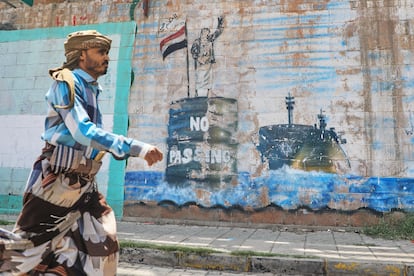
First came the bluster, seasoned with ignorance and the conviction that the U.S. military action in Venezuela could be replicated in Iran: those initial airstrikes coordinated with Israel ended, as we now know, with the Strait of Hormuz closed and the global supply of oil and gas hanging by an increasingly thin thread. Now comes the inaction, the failure to respond to Houthi advances in Bab al-Mandab—thanks to Tehran’s military support and generous funding— and the refusal to help its nominal ally, Saudi Arabia, restore the previous order in that perennial tinderbox called Yemen. If the Houthi rebels already exercised partial control of that second strait earlier, with the capture of Mayun island and the port of Mokha their dominance is now almost total.
The result of both decisions is unequivocal: the president of the United States has helped hand Tehran control of two maritime chokepoints vital to the global economy, stoking inflation, dragging down growth and further darkening his party’s already bleak prospects of winning the November 3 midterms. And all this in just over half a year.
Saudi Crown Prince Mohammed bin Salman called the White House twice last Thursday, Axios reported, to demand greater U.S. involvement against the Houthis and the pro-Iranian militias in Iraq that have halted traffic through the East–West Pipeline. He was unsuccessful: Trump not only ignored his pleas but chose to take a completely hands-off stance, as if it were none of his business.

His own mistakes have left the Republican president with his hands tied in the Middle East. The disastrous war with Iran, which triggered the closure of the Strait of Hormuz, has kept that waterway sealed despite his insistence otherwise. American public opinion is demanding a solution and, according to the polls, voters are preparing to deliver a heavy blow to the president and his party in the midterm elections in a month and a half. The rise in fuel prices, and with it the cost of everything else, last week precipitated the first interest-rate hike since 2023. Military spending in the Persian Gulf is around $40 billion (€34.86 billion), according to a report by the Congressional Budget Office.
Although Trump and his secretary of defense, former Fox host Pete Hegseth, vehemently deny it in all caps on their social media accounts, the Pentagon’s audit arm has admitted that Iranian attacks have caused a severe shortage of missile interceptors, essential to repel an air attack and costly and slow to produce: a Patriot interceptor costs $4 million and replenishing expended rounds can take five years or more. Experts say that while the United States has enough ammunition to continue in this conflict, it could face shortages if another war broke out at one of the world’s flashpoints, for example in the Taiwan Strait.
Signs of urgency
Faced with the risk of a wider conflict, Trump has chosen to protect his own interests first, even if that means answering Riyadh’s calls for help with a poker face. His top priority is finding a solution to the closure of Hormuz. And he is showing signs of urgency: he says he is close to making a major decision on Iran.
This is not the first time in more than six months of war that Trump has promised a decisive move without anything changing substantially. But there are signs that something may be shifting. On Saturday he abruptly left Camp David, the presidential weekend residence in the Maryland mountains, to return to Washington without explaining the change of plans. The president has visited that retreat only three times this term, once to meet his Cabinet. On the other two occasions he made some decision about the war, including its outset.
Trump also plans to meet on Tuesday with Gulf states on the margins of the United Nations General Assembly, a meeting that could be key for deciding on a new strategy.
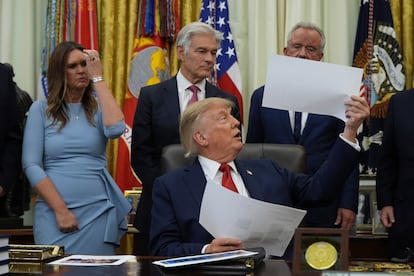
Meanwhile, the real-estate and casino mogul is attempting the impossible: to limit the fallout from recent events in the Red Sea. Last weekend he sent a delegation to Muscat, Oman, to meet Houthi representatives—whom he classifies as a terrorist organization but with whom he maintains open channels of communication. In that meeting, Reuters reported, the Yemeni rebels assured Washington they would not act against any of the dozens of commercial barges crossing Bab al-Mandab to or from the Suez Canal, and that they would confine their attacks to Saudi vessels, their main regional enemy.
Bin Salmán’s urgency —who, without Washington’s backing and to the surprise of many observers, has restrained his response to the Houthis and the pro-Iranian militias in Iraq— reflects a stark reality: Saudi Arabia is betting much of its fate on Bab al-Mandab and, more broadly, on the Red Sea. The temporary halt to the pipeline, which—unlike the suffering of other regional neighbors such as Kuwait, Bahrain or Iraq itself—had allowed it to emerge relatively unscathed from the closure of Hormuz, casts a long shadow over the engine room of the Saudi economy. Despite diversification efforts, it remains heavily dependent on crude oil.
The temporary halt on operations in the East–West Pipeline has driven its exports to zero, except for marginal sales drawn from inventories and the small volumes they can still move through Hormuz. The world, in short, completed on Friday its first full week without receiving virtually a single barrel from the country that led the global sellers’ list. It is an unprecedented situation, not even seen in the oil crises of the 1970s. And it is one that neither Riyadh nor Asia nor the West —European refineries, for instance, already know from state giant Saudi Aramco that they will not be able to count on its crude for at least a month— can afford to let continue for much longer.
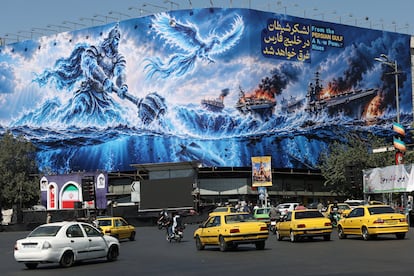
With Hormuz at the mercy of the Islamic Republic, Bab al-Mandab in the hands of its ally in Yemen, the Saudi pipeline shut until further notice and Russian refineries sidelined by Ukrainian attacks, the high price of fossil fuels leaves the global economy in a difficult position. Growth is holding up for now with unusual resilience. But the relentless rise in the cost of living, which will cost the Republican Party many votes in November, foreshadows a downturn in consumption and investment sooner or later—especially after the forced interest-rate increases on both sides of the Atlantic.
Far from responding to the Houthi offensive or trying to speed negotiations with Tehran to reopen Hormuz, Trump’s response has been to ask Volodymyr Zelenskiy —whom he publicly humiliated last year in the White House— to stop attacking Russian refineries that produce diesel, vital for freight transportation and trading at record-high pump prices in U.S. gas stations. So far Kiev has ignored the request; in what is arguably legitimate self-defense, it has found in the energy front a significant vulnerability to exploit against Vladimir Putin’s regime.
If Hormuz is —or was— the key outlet for hydrocarbons from the Gulf petro-monarchies, with the Houthis controlling Bab al-Mandab and the East–West pipeline closed, importers are left almost without supply from a region that provided nearly a third of the fuels the world consumed. It is a formidable loss that accelerates the push for electric vehicles and the substitution of Gulf oil and gas with supplies from other latitudes, but it will have consequences. Closing one’s eyes is not enough.
Sign up for our weekly newsletter to get more English-language news coverage from EL PAÍS USA Edition









































