
Trump’s blow to White House correspondents: ‘a ban on the free press’
More than 900 journalists have permanent access to the White House. A small group of them, the press pool, accompanies the president at all his official events
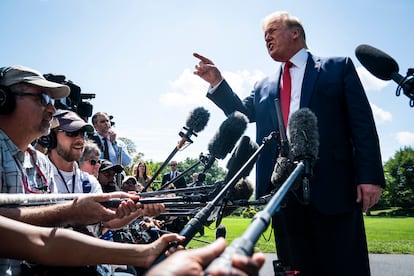

The sudden ban on covering the White House imposed by Donald Trump against several outlets he considers hostile to him —CNN and MS NOW (formerly, MSNBC) and the digital site Politico— has landed like a cold bucket of water for the journalists who routinely cover the office of the world’s most powerful leader.
The ban entered into force on Saturday, when the Secret Service took away the press pass of the MS NOW reporter and cameraperson, barring them from entering the grounds. The same thing happened later to their colleagues from CNN. And the president has warned that he might extend the measure to other news outlets that displease him, such as The New York Times and The Washington Post.
It is not clear whether the prohibition will be enforced and, if so, to what extent: whether it will affect access to the entire complex —including the workspaces the affected outlets occupy in the press area— or only convocations inside the Oval Office and other official-use spaces. The Republican has warned he could extend the measure to other outlets he disagrees with, including the New York Times and the Washington Post.
It is an unprecedented step in U.S. history. Although there have been isolated cases of specific journalists being deprived of their White House access, never had a president gone so far as to ban an entire outlet. The move appears to be in clear violation of the First Amendment, and the media are getting ready to present a legal challenge.
An absolute ban would be an unprecedented step. Although there have been isolated cases in history in which an individual journalist’s permanent press pass to the complex was revoked, never before has a U.S. president gone so far as to bar a news organization from access —a measure that, on its face, appears to infringe the freedom of the press enshrined in the First Amendment to the U.S. Constitution. News outlets are already preparing a wave of lawsuits to challenge the move.
Speaking from the Oval Office shortly after his announcement, the president said: “It’s a very simple ban.” “I don’t want them in my office, I don’t want them here… I would say the ban will go as far as it can go.”
Although in his statement the president said the ban on reporters from the news site Politico and the TV networks CNN and MS Now was effective “immediately,” in the hours following the announcement the affected reporters continued to work in the press facilities in the West Wing of the White House.
“CNN stands fully behind our White House team and their fair and accurate reporting. We have a right under the U.S. Constitution to do that reporting without hindrance or interference from the government,” the cable network said. The outlet, long a target of the president’s ire, has hired First Amendment specialist Ted Boutros to challenge the measure if it takes effect.
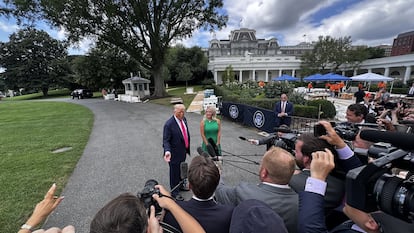
Politico, for its part, said in a statement to The Hill that it will “continue to fairly report on this White House and future ones.” It also rejected Trump’s allegation that it received an illegal subsidy during Joe Biden’s administration and said the allegations have been “throughly debunked.”
Condemnation from the industry
“The president said it plainly in the Oval Office, describing his own planned action as a ‘ban on the free press,’” White House Correspondents Association (WHCA) President Jacqui Heinrich said in a Friday statement. “The Constitution protects the freedom of the press from government interference. That protection does not depend on whether the president likes a news organization’s coverage, agrees with its reporting, or approves of the questions its journalists ask,” she added.
“This is about more than the rights of journalists,” Heinrich wrote. “It is about the right of the American people to receive a full and independent account of the activities, policies and decisions of whoever occupies the nation’s highest office. The WHCA stands in defense of our colleagues at CNN, MSNOW and Politico who are being singled out for doing their jobs.”
The White House Correspondents’ Association represents the professionals who cover the presidency on a permanent basis: roughly 900 journalists from more than 250 outlets around the world.
The dream of the ‘hard pass’
Wearing the “hard pass” —the credential the White House issues to journalists permanently assigned to cover it— and being part of the WHCA is one of the professional pinnacles a political reporter in the United States can aspire to. Achieving it is usually a reward for a long career in the corridors of power in Washington or the ambition of young reporters on the rise.
Those who earn it spend their days in the storied Brady press briefing room, named after Ronald Reagan’s press secretary, James Brady, who was shot in the head in the 1981 attempt on the president’s life by John Hinckley outside the Washington Hilton hotel. It is an iconic space familiar to television viewers —with its podium for the press secretary and U.S. flags in the background— although it is much smaller than it appears, with just 49 seats, all assigned to specific outlets, and its corridors are packed with journalists without seats at every press briefing.
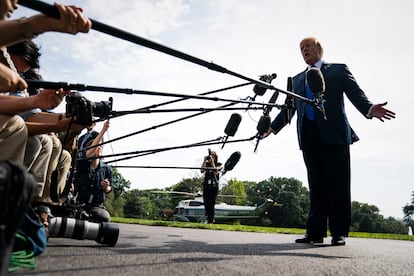
Behind the briefing room is the work area: a handful of desks and booths spread over two floors, where every inch is maximized to accommodate news teams. Tripods, cameras, computers and even a coffee maker —a gift from Tom Hanks that the actor replaces from time to time— fill the space. Because the White House is a historic, protected building (in theory at least; in practice, Trump has demolished the East Wing and is building his grand ballroom there) that tiny area, built over F.D. Roosevelt’s old pool, cannot be altered.
A sacred institution: the press pool
The small size of the spaces gave rise to one of the most sacred institutions inside White House media: the press pool. Every public event by U.S. presidents must have public eyewitness coverage by the press. But the capacity of some of the president’s most common workplaces, whether the Oval Office or the Roosevelt Room, is very limited. For that reason, each day and on rotation, a group of reporters (which always includes at least two television crews, photographers, a radio station and a print outlet) is assigned to represent all the others. When a foreign dignitary visits the White House, a foreign journalist who is a WHCA member—generally a citizen of the visiting state or region—is also included.
That group, or “pool,” is responsible for transmitting the images, audio and video of what happens, and for producing brief reports that include the event’s most relevant facts, the president’s statements and color details that help the other correspondents file their stories. If the president travels to another location, they travel with his entourage, at the end of the long caravan of vehicles that escort the Beast, the presidential limousine. If he travels outside Washington on Air Force One, they accompany him in the press seats at the rear of the plane and attend each of his official or campaign events.
This is not the first time incidents have occurred in such a complex, highly visible relationship between the U.S. president and the journalists who cover him. George Washington already mentioned “false reports.” Theodore Roosevelt attempted to ban reporters who wanted to cover the times his barber shaved him. The Obama administration revoked the hard pass of then dean of the correspondents Helen Thomas over comments it considered antisemitic. That Democratic administration also barred FOX from certain Treasury Department briefings.
But no president has attacked the press as frequently and deliberately as Trump. The current White House occupant barred the Associated Press from the pool because the outlet declined to adopt the name change from Gulf of Mexico to Gulf of America that the Republican decreed early in his term. Since then there have been other blows: from withdrawing funding for public media —or even nearly shutting them down, as in the case of Voice of America— to filing lawsuits against private outlets.
Derogatory remarks
Trump has also frequently launched derogatory, highly personal attacks against reporters he dislikes, especially women, on social media —the New York Times reporter Maggie Haberman, considered the premier chronicler of his administration, is one of his frequent targets— and in person.
One of his most memorable outbursts was his “shut up, piggy” remark to Bloomberg reporter Catherine Lucey aboard Air Force One. His administration has sent FBI agents to some journalists’ homes to serve them with subpoenas. And his press office has stripped the WHCA of the once-sacrosanct right to organize pool rotations, inserting sympathetic communicators into that group at the expense of traditional outlets.
“Someone needs to explain to President Trump how the First Amendment works,” Tim Richardson, PEN America’s program director for journalism and disinformation, said on Friday.
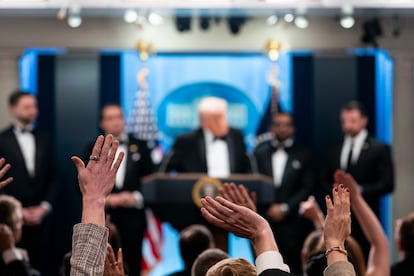
This past weekend the president spent time away from the White House at the presidential retreat Camp David in Maryland. He was, of course, be accompanied by the pool. But the previously agreed rotation did not include any of the banned outlets.
Sign up for our weekly newsletter to get more English-language news coverage from EL PAÍS USA Edition









































