
Crypto giants flood the Republican Party with money despite failure of the Clarity Act
The industry is the top donor in the midterm elections, with tens of millions for various candidates in the expectation Trump will maintain his support for the sector
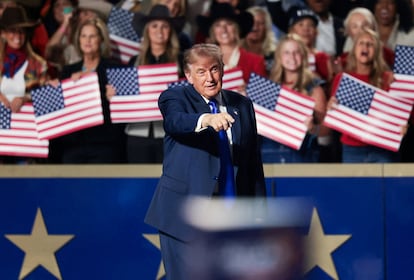
In July 2024, during a crypto conference held in Nashville, Donald Trump vowed that if he returned to the White House he would turn the U.S. into the crypto capital of the world. Two years later, the largest market for digital assets still lacks a law to regulate the industry, while Europe has had one since December 2024. On Tuesday, the Senate blocked the progress of the Clarity Act yet again, citing insufficient safeguards to prevent public officials — including the president himself — from benefiting from their crypto businesses. Despite the legislative setback for a bill that includes many of the industry’s proposals, the sector has not lost faith: crypto firms and entrepreneurs continue to pour money into Republicans and pro-crypto candidates ahead of the November midterm elections.
The bill, stalled in the Capitol, seeks to clarify that business and to split oversight between two federal agencies: the Securities and Exchange Commission (SEC) and the Commodity Futures Trading Commission (CFTC). The law also promises to provide investor protections and define companies’ obligations.
After clearing the House last summer, only the Senate vote remained for the Clarity Act to become law. Just as the bill’s path seemed clear, the release of Trump’s financial disclosure — which revealed $1.4 billion in revenue from his crypto businesses during the first year of his second term — set off alarm bells among opponents. Democrats regard the ethical provisions in the bill as insufficient because they might not apply to Trump, who launched his crypto ventures before his reelection. After months of negotiations, Tuesday’s vote ended in defeat for Republicans, with 49 votes in favor of advancing the bill and 50 against. No Democrat backed the bill’s advancement, and four Republicans joined them, thwarting the goal of reaching the 60 votes needed to clear the procedural hurdle.
This latest failure is a setback for an industry that hailed Trump as a savior after years of frustrated hopes under a skeptical administration and regulators. The president himself has since become one of the biggest obstacles to regulating the sector, but the industry has doubled down on its bet. In the current campaign cycle, the sector has spent $206 million to support candidates from both parties, both through direct candidate donations and through political action committees (PACs) such as Fairshake, Stand with Crypto Alliance, and Digital Freedom Fund. No other economic sector, including the artificial intelligence industry, spends as much on campaign contributions, according to a Public Citizen analysis based on data from OpenSecrets and the Federal Election Commission.
The main crypto super PAC is Fairshake, founded in 2023 with funding from Coinbase and Ripple. It spent $133 million in 2024, according to OpenSecrets. In this election cycle, which will take voters to the polls on November 3, it has been seeding millions into contests across the country. In Alabama it spent $9.8 million to support Republican candidate Barry Moore, according to AdImpact, a website that monitors how political “dark money” is spent on campaign ads, and how much of it. In Iowa, the beneficiary was Zach Nunn, also a Republican and pro-digital-currency, for whom it paid to run an AI-generated ad defending family values.
But they were not alone. A recent Financial Times article revealed that a handful of U.S. billionaires have mobilized to fund the Republican electoral push. Beyond Coinbase and Ripple, companies such as Crypto.com, venture capital firm Andreessen Horowitz, and brothers Tyler and Cameron Winklevoss, founders of the Gemini crypto exchange, also appear on the list.
Elon Musk, also a staunch supporter of digital currencies and who set records in the 2024 presidential cycle by contributing about $290 million to Trump’s campaign, is expected to spend roughly $100 million this time. The billionaire’s shell entity, America PAC, injected funds into key Senate races in August — including Ohio, Michigan, Iowa, Maine, New Hampshire, Texas and Alaska — as well as into critical House of Representatives contests, according to a report filed with the Federal Election Commission on September 2.
In the background is the controversial Supreme Court ruling Citizens United, which in 2013 allowed companies to pay politicians so those officials would later conveniently represent their interests in the Capitol. Emerging industries like digital assets and artificial intelligence have in recent years been occupying a space traditionally dominated by Wall Street.
‘Cryptobros’ flaunt their influence
The path of the Clarity Act had already exposed the growing political weight of the cryptocurrency industry. Earlier this year, a battle erupted between big banks and the crypto sector: the flashpoint was the possibility that stablecoins (cryptocurrencies pegged to the dollar) could offer yields to their users. While banks saw unfair competition with their traditional deposit business and risks of capital flight, part of the crypto industry viewed it as a matter of survival. In an unusual show of force, Coinbase walked away from negotiations and the Republican Party responded by revising the proposal.
Now it is Trump himself who has again complicated the bill’s prospects, putting its future in doubt and making the chance of winning approval before the November elections — in which Republicans could lose control of the Senate — seem increasingly remote. “The Clarity Act would have shielded the industry from political swings and changes in administration,” analysts at Bernstein say.
As a result, the industry is already looking for shortcuts: “We can’t wait on Congress anymore. The SEC and CFTC have the tools they need to create clear rules under existing authority, and I expect will begin working on this in earnest,” Brian Armstrong, Coinbase’s chief executive, said on X. Since Trump’s return to the White House, both agencies have dismissed or shelved dozens of lawsuits against crypto companies alleging market-law violations.
Sign up for our weekly newsletter to get more English-language news coverage from EL PAÍS USA Edition









































