
CJNG cartel leader’s birth certificate reveals previously unknown details about his origins in California
After El Mencho’s death, his stepson Juan Carlos Valencia González became the new boss and the DEA’s most wanted fugitive. He was born in a private facility in a suburb of Los Angeles
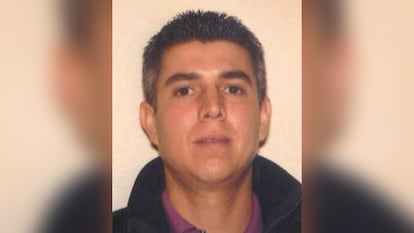

In the fields designated for the father’s information the abbreviation “N/A” appears, for “Not applicable.” That is how the name Armando Valencia Cornelio, one of the founders of the Milenio Cartel, is recorded. The newborn listed on that birth certificate, issued by the state government of California, was Juan Carlos Valencia González. Four decades later he would become the first head of a Mexican drug-trafficking organization — the Jalisco New Generation Cartel (CJNG) — born on U.S. soil, a huge paradox in light of the anti-drug rhetoric of the Donald Trump administration.
The Michoacán native Rosalinda González Valencia, then 21, chose to register her first child as a single mother. As shown on a copy of the capo’s birth certificate obtained by EL PAÍS, the document recorded his name as Juan Carlos Gonzalez (without the accent), a name that over the years would be added to the list of aliases authorities attribute to him, including “R3,” “El JP,” “03,” “Tricky Tres” and “Pelacas.”
A clerical mistake or an inadvertent tangle in the California civil registry also ended up altering Rosalinda’s identity, an anomaly that would complicate locating her in records. “Valencia” was entered as if it were her middle name and “González” as her paternal surname. She left the record as it stood.
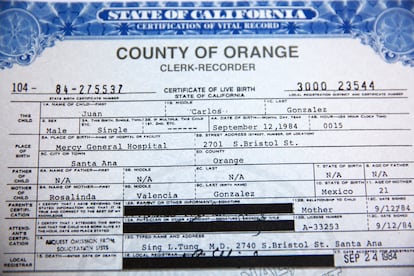
Rosalinda’s firstborn was delivered at 12.15 a.m. on Wednesday, September 12, 1984. The birth took place at Mercy General Hospital, a private medical center in Santa Ana, a suburb about 30 miles south of Los Angeles. That year 1,215 babies were born there.
The hospital, located on Bristol Street and today known as South Coast Global Medical Center, served both patients able to pay their bills and low-income families who relied on public assistance programs. It was an era of overcrowded maternity wards in Orange County as birth rates rose, a trend attributed to the arrival of Mexicans and other Latino immigrants whose presence would transform Santa Ana’s demographics. At that time, Republican George Deukmejian governed California and Ronald Reagan occupied the White House.
The mysterious childhood of ‘R3’
Juan Carlos Valencia González’s birth certificate would be the last public record of him found in Orange County files. From 1986 onward, Rosalinda gave birth in northern California — in San Francisco — to the three children she had with Nemesio Oseguera Cervantes, “El Mencho,” founder of the CJNG. It is possible that R3 spent his early years with his mother, stepfather, and half-siblings in the Bay Area. What happened during that period remains a mystery.
While El Mencho took his first steps in crime selling heroin in San Francisco and served two prison sentences for that offense — he was arrested in 1986 and 1989 before being deported — Rosalinda eked out a living however she could. “My jobs were in the fields, in packing plants, cleaning houses, babysitting and in restaurants. All so I could get by,” she wrote in a letter sent to a Washington, D.C., court, in which she recounted that she had emigrated to the United States at age 14.
Decades later, at the peak of El Mencho’s reign, that family and its associates had built an extensive business network in Mexico that included hotels, restaurants, tequila distilleries, gas stations, and even a children’s shoe business. The DEA estimated the drug lord’s fortune exceeded $1 billion and ranked him among the richest criminals in the world.
The schooling path of R3’s stepsister, Jessica Johanna Oseguera González, offers a clue at to where part of his adolescence may have been spent. According to school diplomas for El Mencho’s daughter that are included in her court file, she completed primary school in the summer of 1998 at Amalia Solórzano de Cárdenas school in Apatzingán, Michoacán. At that time Juan Carlos González Valencia was 13. In 1999 she was enrolled at Castle Park Middle School in the border city of Chula Vista, California. In 2000 she was registered at Colegio Inglés junior high in Tijuana, Mexico, where she finished her studies and went on to high school. But by 2001 Jessica Johanna had returned to southeastern Mexico: she was enrolled at Instituto Ausubel high school in Morelia, Michoacán, where she attended until the fourth semester. In the 2004 school year she was at Jefferson High School in the same city.
A California-made capo
After his birth certificate, the next public record of the new CJNG leader in southern California archives appears in March 2011. Aged 26, he paid $250,000 for a 19,468-square-meter ranch in Hemet, a property now valued at $695,000. In the Riverside County register reviewed by EL PAÍS, the capo’s name appears as it does on his birth certificate: with only his mother’s surname.
In late July the Trump administration initiated proceedings to seize the estate as part of sanctions previously imposed on Valencia González by the Office of Foreign Assets Control (OFAC). But the Justice Department is going further. The indictment filed in a District of Columbia court — which charges him with conspiracy to manufacture and distribute cocaine and methamphetamine, as well as firearms offenses — warns that the government will seek to forfeit any assets R3 acquired with proceeds from drug trafficking.
The new CJNG boss has plenty of relatives in southern California: uncles, cousins and nephews who live or have lived in Santa Ana, Anaheim, Orange, Garden Grove, Lake Forest, Laguna Niguel, San Jacinto, Hemet and Riverside. Some have been under the DEA’s scrutiny for several years.
R3 effectively abandoned his Hemet ranch and left it in the care of his maternal uncle, José María Valencia González, to throw himself fully into organized crime in Mexico. He first led a unit of hitmen known as Grupo Élite and, as of last February, took the helm of the CJNG after his stepfather, El Mencho, was killed during a military operation in Tapalpa. “He stands out the most among the cartel’s regional leaders,” Mexico’s secretary of public security, Omar García Harfuch, said at a press conference on September 4.
A $25 million reward, one of the largest offered for any drug trafficker, has been placed on this California-made criminal who leads the CJNG. For the DEA, R3 is currently its top target.
Sign up for our weekly newsletter to get more English-language news coverage from EL PAÍS USA Edition









































