Jon Savage, music critic: ‘Being a straight man seemed boring to me, hence my interest in punk’
In his latest book, ‘The Secret Public,’ the writer blends his vast musical knowledge with the LGBTQ+ reality, the fight for equal rights, as well as his own identity


Jon Savage is an absolute musical icon. This 73-year-old journalist, critic and writer is a key figure in the history of British (and global) punk, as demonstrated by his book, England’s Dreaming: Sex Pistols and Punk Rock (1991), which delved into the pioneers of the genre.
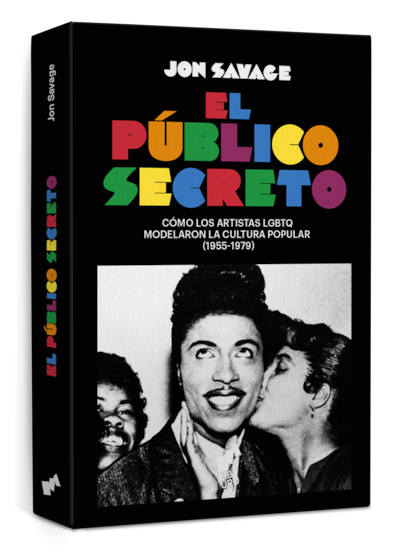
The London-born Savage is also gay. And, in his latest and most impressive book — The Secret Public: How LGBTQ Resistance Shaped Popular Culture (1955-1979), published in 2024 — he brings together his deep knowledge of music, his own identity, LGBTQ+ experiences and the struggle for equal rights.
“This book has been on my mind for decades,” the author tells EL PAÍS in a video conference, “but when you get older, you want to get things done.”
Although he identified as gay at the age of 20, it took him some time to come out. “When I was young, being gay was marginal. And, you know, it still is for a lot of people. Gay people were treated like shit — that’s something that scars you,” explains Savage, who admits that it took him a long time to overcome all that negativity.
Growing up, Savage liked Del Shannon’s melodramatic pop. The Beatles’ long hair also made an impression on him. He was captivated by The Rolling Stones’ aesthetic. And he was fascinated by The Kinks, particularly Dave Davies and his androgynous style. “I was very attuned to that kind of gender divergence. Partly because I thought being a normal heterosexual man just looked really boring.”
Q. How did being gay fit into the music press of the late-1970s?
A. I was always clear that I wasn’t going to pretend to be straight, but I also didn’t live as a gay person. Keep in mind that it’s been about 50 years. A good friend in the industry, Jane Suck, was a lesbian. We were quite close, [but] we never talked about our sexuality. It wasn’t easy back then. But I think if you regard writing as the expression of a person, then of course, your sexuality is going to be involved with it. I mean, how can it not be? And so, it made me take a different path from all of my contemporaries [on the punk scene]. I always wanted to go deeper. I was always interested in the marginal.
Q. In your book, you write about a queer subtext in music. How did the LGBTQ+ audience decipher it?
A. In the 1950s, it was difficult to establish this. [But] in the first chapter, which is about [Andy] Warhol — where I mention [the covers of] his records — I discuss [how, in the 1960s, he tried] to establish a kind of queer aesthetic of pop culture, the earliest that we’ve really been able to find out about. Before that, we can talk about Elvis and his imitators, a bit of doo-wop, as well as some Black music.
I connected the dots by talking to my friends: Robert liked soul and girl bands; James, early Motown. My friend Michael Peter Burton, who’s now dead, ran a gay bar called The Deuce that had a jukebox. One day, I asked him what was playing on it: it was all Motown [Records] and Dusty Springfield. Motown was, obviously, very good for dancing — it was the precursor to disco, with melodramatic lyrics. That went down very well with gay people, who liked a bit of melodrama, heightened emotion.
Springfield, of course, was the leading lesbian pop singer of the day. And, more important than that, she was a truly wonderful, wonderful artist.
Q. You start things off by looking for hidden connections in the song Tutti Frutti, before arriving at the homoeroticism of the Village People…
A. You have to be careful about this, because Victor Willis’ wife sues anybody who hints that the Village People were gay. They were conceived by a gay businessman, Jacques Morali and it shows. Felipe Rose, the one who dressed as a [Native American], walks into a gay bar and starts dancing in front of a cowboy. And the first LP has a cover that’s set in the entrance of a gay bar. There are no women and all the men who appear are stereotyped as gay: they’re clones. They became a gay caricature.
The more successful they became, the more they disavowed those references. When In the Navy [from their fourth album, Go West in 1979] was released — following YMCA [from their third album, Cruisin’, in 1978] and Macho Man [from their second album, which also came out in 1978] — they’ve almost completely disavowed any kind of gay content. Even though they’d built a following among gay audiences, they were now appealing to the mass market, to the mainstream.
Sylvester did make a statement about diversity: he was completely out and fabulous. He was the first openly gay singer to have a big hit: You Make Me Feel (Mighty Real) is a wonderful and important song in its own right, because it’s all about being gay. It’s about people being real, as opposed to having to hide in the closet.
Q. And what are your thoughts on David Bowie?
A. Bowie became an overwhelming cultural force that facilitated the expression of LGBTQ+ diversity and visibility, but he was never an activist like Tom Robinson was. Even though he may have had some activist effect, Bowie was mischievous and calculating: he realized that he could make an impact and wanted to foster cultural change. He played a benefit for the Gay Liberation Front, but then, when he came out as gay — with that famous 1972 line, “I’m gay and always have been” — he didn’t say that he was a member. He never officially aligned himself with it. Personally, Bowie had a great impact on me, particularly the song Queen Bitch (1971). It was a Velvet Underground tribute and I’m a huge Velvet Underground fan.
Q. Your book is about music, but also about history, about rights and about struggle.
A. I’m not interested in talking about music in terms of personal experience. So many people who write about music do that and it’s really tedious. You can talk about music in more gossipy terms. A book about the Rolling Stones practically writes itself, thanks to all the scandals surrounding them.
In The Secret Public, I don’t just tell a story: I describe a time and place through music and specific bands. That’s why it seemed crucial to include the entire political, social and legal context in the U.K. and the U.S. It’s more or less the same thing I did when I wrote the book about Joy Division [This Searing Light, The Sun and Everything Else: Joy Division, The Oral History, published in 2019]. All that context enriches the book.

Q. At one point, you explain how white boys felt intimidated by the “insidious and unconventional sexuality of disco music.” Is something similar happening now with feminism and LGBTQ+ rights?
A. Yes. Any gain made by LGBTQ+ people provokes a backlash. It’s always been that way. We’ve seen enormous gains during the last 20 years, and now, we’ve got a fierce reaction. To be honest, it’s really pathetic. LGBTQ+ people are a reality. Deal with it. All the backlash seems unpleasant to me; it reveals a lot of insecurity. And it’s dangerous.
Nobody takes into account the overwhelming privilege that a lot of white people have. Obviously, if you’re poor, you have less. But generally speaking, a white man always enjoys more privilege than a woman, a person of color, or an LGBTQ+ person.
It’s foolish to think that expanding rights can harm anyone. That kind of backlash is being fueled by dictatorial regimes, like Putin’s Russia, or Trump’s USA. All Americans have internalized homophobia, a certain fear of homosexuality. If someone is so worried about seeing two men or two women kissing, they shouldn’t look. If they’re afraid that seeing a gay or lesbian couple will turn their children gay, they shouldn’t worry, because they will see many more heterosexual couples doing it and they can become straight again. Those arguments are complete nonsense.
Q. What would be your current LGBTQ+ musical reference?
A. I have to qualify this by saying that I’m no longer, you know, on the ground. But the kind of music I listen to is electronic music. I really enjoy what [the German record label] Kompakt releases and I love Pet Shop Boys.
When I was 16, I was a rock fan. I moved on to the Velvet Underground and also to hippie groups. And I think that I’ve come to appreciate disco much more, because, back in the day, you weren’t supposed to like disco if you were a punk rocker.
In 1977, I was writing about punk every week. And, at one point, it all seemed a bit repetitive to me. But then, I listened to two albums that blew me away: I Remember Yesterday (1977) — a masterpiece by Donna Summers and one of the greatest albums of the 20th century — and Magic Fly (1977) by [the French band] Space. That’s how I started writing about the beginnings of disco.
The problem was that a lot of the disco you heard, particularly in 1978, had already become very formulaic. And it was the electronic disco that was becoming interesting. Patrick Cowley was a genius: he has a megamix of I Feel Love [by Donna Summers] that’s incredible.
Q. You also write about the invisibility of lesbians. Do you think that has changed?
A. Young women — and women in general — are much more at the forefront of the music scene than they were, say, 50 years ago. But there’s also a backlash against this. In the book’s title, I refer to the entire community, because lesbians, gay men, trans people, bisexuals, queer people, all of them appear in the book.
One of my greatest sorrows today is how trans people are being attacked, especially in the U.S., but also in the U.K. It reminds me of what they did to gay people [during the AIDS crisis]. It’s disgusting and there’s no excuse for it.
Q. The book ends in 1979, dancing with Sylvester, “with no thought of what is to come.” It was the prelude to the AIDS epidemic and the conservative backlash against sexual liberation. Why did you stop there?
A. I didn’t want to write about AIDS, because it was a horrible and dark time. When you write a book, you have to focus on the subject. I decided to end the book with Sylvester and the National March on Washington for Lesbian and Gay Rights. The story could continue into the 1980s, which was a very rich decade: you had Culture Club, Bronski Beat, Soft Cell, the Pet Shop Boys… but that’s for another book.
If the ending leaves you wanting a bit more, maybe it’s a beautiful ending.
Sign up for our weekly newsletter to get more English-language news coverage from EL PAÍS USA Edition