
A sex ritual on stage and smoke bombs in the stands: 50 years of The Rolling Stones’ first concert in Spain
Held at a tortuous moment for the band and a critical juncture for the Spanish democratic transition, the band played at Barcelona’s Plaza de Toros Monumental as part of a hectic European tour

They are still the representatives of the other God on Earth. Half a century ago, Their Satanic Majesties visited Spain for the first time. A decade after The Beatles’ concerts in a country still under Franco, The Rolling Stones played at Barcelona’s Plaza de Toros Monumental. These were different worlds. The posh audience that showed up for the four young men who sang in suits had been replaced by a more apathetic, pot-smoking youth, as an amateur recording shows. On June 11, 1976, the Spanish Transition was undergoing a critical moment: Franco had died in November, King Juan Carlos I had returned from a consequential trip to the United States, and Carlos Arias Navarro was languishing as prime minister. The concert captured something of the zeitgeist, a decadent glamour in a country that until then had been excluded from the major global tour circuit.
On June 10, arriving from Lyon, where they had played on the 9th, the private plane carrying the Stones landed at El Prat airport at 11.30 pm. They passed through no security controls whatsoever. The musicians and their entourage went to one of Barcelona’s best hotels: the Princesa Sofía —which had opened the previous year and was the city’s second five-star hotel. Mick Jagger and Keith Richards were 32, bassist Bill Wyman 39; drummer Charlie Watts 34, and newly added guitarist Ron Wood 29. The most important active rock band in the world was going through a bad patch. Objectively dreadful, really.
After a memorable start in the 1970s —Sticky Fingers (1971) and Exile on Main St (1972), released just months apart— the Stones were experimenting with other aesthetic directions without much creative success. With Black and Blue, which hit record stores on April 23, 1976, it seemed they had bottomed out. It was not only a musical issue. They were still in court with Allen Klein, their former manager; they had troubles with the British tax authorities, their drug problems were increasing, and the guitarist Mick Taylor had left the band, disillusioned by the secondary role Jagger and Richards assigned him in songwriting and convinced he could only break free by quitting. But after recording in several studios across different countries, they had a new album out. It was so-so, but it was new.
Before Black and Blue was distributed, their tour manager Peter Rudge announced a European tour: 41 shows in 22 cities. They began rehearsals in mid-April (Richards missed the first days) and by the end of the month played the first shows of the tour in Frankfurt. Half a century on, the tour can be reconstructed with notable precision. Pirated recordings are on YouTube, the entire show from Paris on video, and even a documentary by British television.
A concert at a sky-high price
The promoter of the concert in Spain was Gay Mercader. His initial idea was to find a venue for 25,000 to 40,000 people and his first idea for a location was a rural site near the holiday town of Salou. The mayor didn’t object, but the local farmers opposed it for moral and agricultural reasons: they requested a report from the Organización Sindical of Canet —where a legendary rock festival had been held the year before— and it became clear that these hippy types shamelessly stole fruit from the fields surrounding the festival. Organizers then considered the Las Arenas bullring, but finally it was the Monumental at a very high price for the time: 900 pesetas (equivalent to €5.41 or $6.26). It did not sell out. Only about 11,000 tickets were sold, many at the box office the same day. Mercader lost three million pesetas.
For Keith Richards it was a tragic tour. After one of the London concerts he fell asleep at the wheel. The accident was not the only problem. When the police showed up he was fined for possession of marijuana and cocaine. And worse was to come. Before the Paris concert he learned that his premature baby had died of sudden infant death two weeks after birth. He chose to perform that night, convinced he would have nowhere else to go. The tour’s end might also have been dramatic for Jagger. One night in New York, according to music executive Marshall Chess, the singer overdosed on heroin in his apartment.
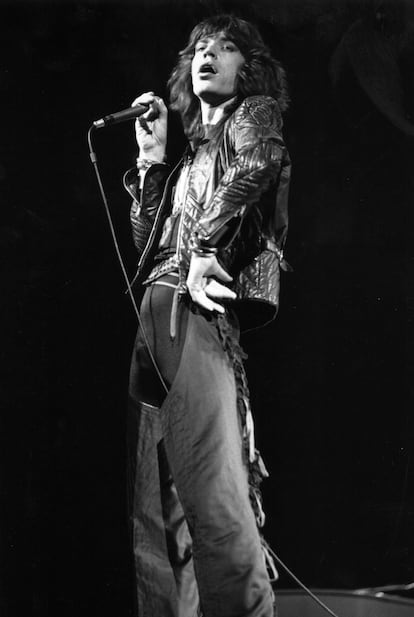
The band lived in that kind of chaos, but the Barcelona concert was chaotic in another way too. There were police charges inside and outside the venue, bottles thrown from inside at the police, who responded by launching a smoke bomb that caused scenes of panic. Although Friday, June 11, 1976, is the date that entered local rock history, the pivotal events began about 20 minutes after midnight that night. In Moncho Alpuente’s review for EL PAÍS, it was “an uninhibited game in which the sexuality and provocation emanating from Jagger at the microphone took on an almost ritual value, like symbols of a primitive, liberating dance.”
The show lasted about 90 minutes and the setlist was the tour standard. They opened with the classic Honky Tonk Woman. The first part of the set was devoted to songs from the 1970s, with a special presence from Black and Blue. Musically notable was the ballad Fool to Cry, which Jagger sang seated at the piano. In the lascivious and controversial Star, Star —dedicated to a groupie and originally titled Starfucker— the penis-shaped balloon that appeared in the performance could not be seen.
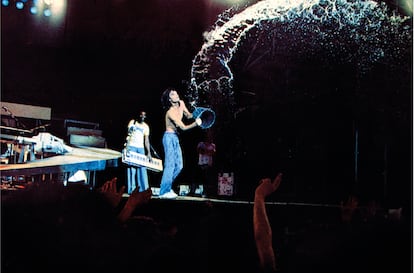
After singing Hand of Fate, Jagger greeted the crowd in the Catalan language he had learned in the dressing room: “Bona nit a tothom (Goodnight to everyone).” The second half featured the 1960s classics, with Angie, the version of Happy sung as always by Richards, plus a couple of pieces that showcased pianist Billy Preston, a key supporting musician at that moment for the band’s musical evolution. They closed with Street Fighting Man and the bucket routine: Jagger threw buckets of water at the audience, some filled with confetti toward the band, and the last one he threw at himself. There were no encores. No Satisfaction. No sympathy for the devil.
The evening’s variations were broadcast over the PA. Before the Honky Tonk Woman guitar riff was heard, Jagger decided to have the hackneyed bullfighting pasodoble from the opera El gato montés by Manuel Penella play faintly in the background. A minute after the concert ended, while the audience chanted “otra, otra,” (encore, encore) the reverse of the opening melody sounded: the patriotic Catalan sardana La santa espina. Beers cost 30 pesetas and sausage sandwiches 50 pesetas. It would be six years remained before they returned. That was on July 7, 1982, the day of a Biblical flood in Madrid.
Sign up for our weekly newsletter to get more English-language news coverage from EL PAÍS USA Edition









































