
Martín Rodrigo Alharilla, historian: ‘The best-known slaveholding families in Catalonia are only the tip of the iceberg’
The expert is studying the economic benefits that the slave trade in the Spanish northeastern region generated in the 18th and 19th centuries
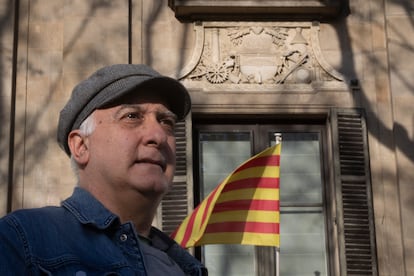

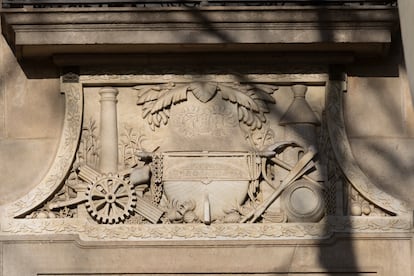
“Look, those two buildings were owned by slave traders,” the historian Martín Rodrigo Alharilla, 57, says offhand while walking through Barcelona’s port area. He continues the route along La Rambla and points out a bas-relief showing chains, ropes, sugar canes and a chimney. The building that displays it on its frontispiece houses the Generalitat’s Department of Culture. “It was built at the end of the 18th century and later bought by Tomás Ribalta i Serra, an indiano (a Spaniard who emigrated to the Americas) with business in Cuba who likely ran a slave-trading factory in what is now Nigeria. An extremely wealthy man who spent his time here living off his income,” the professor explains; he curated the exhibition La infamia, la participación catalana en la esclavitud colonial (The Infamy: Catalonia’s Role in Colonial Slavery), which was shown at the city’s Maritime Museum and is now available online for consultation.
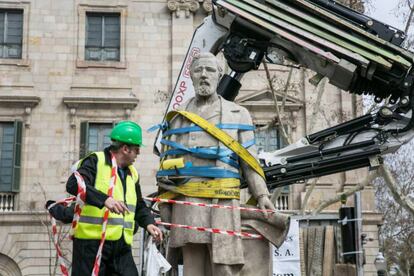
On his tour he passes a plinth, now missing the sculpture of Antonio López y López, the marquis of Comillas: “The only statue in all of Spain to have been removed because the figure depicted was a slave trader.” He turns the corner by the former home of another trafficker who organized two brigantine slave voyages to the Americas. “Pedro Gil Babot lived here; he was a founder of the old Catalan Gas Lighting Company, today Naturgy. Three of the seven founders of that company were slaveholders,” he says. Step by step he maps the city with countless surnames, dates, figures and marriages that, according to his research, generated fortunes in Catalonia and Spain at the cost of the freedom, suffering, and forced labor of thousands of Africans in the 18th and 19th centuries. Two years ago he launched the project España Esclavista (Slave-owning Spain), a website on which he says he and a team have geolocated 220 tangible sites of this past — sites barely covered in textbooks but that shaped the future of the country and the African continent. That initiative was also selected for the Western Europe map on colonial memory shown in the House of European History’s exhibition Postcolonial? in Brussels.
“Today there are migrants who currently have fewer opportunities, but it must be understood that Western wealth is largely explained by slavery and colonialism. They are extractive activities. Capitalism in many territories developed through slavery,” he says at the Maritime Museum of Barcelona after explaining the exhibition. He notes that no politician from any party attended the opening, though he welcomes that the Barcelona provincial council took the initiative to promote it. “What matters is opening the debate. Work like this feeds reflection and invites people to think that social differences were built on this past. And what remains now is racism and inequality.”
This March the UN adopted a resolution declaring the trafficking of enslaved Africans and the racialized enslavement of Africans as “the most serious crime against humanity” in history, involving millions of victims over a period of 400 years. The text was backed by 123 countries, but those in the European Union abstained, and the U.S., Israel, and Argentina voted against it. “It is a carefully worked resolution and speaks of restorative justice, restitution, imprescriptibility, guarantees of non-repetition, compensation… That may explain why Spain and other slaveholding powers abstained. They may be afraid of facing these kinds of claims,” he says.
Although the text is not binding, Rodrigo sees this document as necessary and believes it could have legal implications. “It is another step toward seeking validation of this shameful past,” the professor explains. He describes the plantations where thousands upon thousands of enslaved Africans were forced to work in Cuba — amid the tropical heat, the smoke from the chimneys, and the physical strain — as “hell.” “Imagine what it must have been like. Moreover, one of the harshest realities is that most of them were men, so there was hardly any population growth. This was more like genocide. They would die, and more would be brought in from Africa,” explains Rodrigo, standing before a canvas that recreates these plantations, which enabled their owners to amass immense wealth.
In his research, he finds a legacy that is still palpable today: the acquisitions of urban expansion projects, buildings, and theaters; the founding of banks and lending institutions; annuities, inheritances… “The best-known slaveholding families in Catalonia, such as the marquis of Comillas’s, Joan Güell’s, Vidal-Quadras’s or Miquel Biada’s, are just the tip of the iceberg,” he says. He admits a personal determination to bring many more surnames to light. “But it’s not about pointing fingers at people; it’s because one must understand that slavery was an entire structure that moved huge wealth,” he says.
And indeed, the recent Maritime Museum exhibition listed long rolls of names identified as captains who commanded slave ships to the Americas, shipowners who organized human-trafficking expeditions, and many others involved. “Catalan traffickers who owned or managed factories on the African coast included José de Bérriz, Francesc Canela, Pau Freixas Ribalta, Pere Manegat, Domènech Mustich, Pere Sala, Francest Riera, Cristòfol Roig Vidal and Bonaventura Vidal Calzada,” one of the exhibition labels reads.
Although the practice was sanctioned by law, in Cuba it ceased to be considered legitimate de facto in 1886. “But the activity continued for some time with a degree of impunity,” Rodrigo says. He illustrates this conduct in the recent book La bisabuelita. Género, esclavitud y finanzas entre Cuba y Barcelona (The Great-Great-Grandmother: Gender, Slavery, and Finance Between Cuba and Barcelona), written with Lisa Surwillo, a professor of Iberian literature at Stanford. The research is based on the unpublished manuscript of Mercedes Llopart Xiqués, who recounts the life of her mother, Manuela Xiqués Romagosa, married to Roque Llopart Asúa. The book narrates that this Catalan organized slave-trading expeditions in the 19th century and amassed a fortune with which his wife later bought properties in the city. “It has been exceptional that I could obtain that first-hand family material. Normally I have no connection with slaveholding dynasties. They usually do not want to talk,” Rodrigo stresses. “I wouldn’t say they try to hide it, but it’s an uncomfortable subject. The response is to try to keep it unknown. Clearly responsibility is individual, but status and opportunities are inherited,” he says.
The Pompeu Fabra University professor regrets that Spain has not in some measure acknowledged this past the way the Netherlands did — whose government apologized in 2022 for enslaving peoples — or the French parliament, which in 2001 recognized slavery and the trafficking of Black people as a “crime against humanity” in the law known as Taubira. “Besides including it in the compulsory curriculum, one could start with symbolic reparations. And with acknowledgement of responsibility by banks or entities that had direct ties to slavery,” he suggests. He proposes funding for scholarships, measures that favor social inclusion and support for racialized people. “There should be financed study programs, exhibitions, debates... I am an activist for the truth, that this uncomfortable and painful truth be known and that it encourages reflection,” he concludes.
Sign up for our weekly newsletter to get more English-language news coverage from EL PAÍS USA Edition









































