
Jake Richards, historian: ‘Emancipation created new forms of inequality and injustice, and we need to learn how to resolve these harms’
After a decade of research, the slavery expert has published a book documenting how thousands of ‘liberated’ Africans fell into forced labor systems and faced legal obstacles in their fight for rights
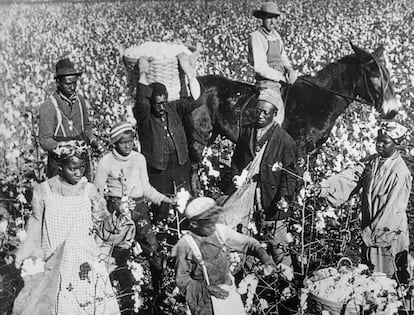

The year 1807, when the British Parliament outlawed the slave trade within the Empire, was not the end of the transatlantic slave trade or the exploitation of some 12.5 million Africans. Rather, it marked the beginning of another little-known chapter in the hell of forced labor and the legal maneuvers endured by the more than 200,000 people rescued — according to the most conservative estimates — by the Royal Navy or other naval patrols between 1807 and 1880 before finally gaining their freedom.
This chapter of history is recounted, drawing on more than a hundred documents, by British scholar Jake Richards, 34, in his newly published book The Bonds of Freedom: Liberated Africans and the End of the Slave Trade. The book has been selected by The Times Literary Supplement as one of the notable titles of 2025. “We need more stories about liberated people and their descendants, about what freedom and justice meant to them,” Richards says in an interview with EL PAÍS from Barcelona, which he visited at the invitation of the Centre de Cultura Contemporània de Barcelona (CCCB).
It took this London School of Economics historian more than a decade to complete a study that shows how, during emancipation, new forms of violence were exercised, and deep inequalities were created — inequalities that still shape Africa and its diaspora today. Now that the U.N. General Assembly has recognized African slavery as “the gravest crime against humanity” and opened the door to legal and economic reparations, Richards hopes that the abuses committed after 1807 against the so‑called “liberated” slaves may also be recognized as harms that warrant reparations.
Question. How well documented was that episode in history?
Answer. Most of the time, scholars place the U.K.’s Abolition Act of 1807 as the end of the story and the triumph of a long abolitionist campaign. But it hasn’t been considered as a starting point for asking what actually happened to the people on board the slave ships. When they were rescued, were they free? How were they treated? What I found is that it took more than 70 years to abolish the transatlantic trade.
Q. How did the process of freeing people from captured slave ships actually work?
A. The 1807 law treated a slave ship as an enemy vessel in a wartime context. This meant that both the ship and its entire “cargo,” including the captive people, were treated as enemy property. When they reached port, they were handed over to a Crown official, who could assign them as recruits to the army or navy, or send them to forced labor in domestic service, agriculture, or building public works for up to 14 years. All these so-called “liberated Africans” had to work to “repay the debt” of being rescued. This is the first time this has been analyzed not only in the British Empire, but also in the Portuguese and Spanish world.
Q. How many archives did you visit, and what did you find?
A. I consulted about 14 archives in the U.K., Sierra Leone, South Africa, Brazil, Cuba, and the United States. Sometimes, I worked with uncatalogued papers. For example, in Havana, I found court cases from the 1860s in which liberated Africans testified in court as survivors, which was crucial for convicting the traffickers. These are incredibly powerful testimonies: people describing how they hid captives or burned ships to destroy evidence.
Q. Another new element in your research is documenting how liberated people joined forces to take their cases to court or to create economic projects that allowed them to gain independence.
A. Liberated Africans never passively accepted their situation; they always had a political agenda, a vision. Although they were no longer technically slaves in their new home and could access the courts, this marked them as a political threat. So the authorities tried to control them to prevent uprisings. Therefore, the “liberated” created forms of economic collaboration to build independent lives. And, often in Brazil and Cuba, women managed to do so more quickly than men. Through domestic service, they demonstrated that they did not need to be subjected to forced labor and that they could be free. They knew they had to prove their independence and obtain documentation to protect their children [because in the Americas, slavery was inherited through the maternal line].
Q. What gaps exist in research on the transatlantic slave trade?
A. We have a very rich literature on the history of slavery in relation to institutions, how it was key to certain businesses. But we need more stories about liberated people and their descendants, about what freedom and justice meant for them. When it comes to thinking about the harms, we shouldn’t limit ourselves to what happened in the era of formal slavery [between the 15th and 19th centuries]. During the processes of emancipation, new forms of inequality and injustice were created, and that needs to be incorporated into our vision of how we resolve them.
Q. Indeed, the U.N. has adopted a resolution recognizing slavery as the “gravest crime against humanity” and proposing reparations. What effects might this have?
A. The question is whether or not the major powers will accede to the demands. That could take a long time. What is significant is that the demand was made on a global stage and that it came from African states. I think that when considering reparations, we must understand that the harm is not limited to formal slavery, but also includes the damage created as part of the abolition process. Secondly, we must consider the damages as multidimensional, because reparations are often perceived as simply an amount of money at stake. But we must also understand consequences such as environmental damage and the lack of access to cultural heritage.
Q. The resolution calls for preserving the memory and promoting academic research on slavery. Do you think this will facilitate access to archives and researchers’ work?
A. I would love to see if this translates into greater funding opportunities for new generations of scholars in places like Sierra Leone, Nigeria, South Africa, and Brazil. There are many scholars writing master’s dissertations and doctoral theses on these topics, and they would greatly benefit from more funding opportunities. Funding is also needed for archival preservation, because these archives are not only for historians but also for the general public. Since I wrote the book, fires in Rio de Janeiro and Cape Town have destroyed documents and collections. Funding for preservation is urgent so that people can have access to the past.
Q. You have also worked in exhibition curating. Have you seen an evolution in the way Western museums address the damage caused by colonialism?
A. The murder of George Floyd and the global Black Lives Matter movements have opened up a very important space for activism, which institutions responded to. Now, in the democracies of the Global North, we are living in an era of political polarization in which certain governments are pressuring against these kinds of investigations and new questions. This space has shrunk in the last couple of years, which is something we all need to be concerned about in any democracy.









































