
Marrying for love of the mafia: ‘Marriages are a governing mechanism’
The study of 900 unions outlines the power network of the various clans of the Calabrian ‘Ndrangheta

When Giulia Immaculata was 13, her parents — members of the Coluccio clan — forced her to break up with her boyfriend so she could marry Cosimo Commisso, nephew of Vincenzo Macrì, who in 2014 was the leader of one of the most prominent clans of the ’Ndrangheta, the Calabrian mafia. The case, extreme as it is, illustrates how, within this organization, marriages go far beyond love; they are a family affair. Now, an analysis of hundreds of marital ties within the group shows that the most powerful families occupy the center of the network. The study, published in the scientific journal PLOS One, also reveals that these marriages strengthen this criminal syndicate and make it more resilient.
The ’Ndrangheta is one of the world’s major criminal organizations. Born in the 19th century among already powerful families engaged in smuggling and goat and sheep theft in the impoverished region of Calabria, in southern Italy, it is now present across the globe and dominates, for example, the international cocaine trade. Unlike other Italian mafias, such as Sicily’s Cosa Nostra or Naples’s Camorra, the organization is built on blood ties among its members, with family clans — the ’ndrine — serving as the basic units of its structure.
By studying 906 marriages involving members of 623 ’Ndrangheta clans, a team of researchers at the University of Milan‑Bicocca has been able to uncover the organization’s underlying structure. Drawing on thousands of judicial documents and records from Italy’s anti‑mafia directorates, they gathered information on roughly 4,500 suspected or confirmed members of the Calabrian mafia, assigning each one a unique identifier. Each family became a node in a network in which marriages served as the connections. In this way, the researchers were able to map the web of marital ties formed over recent decades.
“The first finding is that the most powerful clans are also the most important in the marriage network: they have more connections, occupy strategic positions, and are more closely linked to other influential families,” says Maurizio Catino, a sociologist at the University of Milan and co-author of the research. “The second finding is perhaps the most surprising: it is not only the most powerful clans that hold the network together. On the contrary, alliances between less visible or less influential clans often function as structural pillars.”
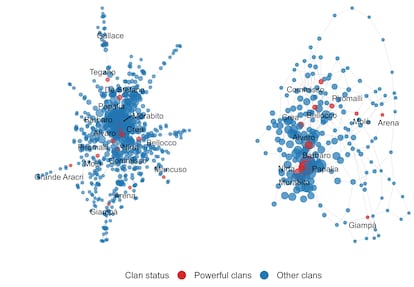
Marriages within the same clan are rare, accounting for barely 5%. But among the most powerful clans, this figure doubles. As seen among social elites, those at the top tend to marry one another more often. In fact, the authors link this mafia practice to the marriage policies of the powerful Medici family during the Renaissance.
The third finding concerns the role of women in a structure that is not only patriarchal and patrilocal — brides move in with the groom’s family — but also deeply hierarchical. “We expected a simpler pattern — powerful clans receiving women from weaker clans — but the reality is more complex,” says Sara Rocchi, also from the University of Milan-Bicocca and co-author of the study. “While powerful clans do receive, on average, more wives, the difference is not statistically significant,” she adds. In fact, everything suggests that the most advantageous positions belong to clans that combine different strategies, both giving and receiving women in marriage.
“Marriages are a governing mechanism in the ‘Ndrangheta,” says Rocchi. Illegal organizations cannot rely on the tools available to legal groups. “They cannot use binding contracts, courts, formal procedures, or transparent rules to regulate cooperation,” she explains. “At the same time, they need to solve very practical problems: who to trust, how to coordinate, how to resolve disputes, how to secure business deals, and how to prevent betrayal.”
The study shows that women — as in Giulia’s case — are assets of the family, albeit passive ones. They do not choose to act as agents in forging alliances. In this social structure, “women have historically been assigned subordinate roles: they are expected to bear children, protect the family’s reputation, and transmit values such as loyalty, silence, and honor from one generation to the next,” recalls Alberto Aziani, the study’s third author.
The Godfather also begins with a wedding. Directed by Francis Ford Coppola in 1972 and based on the novel of the same name by Mario Puzo, the film opens with the wedding of Connie, daughter of Don Vito Corleone (played by Marlon Brando), head of the Cosa Nostra, to Carlo Rizzi. But that’s where the similarities end.
“The ‘Ndrangheta is distinguished by the fact that its basic unit, the ‘ndrina, is not only an organizational unit: it is also a blood family,” recalls Catino, the first author. “Recruitment is firmly based on kinship. The sons of men of honor are considered linked to the organization from birth, even before formal affiliation.”
In Sicily’s Cosa Nostra, the situation is different. Family, kinship, and marriage also matter, “but the famiglia of the Cosa Nostra is not the same as a biological family; in fact, historically the Cosa Nostra has tried to limit the number of close relatives within the same organizational unit precisely to avoid the formation of alternative power centers based on blood ties,” the researcher explains.
He concludes by underscoring the strategic value of marriage: “Since the organization is so heavily based on blood, marriage becomes a way to build trust, ensure cooperation, reinforce secrecy, and unite the different clans over time.”
Sign up for our weekly newsletter to get more English-language news coverage from EL PAÍS USA Edition









































