
The Hasan Piker case: How the right tried to mock his ‘meat pics’ and failed
The YouTuber and socialist activist saw an image he had shared projected on the jumbotron during the recent Republican convention. The result was an unprecedented spike in popularity


“A Progressive Mind in a Body Made for the ‘Manosphere’” That’s how The New York Times described the streamer and political commentator Hasan Piker, 35, in a feature that emphasized his demanding workout routines and likened them to those of fitness influencers, whose ideology tends to shift toward conservatism.
“It’s ironic because like a lot of those ‘Sigma grindset’ guys are constantly talking about ‘regimens’ and ‘being an alpha dog.’I do live that life,” he added. “But then I have the diametrically opposite politics,” he told the NYT.
Piker was known on the U.S. left for his role as an activist and commentator on YouTube, but the Republican National Convention in Dallas, Texas, held last week, made his name known worldwide. There, in an effort to discredit the positions he represents, organizers projected onto a giant screen an image of him posing in underwear in front of a mirror. The photo dates from 2024 and had been posted by Piker on his social media to tell followers he had lost weight.
Piker took it in stride. “They blurred my penis!” he exclaimed, astonished, when he discovered what had happened during a livestream in which he was covering the convention. The projection of the image was a full-fledged attempt at slut-shaming — the English term for judging someone’s sex life (or in this case, Piker’s decision to post lightly clothed photos or his workout routines, which, of course, are enthusiastically received by many followers).
For many analysts, the Republicans’ attempt to discredit the activist backfired. Jessica Tarlov, a Democratic political strategist, said on the program The Five on conservative Fox News that the moment amounted to ”a bunch of betas standing around looking at a half-naked socialist.” A huge number of internet users did not miss it, either. Google searches for “Hasan Piker shirtless” rose 5,000%.
Times have changed and the barriers between the public and private spheres have fallen. These kinds of photographs are common on social media, whether posted by musicians, athletes or business leaders (Mark Zuckerberg himself, one of the most powerful men in the world, flaunts a chiseled body on his accounts). Politicians also show off their musculature. So the smear campaign — implying that posting shirtless or underwear photos on social media is shameful — did not entirely succeed. Although tens of thousands follow Piker for his political opinions and commentary, many others visit his profile because they find him attractive. What they find meets their desires: there are numerous shirtless photos that once again link politics and eroticism.
Apparently, ideological sympathy is no longer gained solely through speeches but also through pull-ups. “Some of his fans scrape, screenshot, clip and repackage [his images] into “fancams” that travel across the internet, glorifying Mr. Piker’s appearance and, indirectly, his beliefs,” the The New York Times noted, adding that in a 2023 Twitch stream Piker asked viewers to participate in a live demographic survey that produced a snapshot of his audience: roughly 70% of respondents identified as male, more than 60% said they were under 30 and about 40% reported a sexual orientation other than heterosexual.
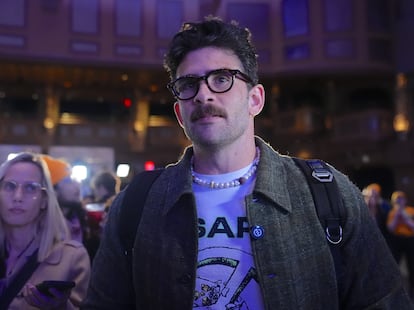
Piker is a heterosexual man who wears jewelry and paints his nails, something many of his followers say has helped promote different forms of gender expression. As Jordan Dean, a trans gender-studies student who follows Hasan Piker, told The New York Times, “Watching him be comfortable painting his nails, wearing dresses — it’s not revolutionary things. But he’s showing that it’s OK to be a cis guy and experiment with gender presentation.”
Political scientist Marcos Dosantos believes the image shown on the jumbotron at the Republican Convention is an illustrative example of the battle for ideological attention. “If the far right plays to ridicule, hatred and insult, now a left-leaning influencer has benefited from the virality of desire. Piker and other political commentators understand, as feminism has argued for decades, that beauty is also symbolic capital and therefore power.” Dosantos adds that Piker himself has said publicly that dressing in a suit is a communication tactic because he knows it helps his message penetrate center and right-leaning audiences. “Using aesthetics as a weapon is not new, but the digital revolution multiplies the experiments. Let’s not fool ourselves: some messages land better when wrapped in attractive packaging. And this doesn’t only translate into the objectification of commentators or the wardrobe upgrading of ministers; it also shapes the communication style of politically minded media that incorporate pop culture or entertainment resources to boost engagement,” he explains.
The Spanish journalist Anna Bosch, who worked for the state broadcaster RTVE, quotes Coco Chanel when reflecting on political commentators who show off their bodies. “The designer said there is no second chance to make a good first impression. Therefore, if your physical appearance is striking, that will be the first impression we take away, relegating intellectual argument to second place. To what extent does being ‘super ripped,’ having abs in men’s cases, or hypersexualization in women’s cases, attract attention or distract? Where is the line between drawing attention and being taken seriously? To what degree do we stay with the facade rather than the content?” she asks. “The problem is that it doesn’t matter how smart they are: if the first thing that catches your eye is the body, our minds come with prejudices and stereotypes and we have to work harder to appreciate their argument,” she adds.

That issue, of course, also affects female political commentators. “I get attacked for my body. My body bothers them. What do I have to do to be allowed to sit in a chair? Dye my hair? Wear glasses? Lose weight? What do I have to do to fit the right’s canon? Really, they only hate women who do not bow down,” Sarah Santaolalla told EL PAÍS. The political analyst refuses to hide her silhouette and proudly highlights a voluptuousness many believe overshadows her message. “Pretty, smart and feminist,” she wrote in an Instagram story in which she said those three adjectives are precisely what bother a large number of right-wing men.
Symone Danielle Sanders-Townsend, a political strategist and commentator, replied in 2018 on social media to a stranger who offered advice unrelated to her political arguments: “Hi Symone. You are so smart and beautiful. I like your comments on CNN. But may I give some advice? Okay, what do you think about your long nails? [It’s] not appropriate when you are on CNN TV and discussing about politics. This is my opinion. Please, don’t take it bad. [I’m one of your] followers. Thank you.” And thus the commentator responded: “I’m fully aware that when I show up curvy, with a low cut, a bold lip, an oversized bow, amazing nails, and a chilling analysis … people don’t know how to take it,” she continued. “I am not ‘supposed’ to be able to give you solid political commentary with a bedazzled nail right? I have no problem showing up authentically as Symone and delivering. The problem is most of y’all aren’t comfortable.”
Of course, men who analyze the political scene in the media do not receive the same level of hate, and proof of that is that Hasan Piker’s photo provoked more sighs than scorn. What would have happened if Sarah Santaolalla had been the one projected on a huge screen posing in lingerie?
Sign up for our weekly newsletter to get more English-language news coverage from EL PAÍS USA Edition









































