
Trump brings US democracy to its lowest point in recent history
Washington’s retreat from the rules-based order has weakened confidence in multilateralism and emboldened authoritarian leaders and populists, study finds

A great deal would have to change in the next two years for Donald Trump’s second term not to go down in history as the period of greatest democratic decline in recent U.S. history. The main democratic quality indicators measured by the International Institute for Democracy and Electoral Assistance, founded in 1995 by 14 countries from the Americas, Europe and Africa—from judicial independence to press freedom; from freedom of speech to economic equality—have fallen to 50-year lows. The indicators are at their lowest this year since the institute began conducting its annual study half a century ago, based on data from more than 170 countries. In March, the Sweden-based V-Dem Institute also removed the United States from the category of a full liberal democracy.
“In some respects, such as runaway polarization, the deterioration of American democracy predates Trump. However, what we have seen over the past two years is a devastating acceleration,” underlines the intergovernmental organization’s secretary general, Kevin Casas‑Zamora, by phone. “The assault on the norms of the rule of law has been very aggressive, with a large strengthening of executive capacities and prerogatives at the expense of all checks and balances. And what happens in the U.S. has global implications,” he warns.
Trump’s Washington has become, in short, “the most conspicuous example and the main accelerator of a troubling global trend of erosion and weakening of the rule of law.” It is an example of negative leadership that “undermines confidence in multilateralism and emboldens authoritarian leaders” across regions—mostly of an ethno‑nationalist bent.
The Republican Party has stopped being unconditionally loyal to the democratic game: it conditions its loyalty to the democratic system on whether the results are favorable to it. And that is a huge problem, one of the most complex a democracy can faceKevin Casas-Zamora, IDEA Secretary-General
“Their model is being replicated by other leaders and countries, and it corresponds with the widespread offensive against international law: it’s all part of the same process,” the head of the Stockholm‑based body adds, framing this dynamic within something much broader: a “new populist right that attacks norms as a wall that’s standing against the popular will they claim to embody. And that view seeks to emasculate all controls on political power: we have seen it with [Hungary’s Viktor] Orbán and we see it with Trump or [El Salvador’s Nayib] Bukele, among many other cases.”
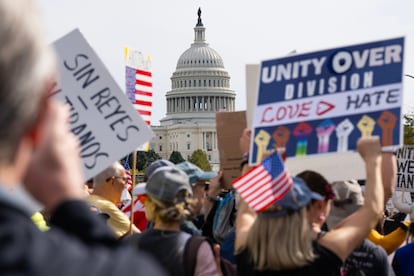
With seven weeks to go before the midterms, with both chambers of Congress at stake and grim prospects for the Republican candidates, Casas‑Zamora believes that the conditions exist for the vote to be “free and fair.” He thinks, however, that it is “less clear” that Trump will accept the results. “The Republican Party has stopped being unconditionally loyal to the democratic game: it conditions its loyalty to the democratic system on whether the results are favorable to it. And that is a huge problem, one of the most complex a democracy can face.”
Global trend
Democratic decline worldwide is, in any case, a global phenomenon not exclusive to the ethno‑nationalist surge. In 2025, for the 11th consecutive year, there are more countries whose democracies have deteriorated than those where they have improved.
In the last five years, six out of 10 nations recorded setbacks in at least one of the four key democratic performance indicators: representation, rights, rule of law and participation. The decline is “widespread” in the first three. But the rule of law is by far the pillar that suffers the most.
There is more. Judicial independence is, on a global scale, at its lowest level in 36 years. And both the holding of “free and fair elections” and access to justice and freedom of speech and of the press are at three‑decade lows.
What is striking about the United States, for Casas‑Zamora, is “how fast the process of destroying many of the foundations of democracy is.” “And what it means, is that many of the institutions [that sustain it] were already previously very weakened. With one very significant exception: the judges, not so much those of the Supreme Court but those at lower levels.”
Ultimately, more than the rules themselves, what sustains a democracy is the willingness of political powers to respect them. “That self‑restraint is fundamental,” notes the secretary general of IDEA International. “And what we are seeing in the White House is exactly the opposite: a constant will to subvert them.”
Sign up for our weekly newsletter to get more English-language news coverage from EL PAÍS USA Edition









































