
Ten styles of the new Democrats
The Democratic Party is now a broad coalition marked by diverse communication styles and ideological positions. That lack of definition and variety, for now, has not been a bad formula

A year ago, the Democratic Party was in one of the worst moments in its history. The organization was still associated with the poor image of former president Joe Biden and lacked a distinctive style or ideas to chart its course. That has begun to change with internal campaigns for the midterms and the emergence of politicians who are laying the groundwork to run for president in 2028.
Democrats are now a diverse party marked by different communication styles and ideological positions. That lack of definition and variety, for now, has not been a bad formula. It has allowed them to reconnect with voters from different blocs and to capitalize on rejection of Donald Trump ahead of the November elections.
The success of their current communication is closely tied to skillful use of language. They do it in different ways, but together they have managed to challenge Trump and the Republicans’ monopoly on certain words. This article identifies 10 different styles that have been key to the party’s resurgence. Each is linked, to a greater or lesser extent, to a specific candidate or group, but that does not mean it is exclusive to that person. Other communication approaches are being used, though I have highlighted the most novel and attractive ones. To simplify the analysis, the styles of these new Democrats are grouped into three broad categories: the confrontational, those that emphasize Trump; the proximity styles, which focus on the relationship with voters; and the anti-establishment, which center on society and the need for change.
Democrats are still searching for a single style that will distinguish and define them for the coming years. That will only happen when they have a clearly defined candidate for the 2028 presidential race. And, very likely, that candidate will end up shaping their approach based on all these ideas currently being tested.
The confrontational styles
They are characterized by confronting the current president and using that to position their own message. Barack Obama was something of a precursor to this style when he strongly criticized Trump at the 2024 Democratic National Convention.
- Caustic
Georgia Senator Jon Ossoff’s reelection campaign has elevated the Democrat to the position of possible presidential contender and helped him surpass one million followers on Instagram. Within the larger complexity, his strategy is simple to explain: speeches with sharply critical soundbites about Donald Trump and his allies’ most unpopular aspects. These are shared on social media with changes of shot and prominent headlines, which gives them great virality. The most impactful clip showed Ossoff saying that Trump does not want to do the work of the presidency because he only wants to travel with Nathalie Harp, his now-famous aide. The question about Ossoff is whether this caustic style can be sustained beyond prepared speeches.
- Trollish
California Governor Gavin Newsom, a likely presidential contender, began gaining traction on social media almost a year ago by mimicking the president’s style to make him look ridiculous. Posting with indiscriminate use of uppercase letters, using bombastic adjectives and even signing some messages with his initials, his aim is to expose the president and capture audience attention. He has succeeded and, along the way, has surpassed two million followers on Instagram. In the future, however, he will have to try other styles to remain relevant.
- Satirical
Other Democratic hopefuls have used irony and satire to respond to Trump and engage audiences. For example, Illinois Governor J.B. Pritzker did so a year ago when the White House threatened to send troops to Chicago and asked governors to redraw electoral maps to favor Republicans: “It’s cheating. Donald Trump is a cheater. He cheats on his wives, he cheats at golf and now he’s trying to cheat the American people out of their vote.” That line raised his profile for a few days, but his main problem, and that of other similar hopefuls, is that he has not managed the consistency of Newsom and Ossoff. His challenge is to use Trump without depending entirely on the president mentioning him or his state to gain traction.
The engagement styles
These approaches stand out for their ability to forge a direct connection with voters at a time when social media has transformed political communication and brought politicians closer than ever to their audiences.
- Folksy
A strategy that has worked well for several Democratic pre-candidates in primaries has been presenting themselves to voters as an ordinary citizen who understands the needs and wants of the average American because they are one of them. Before his downfall, Graham Plattner, a former Senate candidate in Maine, was the leading exponent of this style. Today, figures like Bob Brooks, a Pennsylvania firefighter running for Congress, continue to carry this banner. In his introductory spot, he proudly said he had worked as a bartender, pizza delivery driver and gardener. He also shows off his tattoos and is seen riding a motorcycle.
I’ve had lots of jobs — bartender, Teamster, union leader, 20-year firefighter.
— Bob Brooks (@VoteBobBrooks) August 26, 2025
Now, the biggest problem we face is a Washington that burns working people. I’m running for Congress in one of the closest districts to take on the billionaires and big corporations holding us back. pic.twitter.com/KAyxPYYzVz
- Open
Authenticity is one of the most important traits for connecting with audiences on social media, which is why its relevance has also grown exponentially in politics. Alexandria Ocasio-Cortez manages to engage audiences by opening much of her private life to the public. Since mid-August, for example, she has posted on Instagram about her egg-freezing process to be able to continue her political career without giving up motherhood. She has done so through live videos, a Q&A session and reels with updates and useful information about a procedure that matters to many women.
- Accessible
On social media communication is increasingly fast. It is harder to capture attention, and messages must be more direct and clear so a distracted audience can understand them without much effort and with a touch of entertainment. Zohran Mamdani has become the primary reference for this style. His videos feature constant shot changes, humor and he speaks directly to the audience. The New York mayor was an example of a campaign made for social media and now sets the standard for governing for social media. The next Democratic presidential candidate will have to learn a lot from him. And if they win, they will have to keep him as a reference from the White House.
The anti-establishment styles
In an era when distrust of institutions has reached historic levels, these styles focus on offering a paradigm shift. They do not settle for the traditional; they confront it directly to denounce and try to change it.
- Moral beacon
Bernie Sanders is the second most popular politician in the United States, after Barack Obama. He is 84 years old and, because of his age, can no longer run for president, but the Vermont senator is becoming one of the party’s main references with a style centered on defining what is morally acceptable and what is not. His long-standing message against inequality and the fight against excessive wealth has been amplified in the face of the growing power of Silicon Valley oligarchs and the rise of artificial intelligence. He currently has great power in shaping the progressive wing’s political agenda, and his endorsement will be very important for the presidential primaries.
- Disruptive
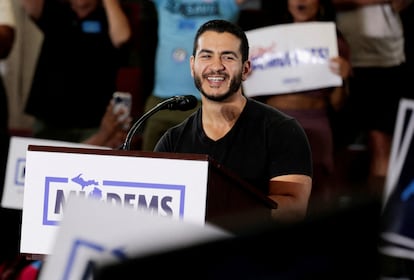
“They changed the old rules. The old playbook is broken,” those highlighted words open the video with which Abdul El‑Sayed celebrated his victory in the Michigan Democratic primaries in early August. At a time when the power of political and economic elites is being questioned, displaying an irreverent style that goes against the status quo has catapulted several hopefuls. El‑Sayed’s case is especially notable because he won despite the powerful pro-Israel political lobby spending more than $50 million trying to defeat him. He now faces the challenge of winning the general election in a closely contested state. What happens in Michigan could define the viability of a left‑wing presidential candidacy in 2028.
- Defiant
Many of the most progressive pre-candidates have had to fight within Democratic primaries against the message that they are too radical for the general election. Some, like Angie Nixon, who won the Senate nomination in Florida, have responded with a defiant tone that helps them connect with the party base. Faced with criticism that she is too radical, she replied: “If wanting your neighbor to be able to buy the insulin they need is radical, then call me radical. If it’s extremist to believe a mother should not have three jobs to pay for housing, then I’m an extremist.” She did not shy away from the labels her rivals tried to impose; she challenged them to defeat them.
- Evangelizing
In the Christian South, Democrats have nominated a Presbyterian seminarian as their Senate candidate in Texas. James Talarico does not avoid the subject of faith; he incorporates it into many of his speeches and contests a frame that Republicans have traditionally dominated. He uses an optimistic rhetorical tone that emphasizes the need to reduce polarization to focus on solutions, which recalls the early days of Barack Obama.
Sign up for our weekly newsletter to get more English-language news coverage from EL PAÍS USA Edition









































