
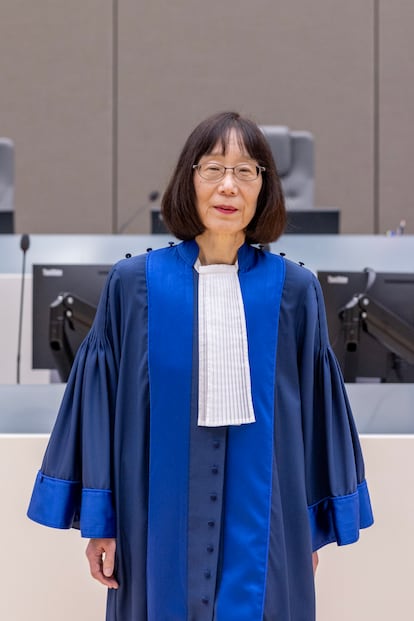
Tomoko Akane, president of the International Criminal Court: ‘History sooner or later will call us all to account. Where were you?’
The judge, who has been sanctioned by Washington, believes the ICC is facing its toughest challenge since its creation, but maintains that the pursuit of justice is a shared responsibility and a right of victims


Tomoko Akane was elected by her fellow judges in 2024 as president of the International Criminal Court (ICC). Her term ends in 2027, coinciding with the end of her statutory nine-year tenure as a judge at the world’s only permanent court for prosecuting those most responsible for genocide, war crimes and crimes against humanity.
In August, the United States sanctioned Akane along with Senegalese prosecutor Abdoulaye Seye. As a result, the judge is currently barred from entering U.S. territory and has had her credit card canceled. She is one of 13 judges, prosecutors and staff members of the ICC sanctioned by the administration of U.S. President Donald Trump, which has described the ICC as a “corrupt and fatally politicized” body that threatens U.S. sovereignty and attacks its closest ally, Israel.
The United States is not among the court’s 125 member states, and Washington argues that no international tribunal can supersede its own courts and Constitution. Secretary of State Marco Rubio has gone further, declaring that he intends to “dismantle” the ICC, and he is also pressuring allied countries to withdraw from it.
Akane sat on the Pre-Trial Chamber in 2023 that issued the arrest warrant for Russian President Vladimir Putin, and she was also convicted in absentia by Moscow’s courts. She is an unprecedented situation. The ICC president responded to a questionnaire sent by EL PAÍS in her first interview with a Western media outlet since the sanctions were announced.
Question. How are you coping with the sanctions imposed on you by the United States?
Answer. It is always a shock to see your name appear on the same list as drug traffickers and terrorists when you are a judge committed to upholding the rule of law. Many of their effects have yet to materialize, but I can reasonably expect these sanctions to affect aspects of my personal life. My credit card was suspended almost immediately. Other judges have experienced daily practical disruptions as a result of companies ceasing to provide services to sanctioned individuals.
I have been driven by a commitment to justice since my junior high school years. At this critical moment, as its president, I feel a personal responsibility to help protect the Court, its independence, and its ability to deliver justice to victims. I will continue to carry out my duties and fulfil my mandate. I took an oath to do so, and I remain steadfast in that commitment.
Q. Is the ICC facing its greatest challenge since it was created in 2002?
A. Nine of the Court’s eighteen judges, both deputy prosecutors, the former prosecutor, and one staff member have been designated for sanctions by the United States. In addition, nine current and former judges, including the entire presidency of the ICC, have been convicted in absentia by the Russian Federation [after an arrest warrant was issued for Russian President Vladimir Putin over his alleged role in the forcible deportation of Ukrainian children], with obvious implications for their personal security. In total, two-thirds of the Court’s judges are currently subject to coercive measures from some of the world’s most powerful states. This is an absolutely unprecedented situation in the Court’s history. These attacks are a testament to the importance and impartiality of the Court’s work. Efforts to investigate and prosecute the gravest crimes under international law inevitably attract resistance from those who would prefer impunity to accountability.
Q. Are we witnessing the beginning of the end for the international rule of law?
A. These are deeply troubling times for international justice and for the rules-based international order. At the same time, it is encouraging to see states, civil society organisations, and citizens speaking out in defence of international law. Such expressions of solidarity are more important than ever. The Court was not created by chance nor was it established overnight. Rome was not built in a day, and neither was the Rome Statute [the treaty that underpins the ICC’s work]. The Court emerged from the lessons of war, persecution, and mass atrocities, and from the conviction of states that law and justice must prevail over force. Those values remain as important today as ever. The Court remains a young institution — barely more than two decades old, measured against national legal systems built over centuries. But it is built on an idea whose time has come: no one is above the law.
Q. The crimes prosecuted by the ICC may seem distant, but they could happen anywhere. Can it still remain the cornerstone of the global fight against impunity?
A. A permanent court is in place before the crimes occur, its jurisdiction is known in advance, and it applies the same law to everyone within its reach. Permanence is what allows a court to deter and not merely to react, and it is what makes the promise credible for people who would have no reason to expect that a tribunal would ever be created for them.
I was once in the courtroom when a victim of sexual violence was asked why she decided to testify. She said: “I know no one else can defend me, only justice, the judges. They are the only ones who can help me. […] because what happened to me, I wouldn’t want that to happen to anyone else.” These victims remind us why this work matters and why it must continue: to carry the promise of “never again.” History sooner or later will call us all to account. “Where were you?” we will be asked. I call upon states to defend and foster those fundamental principles of international law which are also moral imperatives, and to continue the pursuit of justice.
Q. What kind of external collective action does the ICC need to withstand Washington’s actions?
A. We have received strong expressions of support from States and will remain in close contact with them to address the challenges arising from these measures, including political, legal, financial, and operational concerns. There is a further form of collective action: cooperation. ICC decisions can only be enforced when states give them effect — above all by executing arrest warrants. The pursuit of justice is a shared responsibility.
Q. How do the sanctions affect victims?
A. I can assure you that victims remain at the heart of our proceedings. They participate in trials through their legal representatives, ensuring that their views and concerns are heard throughout the process. Following a conviction, victims may also be eligible to receive reparations.
Upcoming cases
It is expected that the trial of former Philippine president Rodrigo Duterte will begin in November, while another case, involving serious crimes allegedly committed at a detention center in Libya by former militia commander Khaled Mohamed Ali El Hisri, is scheduled to open next year.
To date, the court has opened 18 investigations and helped secure accountability for serious crimes including the recruitment and use of child soldiers, the destruction of cultural heritage, sexual violence and attacks against civilians.
Q. The United States says the Court is politicized and has Israel “in its sights.” Does the ICC breach the national sovereignty of its 125 member states?
A. The Court’s mandate is to investigate and prosecute when states are unwilling or genuinely unable to do so. The ICC complements rather than replacing the national systems. That is not an infringement of sovereignty. It is sovereignty being exercised. The creation of the ICC itself is the result of states exercising their sovereignty and concluding a multilateral treaty. It is founded on the shared conviction that the rule of law provides the strongest protection against the abuse of power and that accountability is essential. Judges do not choose the situations that come before them, and we do not choose the accused. We simply apply the law to the evidence in the cases we receive. That is what impartiality requires.
Q. In its early years, the ICC was criticized for focusing on Africa. Now there are arrest warrants for Putin and for Israeli Prime Minister Benjamin Netanyahu over the war in Gaza. What changed?
A. At the beginning of the Court’s work, a number of investigations stemmed from self-referrals by African states or referrals by the United Nations Security Council regarding conflicts in Africa. Over time, the Court’s work has expanded to encompass all regions of the world. However, our responsibility is not to respond to political debates. Our duty is to apply the law impartially and without regard to geography, nationality, or political considerations.
Q. The ICC does not have its own police force and relies on international cooperation to carry out its arrest warrants. Doesn’t that undermine accountability?
A. None of the current proceedings would have been possible without states cooperating to arrest and surrender the suspects concerned.
Cooperation with the Court remains a core challenge. It is also a legal obligation, and an important means for states to reinforce their commitment to international justice. Arrest warrants issued by the Court do not expire. There is no statute of limitations for the gravest crimes. History has shown repeatedly that justice can take time, but accountability remains possible. History has shown again and again that justice can take time, but accountability remains possible.
Sign up for our weekly newsletter to get more English-language news coverage from EL PAÍS USA Edition









































