
Wang Xingxing, the student who failed English and is now leading the humanoid robotics race
The founder of Unitree went from tinkering with homemade motors in a small town in Zhejiang to selling more bipedal robots than anyone else in the world
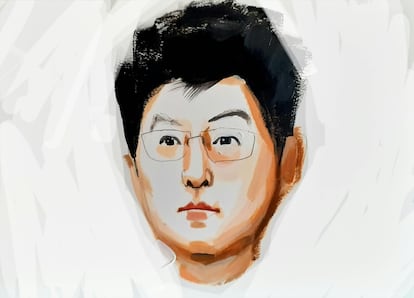
Wang Xingxing, 36, fell in love with technology at an early age. Even as a schoolboy, he dreamed of building robots that would leave their mark on history. Fortunately for him, dreams sometimes do come true, and even end up listed on the stock market. Unitree, the company he founded in 2016 and that has become famous for its humanoid robots that can dance and perform kung fu, made a spectacular debut on the Shanghai stock exchange.
The company’s shares began trading on August 19 at around $22. By the close of the session, they had climbed to $125, a gain of 460%. Its initial valuation of $9 billion soared to $50 billion with the ringing of the opening bell. Grey-market trading had already pointed to a historic day for Unitree, while buy orders from retail investors exceeded the available shares by a factor of 8,000. The enthusiasm was real. Since then, however, the stock has fallen by around 35%, prompting debate among analysts over whether the decline reflects a natural correction or the signs of a speculative bubble.
Unitree, officially known as Yushu Technology, was the world’s largest manufacturer of humanoid robots in 2025, although it also produces robotic arms, sensors and other equipment. It sold more than 5,500 bipedal robots that year, generating roughly €215 million in revenue and about €36 million in profit. Its stock market debut was not only a milestone for the company. It was also a landmark moment for Beijing and its drive to secure technological leadership.
Wang runs his business much as he builds robots: pragmatically and rationally. He hardly fits the stereotype of the child prodigy or straight-A student. In fact, he may have become a successful engineer and billionaire not because of China’s notoriously demanding and rigid education system, but in spite of it. “The education system suppressed me from a very young age, and I never felt I was achieving anything,” he told the Chinese outlet LatePost last year.
Born in Yuyao, in Zhejiang province, in 1990, Wang developed an interest in science and technology at an early age. By the time he was 10, he was fascinated by foreign documentaries about aviation and aerospace engineering. One of them introduced him to early robotics experiments by the future founder of Boston Dynamics. Gifted at drawing, he spent his allowance on components and parts, nurturing a talent for building mechanical and electronic devices. “You could say I’ve been tinkering with this kind of stuff since I was a kid,” he told another Chinese media outlet. He initially dreamed of becoming a researcher, but a classmate suggested that he was thinking too small: instead of doing the research himself, he should start a company and hire scientists to do it. The idea took root.
In middle school, he built a miniature turbojet engine. In high school, he experimented with self-recharging batteries and immersed himself in projects that, on one occasion, nearly resulted in chlorine gas poisoning. His grades, however, failed to reflect his potential and were dragged down by subjects that did not interest him. “I failed English when I was young and only passed it three times during my three years of high school,” he recalled to LatePost. In the subjects that did capture his attention, by contrast, he consistently ranked among the top students in his class. Before university, he admitted, he felt somewhat inferior to students from more prestigious schools, but eventually stopped caring about the comparison.
In 2009, Wang enrolled in mechatronics engineering at Zhejiang University of Science and Technology. After graduating, he hoped to pursue a master’s degree in engineering at the prestigious Zhejiang University. But once again, his difficulties with English got in the way: he failed to attain the required score and instead enrolled at Shanghai University, which lacked the same standing in the field. There, he developed XDog, a quadruped robot powered by electric actuators that were far cheaper than the hydraulic systems commonly used at the time. The project earned him second prize in a national entrepreneurship competition.
Although he had not abandoned the idea of starting a company, he felt he lacked the necessary support. “I felt that my personal capabilities, network and financial situation were not up to the task,” he later recalled. He joined drone maker DJI, but only a few months into the job, a video of his robotic dog attracted widespread attention from the media, social networks and potential investors. In 2016, he founded Unitree, and the following year unveiled its first commercial product, Laikago, an upgraded version of XDog.
Wang, who serves as both chief executive and chief technology officer, initially wanted nothing to do with humanoid robots. The sector was still in its infancy and demand was virtually nonexistent. According to Wang, interest in humanoid machines surged thanks to Elon Musk’s enthusiasm for the technology and rapid advances in artificial intelligence. In February 2023, a three-person team at Unitree began working on transforming one of the company’s quadruped robots into a bipedal machine. In August that same year, the company unveiled the H1 humanoid robot.
Over the past two years, videos of Unitree robots dancing alongside humans and performing in martial arts exhibitions have gone viral around the world. Yet for now, the rise of these machines remains more of a social phenomenon than an industrial revolution. Their capabilities and practical applications are still limited, and relatively few are being used for productive or genuinely useful tasks. According to Time magazine, nearly three-quarters of the humanoid robots sold by Unitree are purchased by universities, independent developers and research institutions. Another 17% go to commercial venues, while only 9% end up in industrial settings.
They can perform seemingly impossible acrobatics, execute precise dance routines and even beat Usain Bolt’s 100-meter record, albeit while crashing into a safety mat at the finish line. But while they excel at carefully choreographed feats in controlled environments, they still struggle to carry out simple commands in the real world. Speaking at the World Robot Conference in Beijing last August, Wang said that the “ChatGPT moment” for humanoid robots, the breakthrough that could transform the industry, is still at least two or three years away in the most optimistic scenario and perhaps as many as 10 years away in the least favorable one. “It won’t happen overnight,” he warned in Time. The robot revolution, and perhaps any robot uprising as well, will have to wait.
Sign up for our weekly newsletter to get more English-language news coverage from EL PAÍS USA Edition









































