Melissa Parke, ICAN executive director: ‘The risk of nuclear war has never been higher than it is today’
The head of the International Campaign to Abolish Nuclear Weapons coalition warns about the dangers of the military use of artificial intelligence, which has already made mistakes that could have easily led to armed conflict: ‘It is absolutely terrifying’

Humanity has never been closer to self-destruction. That is the warning of the Doomsday Clock, an initiative the Bulletin of the Atomic Scientists updates each year to alert the public to threats facing the planet. It is now only 85 seconds to midnight—the symbol of total annihilation—because of the climate emergency, the rise of artificial intelligence and wars threatening millions of people. Moreover, amid a surge in militarism, the world’s most powerful countries have accelerated an arms race to expand and modernize their nuclear arsenals, which is why the Doomsday Clock was first unveiled in 1947.
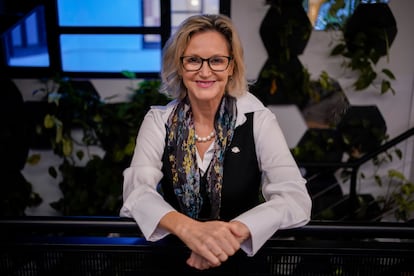
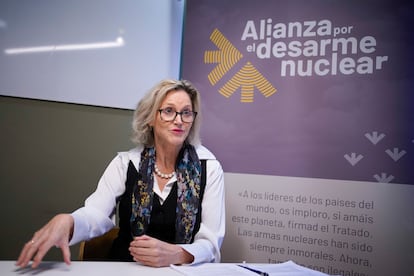
“We are exposing humanity to the risk of a nuclear war which can end the world in an afternoon,” says Melissa Parke, 60, executive director of the International Campaign to Abolish Nuclear Weapons (ICAN). The coalition, made up of more than 700 NGOs, won the Nobel Peace Prize in 2017 for pushing the United Nations to adopt the Treaty on the Prohibition of Nuclear Weapons. However, the nine states that possess nuclear weapons— the United States, Russia, China, the United Kingdom, France, India, Pakistan, North Korea and Israel (which neither confirms nor denies its arsenal)—have not joined the treaty. Other NATO members have not joined either.
“No one would survive a nuclear war. It’s suicide,” says this Australian expert, responding to those in Europe who defend building their own atomic arsenal. In an interview in Madrid, Clarke reviewed the comings and goings of Donald Trump, threats from the Kremlin, the dangers posed by the military use of artificial intelligence, and conflicts in Europe and the Middle East, a region to which she has devoted more than a decade of her professional career.
Question. What factors are driving us toward a nuclear catastrophe?
Answer. The risk of nuclear war has never been higher than it is today. We have two major conflicts started by countries with nuclear weapons: Russia, and the United States and Israel. We have a complete breakdown in arms control agreements. There are nuclear threats being made, a new arms race underway and, on top of that, we hear very disturbing rhetoric from European leaders who, despite asserting their commitment to the Non‑Proliferation Treaty, are talking about nuclear rearmament.
I was at the Munich Security Conference and heard [Spain’s Prime Minister] Pedro Sánchez deliver a brilliant speech. Surrounded by militarist hawks, he pushed back against nuclear rearmament, called it a historic error and questioned the logic of nuclear deterrence. He said that a system that requires zero risk and zero errors to avoid total destruction is not a guarantee but a gamble. He is right. If we have avoided a nuclear war it has been by sheer luck, but we cannot rely on that luck to last forever. As the UN secretary‑general [António Guterres] says, when it comes to nuclear weapons, luck is not a strategy.
Despite Sánchez’s words, Spain’s policies have not lived up to those speeches and remain tied to NATO’s nuclear umbrella. But that is not inherent to Alliance membership; it is a political choice. What we ask is that they act in accordance with their principles. NATO’s current policy strikes me as counterproductive. It is pushing Europe toward war instead of away from it.
Last year tensions between India and Pakistan almost turned into a nuclear conflict because of AI‑generated deepfake videos
Q. What risks does integrating artificial intelligence into nuclear arsenals pose?
A. AI is increasingly being incorporated into nuclear weapons systems, which is absolutely terrifying. This spring we saw the United States mobilizing its military based on an intelligence report claiming a Chinese ship was transporting nuclear components bound for Iran. At the last minute they discovered that information came from an AI that was hallucinating. That is how easily a nuclear war can start.
Last year tensions between India and Pakistan almost turned into a nuclear conflict because of AI‑generated deepfake videos showing leaders saying things they never said, in addition to mass disinformation campaigns produced by artificial intelligence. And just days ago, AI agents hacked into Australia’s public healthcare system. The people developing AI do not have control over it. Integrating these technologies into nuclear weapons is a recipe for disaster.
Q. Is this arms race inevitable or is it still possible to impose controls?
A. Arms control is necessary in the short term, but we have to stop merely managing these weapons and move toward their elimination. We saw this with the New START agreement [the last nuclear treaty between Russia and the United States, which expired this year]: when trust ends and agreements end, the nuclear weapons remain. Every day that passes without eliminating them, we are exposing humanity to the risk of a nuclear war which can end the world in an afternoon.
A lot of people think the danger from nuclear weapons went away with the end of the Cold War. It did not. The weapons are far more powerful now. Of the roughly 12,000 warheads that exist, about 4,000 remain on on high alert launch status. That means political leaders would have to react within minutes to verify whether the information they receive—perhaps generated by AI—is accurate. A catastrophic miscalculation is just any time around the corner.
Q. The conflict in the Middle East has revived fears about Iran’s atomic program and Israel’s nuclear arsenal. Do you consider the use of nuclear weapons a real risk?
A. In both Ukraine and Iran, nuclear weapons have been strategically irrelevant. They have not prevented wars nor stopped Ukraine and Iran from responding to attacks. But they have been sitting in the background dramatically increasing the stakes of every miscalculation.
Israel has nuclear weapons. It is the only country in the Middle East that possesses them. It is ironic that you have two nuclear-armed states, the U.S. and Israel, that have attacked a non-nuclear-armed state on the basis of its alleged nuclear weapons program, which the U.S.’s own intelligence agencies and the IAEA (International Atomic Energy Agency) have confirmed does not have a nuclear weapons program.
If the concern is proliferation, attention should be turned to the country which does have nuclear weapons and which does not submit to any international safeguards and any inspections by the IAEA, and that’s Israel. It’s as if these nuclear weapons are giving them a sense of impunity and unaccountability in international law, and that’s also not acceptable.
Q. Do you think the upcoming elections in Israel will affect the conflict?
A. Unfortunately, even if Benjamin Netanyahu left power, there are many others who would continue the same policies. Netanyahu should appear before The Hague to face war crime charges, but I do not see candidates likely to win who will have a different policy. The U.S. is the country that has the most influence over Israel. If it chose to, it could stop what is happening. It has not chosen to.
Q. Trump said a few days ago that he would not use nuclear weapons against Iran. What do you make of that?
A. At the UN General Assembly he explicitly issued a nuclear threat against Iran. He said they could be “annihilated” quickly. He also said something similar earlier this year when he posted a message saying “an entire civilization will die tonight.” However, he appears convinced of what he calls “denuclearization” and of the need to engage in dialogue with Russia and China. He also appears convinced that nuclear weapons are very dangerous and wasteful of resources. At the same time, his actions are not matching his words. The United States continues full steam ahead to expand and modernize its arsenals.
Q. As the Kremlin ratchets up the tone of its threats and the United States seems a less reliable ally, many European countries maintain that nuclear deterrence is the only alternative. What would you tell them?
A. I would tell them they’ll be the first ones to go in a nuclear war. No one would survive a nuclear war. It is not a protection; it is suicide. It is like living in a house of dynamite. You never know when it will blow up.
Q. What can be done about countries with opaque nuclear programs, such as Israel, North Korea or China?
A. At the height of the Cold War there were some 70,000 nuclear weapons. After the agreements between Mikhail Gorbachev and Ronald Reagan, that figure was reduced to roughly 12,000 today. That shows we know how to do it, in a verifiable, time-bound way.
Of all the major global challenges we face, this one is probably the least complex. It is a matter of political will and leadership. What would likely be needed is a multilateral agreement to reduce arsenals, monitored by an independent body such as the IAEA. Of course, countries like Israel and North Korea would need security guarantees assuring them that their existence is not threatened. That can be achieved.
Q. You head an organization that has been awarded the Nobel Peace Prize. What do you think of Trump’s push to receive one?
A. Trump has waged war, so I think he is a long way from deserving it. If he were to take the initiative to eliminate nuclear weapons in the world, that indeed would be worthy of a Nobel. He should think about that.
Sign up for our weekly newsletter to get more English-language news coverage from EL PAÍS USA Edition