
The age of nuclear clocks is here: A new tool for probing the laws of physics
Chinese and European scientists have unveiled prototypes that usher in a new era of timekeeping, using thorium-229 as their ‘pendulum’
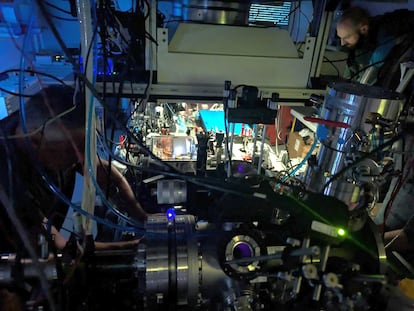

Welcome to the age of nuclear clocks. They are not yet as precise as the atomic clocks that keep time (and much more) in modern society. But because they are based on the atom’s nucleus rather than its electrons, improving their performance is only a matter of time. More importantly, these devices will be far more than timekeepers: they could help answer some of the most fundamental questions in physics and open entirely new avenues of inquiry.
One prototype has been developed by Austrian and German researchers, who describe their achievement in Nature. Another has been built by Chinese physicists and is detailed in the same journal, long considered the leading edge of scientific research. It is quite possible that some of the scientists listed as authors on these papers will be among the recipients of a future Nobel Prize in Physics.
The clock developed at the Vienna University of Technology (TU Wien) in Austria has achieved a precision of 10⁻¹⁵, equivalent to an error of roughly one second every 30 million years. “It is completely normal for a new type of clock not to immediately outperform all existing technologies; this is an initial proof of concept, and what matters is the potential for future improvements,” says Thorsten Schumm, a TU Wien researcher and senior author of the paper on the European prototype.
“For everyday life, with a few caveats, we do not need to know the time to within a second over billions of years,” notes Daniel de Mercado, a physicist at the Spanish Center of Metrology, who is part of the team developing its own optical atomic clock based on the energy transitions of calcium-40 ions.
The main motivation for achieving such extraordinary precision is not their use as conventional timekeepers. Rather, both today’s atomic clocks and the nuclear clocks of the future could provide a powerful probe of fundamental physics.
“The frequencies of atomic and nuclear transitions depend on the constants and fundamental forces of nature, so an extremely precise measurement allows one to search for small discrepancies between the observed value and what our theories predict,” De Mercado explains. “If systematic deviations were found, they could signal new physics, for example as-yet-unknown interactions or clues about the nature of dark matter.”
Since U.S. scientists built the first atomic clock using ammonia in the 1940s and a second using cesium-133 shortly afterward, the way we measure time has changed radically. Today the official definition of the second depends on the oscillations between two energy states of a cesium-133 atom — 9,192,631,770 periods. It would take hundreds or billions of years (depending on the clock) for one of these clocks to gain or lose a second. Beyond physics laboratories, that precision underpins critical operations in geolocation, space exploration, telecommunications, financial transactions, defense and more.
“The history of timekeeping is a history of ever higher tick frequencies,” says Schumm. “A clock improves the faster it ticks or swings. Basically, the faster the tick, the less critical it is if you miss a pendulum movement,” the physicist explains. With atomic clocks, the oscillation frequency is so high that they achieve very high precision. “The nuclear clock is another step, because it provides the fastest tick currently available,” Schumm adds.
Whereas atomic clocks are based on oscillations involving atoms or the electrons orbiting them, nuclear clocks operate using transitions within the atomic nucleus itself. “For decades the fastest, smallest springs we could find were single atoms. But they are reaching a limit; if you make them oscillate too fast, you start knocking electrons off,” explains Schumm. That is why the move to the nucleus is so significant. “They are 1,000 times smaller and the nuclear forces involved are enormous, which makes them a fantastic spring or pendulum,” he says.
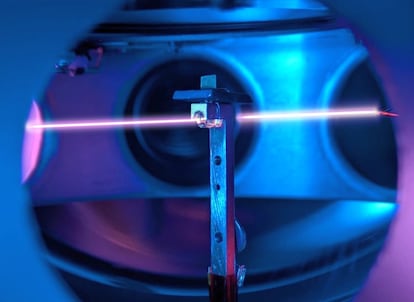
Both the European clock and the one developed by the team led by Shiqian Ding, a physicist at Tsinghua University in Beijing, share a similar design. The oscillator at the heart of both devices is thorium-229, whose nucleus can switch between just two energy states. When exposed to a specific laser, the system measures the frequency of the transition between those states. Unlike atomic clocks, which rely on several million atoms, these prototypes can contain up to a quadrillion thorium nuclei embedded within the crystal lattice of another material, in this case calcium fluoride.
Nuclear clocks have the advantage of being less sensitive to external disturbances. In a comment also published in Nature, Akio Kawasaki, a scientist at Japan’s National Metrology Institute, notes that “one of the main sources of uncertainty comes from external electric fields.” But the nucleus, where the four fundamental forces converge — in particular the strong nuclear force that binds neutrons and protons — promises to be much more resistant to external electric fields.
Sign up for our weekly newsletter to get more English-language news coverage from EL PAÍS USA Edition









































