Tortured and jailed without a conviction: Three innocent men freed in Mexico after 24 years in prison
Authorities framed Ricardo Almanza, Jorge Hernández and Sergio Rodríguez as members of a criminal gang using fabricated evidence and coerced confessions


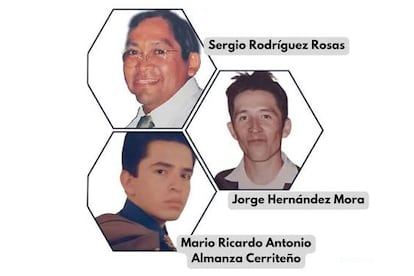
Ricardo Almanza was 25 when he was arrested. On Thursday, when he walked out of the Preventive Detention Center in the San Mateo Xalpa neighborhood of southern Mexico City, he was 49.
Along with Sergio Rodríguez and Jorge Hernández, Almanza was arbitrarily detained in the State of Mexico in August 2002 and accused of kidnapping and organized crime. Together with three other people, they were charged as members of a gang known as Los Kempes, which authorities linked to two kidnappings that allegedly yielded ransom payments of 12 million pesos (roughly $650,000 at the time) each.
On Wednesday, however, a judge in the state of Tlaxcala, where the crimes were allegedly committed, ordered the immediate release of the three men after 24 years behind bars. Nearly a quarter of a century later, they have been cleared of crimes they never committed. Their prosecution and imprisonment were built on torture, threats and fabricated evidence.
The victims of the so-called Tlaxcala case were never convicted by a final court ruling despite spending more than two decades entangled in legal proceedings marred by serious judicial irregularities, fabricated evidence and chronic delays in the justice system. In 2023, the United Nations Working Group on Arbitrary Detention concluded that their imprisonment was arbitrary and called for their immediate release.
Framed and tortured
According to a report by the U.N. Human Rights Office, on August 13, 2002, Sergio Rodríguez, then 43, was informed that one of his sons had been detained. He searched for him at several police stations in the State of Mexico before being told that he might be at the Justice Center in the municipality of Ecatepec.
As Rodríguez headed there with another of his sons, their vehicle was intercepted by an unmarked truck. Three armed men forced them out, covered their faces and pushed them into the vehicle. Once inside, with their hands tied behind their backs, they were beaten.
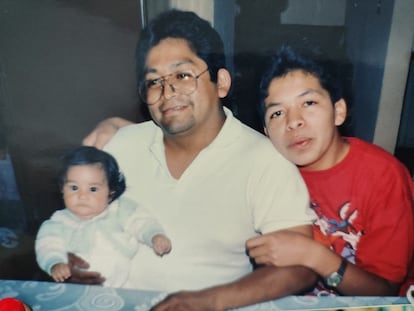
When Rodríguez arrived at the prosecutor’s office, the son he had been searching for was already being tortured. Rodríguez was forced to strip naked and thrown to the floor, where officers stomped on him, suffocated him and kicked him in the ribs. The beating stopped only when the officers noticed a surgical scar. He was later paraded before the media at the same facility as a kidnapper, alongside several others.
He was then taken to a cell and forced to read a confession aloud while his voice was recorded. Afterwards, he was made to sign documents under the threat that, if he refused, his sons would be killed.
Hernández was framed in much the same way. He was 21 when, later that same day, three men violently detained him outside his home in the State of Mexico and held him for several hours. He was taken to the state prosecutor’s office, where officers tried to force him to sign a set of documents. When he refused, they tortured him for hours. He was beaten, suffocated with a plastic bag and subjected to various forms of water torture.
Like Rodríguez, he was displayed at the same press conference as a kidnapper. When he continued to resist, a commander transferred him to a cell, pressed a gun to his head and forced him to sign the documents and record a confession.
Almanza was dating one of Hernández’s sisters. After witnessing Hernández’s arrest, he was approached by an officer who asked whether he was “Alejandro,” the name that appeared on an order to bring someone in for questioning. Almanza replied that Alejandro was a 10-year-old boy.
Concerned by what he saw as the excessive use of force and the arbitrary nature of the arrest, he accompanied the officers. But once they reached the prosecutor’s office, he was prevented from leaving the vehicle. Officers detained him on the spot and told him that, since the child they were looking for was not there, he would “take his place.” He was beaten, tortured with electric shocks for hours and ultimately implicated in the crime.
Alongside Hernández, Almanza and Rodríguez, three other men were arrested in the State of Mexico: Oswaldo Rodríguez, who spent 14 years in prison; Hugo Rodríguez, who spent eight months behind bars; and José María Cirilo, who died in custody in 2013. None of them was arrested in Tlaxcala, roughly 75 miles away, where the kidnapping was allegedly committed.
Agustín Acosta, the lawyer representing the three men who have now been released, says authorities were determined to find culprits at any cost. “The investigation was so poorly conducted that they were actually looking for an Alejandro Hernández, but he was a 10-year-old boy. When they were told he was a minor, they took Jorge, his older brother, instead. They were arrested despite having absolutely nothing to do with the crime,” he said in a telephone interview.
The investigation was led by Edgar Bayardo del Villar, then Tlaxcala’s anti-kidnapping prosecutor, who was later accused of ties to the Sinaloa Cartel. He was gunned down in a Mexico City café in 2009.
In 2002, Luis Cárdenas Palomino was head of police investigations at the now-defunct Federal Investigative Agency, which assisted in the arrests. Cárdenas Palomino was later convicted in a separate torture case. Several officers involved in the operation now face criminal charges and arrest warrants for torture.
In March 2019, a court ruling concluded that Los Kempes never existed. The defendants were acquitted of organized crime charges, and each was cleared of one of the kidnappings attributed to the alleged gang. On March 1, 2022, arrest warrants were issued for nine participants in the operation on suspicion of torture.
Enchiladas to celebrate freedom
The first thing Almanza did after walking free on Thursday, following 24 years in prison, was join his family for a glass of orange juice and a plate of green enchiladas. He had expected to be released on Tuesday night, but a bureaucratic mix-up involving official notifications delayed the process. After nearly a quarter of a century behind bars, he admits that being free again “feels different,” but says that as he made his way home, he felt “a lot of happiness.”
Almanza spent eight years in Mexico City’s South Prison before being transferred in 2010 to the former federal prison in Perote, Veracruz. Over the next 19 months, he was moved between prisons in Huimanguillo, Tabasco, and Guasave, Sinaloa. After four years in northern Mexico, he was transferred again, first to Durango and eventually back to the capital.
“We were collateral damage from structures like those built by Genaro García Luna,” he says, referring to the former Mexican security chief convicted in the United States in 2024 on drug-trafficking and organized-crime charges. “And from corrupt police officers. Now all we want is some peace, to work and move forward with our lives.”
“You leave prison with nothing. The only thing I want is to thank all the people who took an interest in helping bring our innocence to light,” Almanza says.
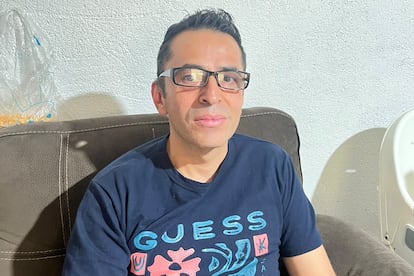
Each prison transfer was a traumatic experience for Almanza. He recalls that during air transfers, prison guards shackled inmates’ hands and feet and forced them to keep their heads bent down onto their knees throughout the flight.
“It was very painful and traumatic,” he says by phone. “Many people soiled themselves, vomited or fainted, and everyone was treated the same. I was shuttled all over the country, visiting federal prisons labeled as a kidnapper, enduring screams, beatings, and abuse. But thank God we made it through; we’re still alive and we’re still giving it our all now that we’re free.”
He remembers the harshest conditions being at the federal prison in Villa Aldama, Veracruz, which he describes as “constantly cold.” “When we arrived, they didn’t give us mattresses, shoes, blankets or jackets. It was about four or five days of sleeping on cardboard and newspapers, with illnesses and very scarce food. If they gave us 10 beans, that was a lot,” he recalls.
Before his arrest, Almanza worked as a sales promoter, organizing events and marketing products for a private company. In 2019, after being transferred back from Durango to Mexico City’s South Prison, he learned sewing and upholstery. “My sister and I are thinking of opening an upholstery shop; that’s what I liked and learned there,” he says.
Sign up for our weekly newsletter to get more English-language news coverage from EL PAÍS USA Edition