
‘Hondurasgate,’ the alleged US and Israeli interference plot to destabilize Mexico and other progressive governments
A leaked audio recording points to former Honduran President Juan Orlando Hernández, Javier Milei, and Donald Trump as attempting to create a platform to spread fake news about the administrations of Claudia Sheinbaum, Lula, and Gustavo Petro
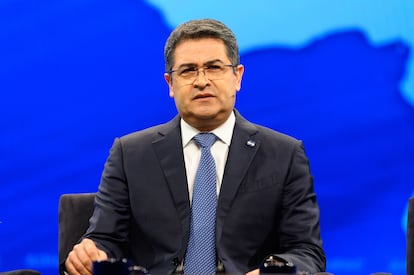

The United States and Israel, with the help of Honduras, are allegedly positioning themselves on the geopolitical chessboard to control spheres of influence in Latin America. The news outlet Diario Red en América Latina and the website Hondurasgate have revealed, in an investigation based on leaked audio recordings, the interventionist intentions of leaders of the global right. One piece of evidence, released at the end of April, claims that former Honduran president Juan Orlando Hernández, pardoned by Donald Trump from his 45-year sentence for drug trafficking — with the support of the Republican president himself, his Argentine counterpart Javier Milei, and the current Honduran administration — are conspiring to create a channel for disseminating fake news with the intention of spreading misinformation and destabilizing the governments of Brazil, Colombia, and Mexico.
The second installment of the Hondurasgate scandal, of the three released so far, includes a recording of an alleged conversation between Hernández, who had become an operative in the region for the U.S. president, and the current president and vice president of Honduras, Nasry Asfura and María Antonieta Mejía, respectively. The objective: to undermine the administrations of Claudia Sheinbaum and Gustavo Petro, both of whom adhere to left-wing ideologies.
Milei’s financial support
In the conversation between Hernández and Asfura, the former president tells the Honduran leader that he needs $150,000 to rent an apartment in the United States, where he plans to set up an office for a digital journalism unit. This unit will publish information about Manuel Zelaya, who accused Trump of “protecting the plunderer of the state,” referring to Hernández’s pardon last November, and about Xiomara Castro, who served as president until handing power to Asfura. “Someone else here, from the U.S. president’s team, will handle it for me. Well, he’s one of the Republicans who are helping us. They’re going to set up a news site for us.”
Asfura’s response is: “I’m going to transfer it from a friend’s account. Let’s see if they can give it to you in cash, but explain to me, what are we going to do with it, what do we gain?” Hernández replies: “We’re going to set up a cell, Mr. President. From here, from the United States, an information cell, so they can’t track us there in Honduras. It’s going to be like a Latin American news site. I was on a call with President Javier Milei and it was successful. Very, very, very good, and I think that at this point we can do great things for all of Latin America. There are some cases coming up against Mexico, some cases coming up against Colombia, and, most importantly, against Honduras, against the Zelaya family.”
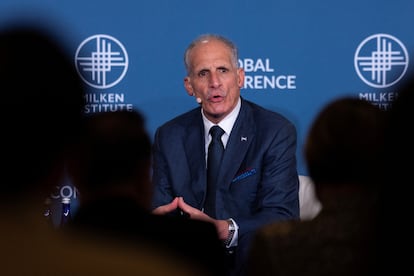
“Also, I think you need a little more money. For yourself. So we’re going to send another $150,000. And that way you can survive a little longer. We’re going to take it from INSEP [Secretariat of Infrastructure and Public Services],” Asfura says at the end of the conversation. On the same topic, in another alleged communication between the former Honduran president and the current vice president, Hernández emphasizes the importance of having that liquidity, “with the support of some Republicans,” in order to “attack and eradicate the cancer of the left” in Honduras and throughout Latin America.
“I was telling President Asfura that we were able to speak with Javier Milei, and he’s also contributing $350,000. Another great friend of ours from Mexico is also providing support, specifically for the Mexican community. We’re pretty much ready and hoping this moves forward quickly,” Hernández added, without revealing the identity of this Mexican contact involved in the project.
The conversations, according to the source, originated from WhatsApp, Signal, and Telegram. They were recorded between January and April 2026. The website that released the 37 recordings, making them available in their entirety, details that each file was analyzed using the Phonexia Voice Inspector protocol, a forensic suite from the Czech company of the same name, founded in 2006 and deployed in more than 60 countries by intelligence agencies, law enforcement, banks, and media outlets.
Sheinbaum, during her morning press conference this Wednesday, said that she did listen to the audio recordings and saw part of the news reports. The Mexican president again sent a message, though without mentioning her by name, to Isabel Díaz Ayuso, regional premier of Madrid, who is currently on a tour in Mexico, as part of an international right wing linked to groups in Spain, the United States, and Argentina that have a network to spread fake news because “they don’t like Mexican humanism” and “prefer to worship Hernán Cortés.”
“They can set up a smear campaign office against our government in Honduras, using resources from a friendly nation. It won’t affect us, not at all. There may be days of confusion, but if we remain true to our principles and know what we must do, within the framework of our Constitution, the laws, and with respect for sovereignty, no one will be able to undermine the transformation project. It’s that clear,” Sheinbaum stated.
Netanyahu’s intervention
Hernández, known as JOH, was president of Honduras from 2014 to 2022 for the conservative National Party. Those were years of cooperation with the U.S. in the fight against drug trafficking. Or at least, that was the appearance he sought to project. In 2024, he was sentenced in Manhattan to 45 years in prison for associating for more than a decade with drug traffickers who paid him bribes to ensure that more than 400 tons of cocaine reached the northern border of the Rio Grande. Three years earlier, his brother Juan Antonio Hernández had been sentenced to life imprisonment for the same crimes. The New York District Attorney’s Office had accused JOH of receiving $1 million from Mexican drug lord Joaquín “El Chapo” Guzmán.
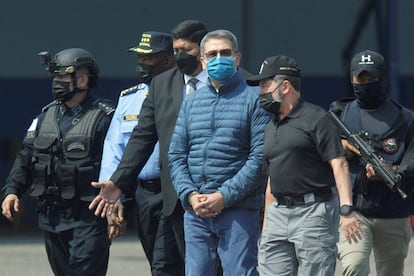
According to the same leaks from Hondurasgate, Trump’s pardon of JOH, days before the elections in Honduras, was not a gesture of clemency, but rather the initial payment in a larger agreement. In one of the recordings, Hernández explains it directly, though without revealing his interlocutor: “The pardon money didn’t even come from you. It came from a group of rabbis and people who supported Israel.” In another audio recording, he says that Israeli Prime Minister Benjamin Netanyahu had “everything to do” with his release and the negotiations that made it possible.
This alleged leak comes at a time when diplomatic relations between Mexico and the United States are at their most strained, due to Washington’s indictment and extradition request against Rubén Rocha Moya, the governor of Sinaloa, and nine other officials for alleged ties to drug trafficking. This is further exacerbated by Trump’s repeated threats to intervene in Mexico against organized crime, something he reiterated this Wednesday.
Trump’s relationship with Petro has also been less than cordial. Despite smoothing things over after his Colombian counterpart’s visit to Washington in February — but not before Petro had his visa revoked and was called a “narco” by the Republican — pressure remains on both the United States and Mexico to implement tougher and more effective policies against drug trafficking.
Sign up for our weekly newsletter to get more English-language news coverage from EL PAÍS USA Edition









































