
The US enters a new era of interventions in Latin America
Trump’s new National Security Strategy places the main geopolitical focus on the Americas and calls on the region to help curb immigration, drug trafficking, and China’s influence
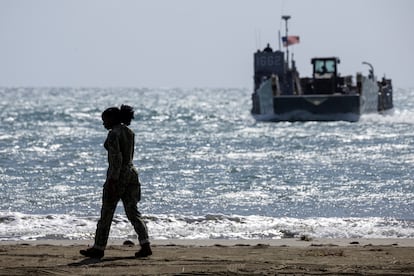

For decades, Latin America was the so-called backyard of the United States. Now Washington has declared the region its front yard. The Trump administration’s new National Security Strategy, published on Friday, places its main geopolitical focus on the Americas, to the detriment of Europe and the Middle East. Two centuries after its proclamation, the 19th-century Monroe Doctrine — which ushered in an era of Washington interventionism in Latin America directed mostly against leftist governments and sympathizers — is returning, now with Trump-era characteristics. The military campaign around Venezuela is one example. The pressure — even to the point of electoral interference — in favor of like-minded governments and politicians in a region more polarized than ever is another.
In what the White House defines as a “Trump corollary to the Monroe Doctrine,” already jokingly nicknamed the Donroe Doctrine after Donald, Latin America is seen as a source of some of the United States’ most serious problems, and is being pushed to cooperate so that Washington can meet its goals: drastically reducing migration, “neutralizing” drug cartels and transnational crime, and eliminating the Chinese investments flourishing in the region. Whether through goodwill — via economic cooperation incentives — or through pressure: the document makes clear that the large naval deployment in the Caribbean off the coast of Venezuela will remain there for quite some time.
“We want to ensure that the Western Hemisphere remains reasonably stable and well-governed enough to prevent and discourage mass migration to the United States; we want a Hemisphere whose governments cooperate with us against narco-terrorists, cartels, and other transnational criminal organizations; we want a Hemisphere that remains free of hostile foreign incursion or ownership of key assets, and that supports critical supply chains; and we want to ensure our continued access to key strategic locations,” states the National Security Strategy.
The main target, for now, is Venezuela. In that country and its Chavista regime, all the factors of U.S. interest converge: abundant natural resources including oil, transnational crime, mass emigration, a regime ideologically opposed to Washington with strong ties to China and Russia, and a president, Nicolás Maduro, whom Washington — and Europe, and other governments in the region — consider illegitimate, especially after the electoral fraud of July 2024.
Amid the naval deployment in the Caribbean, tensions are at their peak. Trump heightened them even further this week by reiterating that “very soon” the military campaign — which until now has focused solely on attacks on alleged drug-running boats and has left at least 87 people dead and 22 vessels sunk — could move into a new phase involving actions on Venezuelan territory.
The content of the new National Security Strategy is no surprise. Since his return to the White House, the rhetoric of Donald Trump and his administration had already sparked accusations of neo-imperialism and comparisons with the 1823 Monroe Doctrine, which evokes the United States’ hegemonic policy in the region and brings back the specter of its most atrocious episodes, from backing coups and dictators such as General Augusto Pinochet in Chile to military interventions — the most recent in Panama just three decades ago. In January, the U.S. president threatened to annex Greenland (an autonomous Danish territory) in the Arctic and to forcibly regain control of the Panama Canal. Since then, with anti-communist hawk Marco Rubio leading his foreign policy, the administration’s focus on the continent has become increasingly evident.
“Everything we’ve seen in recent months points to a kind of 2.0 gunboat diplomacy. You don’t have to think too hard to know that the Trump administration doesn’t understand what we used to call ‘soft power’ and thinks that the only power that exists is the power of force, and forcing people to choose to be on your side,” says John Walsh, director for the Andes and drug policy at the Washington Office on the Americas (WOLA).
Rewards for allies
What the document does do is codify this reordering of a policy in which Trump has not hesitated to intervene to help his allies or to try to harm those he perceives as hostile — a policy in which democracy is no longer invoked as an essential value, corruption is not mentioned at all, and “rewards” are promised to those aligned with him. It also acknowledges the need to cooperate with governments of a “different” orientation, provided they are willing to work together on issues of common interest. But for the recalcitrant ones, like Venezuela, it has a warning: “targeted deployments” of a military force that is going to increase its presence and may resort to “lethal force” where necessary.
Trump has met in the Oval Office with Nayib Bukele of El Salvador; he has bailed out Javier Milei’s Argentina with a $20-billion package; he has cut tariffs for those two countries and for Daniel Noboa’s Ecuador. His administration has lavished praise on Bolivia’s new right-wing president, Rodrigo Paz. And it has intervened in electoral processes — something that had seemed a thing of the past: it conditioned aid to Argentina on Milei’s victory in the October 26 elections.
Last week, it upended the elections in Honduras by expressing support for the right-wing candidate Nasry Asfura. It delivered the final blow by pardoning former Honduran president Juan Orlando Hernández, who was serving a 45-year prison sentence in the United States for drug trafficking — something that contradicts Trump’s claims that his hostility toward Venezuela is rooted in the fight against drugs.
Meanwhile, he has lashed out at Colombian President Gustavo Petro, whom he has insulted as a “thug” and “drug trafficker,” and he tried to stifle Luiz Inácio Lula da Silva with a mountain of tariffs against Brazil — only to backtrack later, forced by the surge in food prices that his decision produced in the United States.
“Vassal states, that’s what Washington is aiming for,” says former Chilean minister and ambassador Jorge Heine. “And it says so openly in this National Security Strategy. That it will deal with countries with which it shares ideological affinities and not with others. It’s a very stark statement,” adds this professor and researcher at Boston University.
Chile, in fact, is one of the countries targeted by Washington’s strategy: the second round of elections will be held on December 14, in which the far-right candidate José Antonio Kart is currently ahead of the progressive candidate Jeanine Jara in the polls. The outcome of those elections could tip the ideological balance of the region one way or the other.
Heine points, among other things, to sections in the document that specify that Latin American countries — “especially with those countries that depend on us most and therefore over which we have the most leverage” — will have to award contracts to U.S. companies without the need for public tenders. Or that Washington will do “make every effort to push out foreign companies that build infrastructure in the region,” an allusion to China, as Chinese corporations are constructing everything from ports such as Chancay in Peru to the metro system in Bogotá.
The former ambassador recalls that, in the past, U.S. companies gave up on such projects because they found them unprofitable. “What should Latin American countries do then? Say no to those projects that Washington doesn’t like and resign themselves to underdevelopment?” he asks. “The United States is too late; there’s no turning back from China’s presence in Latin America.”

First test by fire
The first real test for the new strategy will be what happens in Venezuela. The U.S. president faces a dilemma: if he acts, he risks angering his electoral base, the MAGA movement, which opposes unnecessary wars abroad. But if he limits himself to some kind of symbolic action, “the regime will continue and become stronger,” Heine argues. It wouldn’t be a demonstration of the “potent restoration of American power” as sought by the White House.
“In his ideal scenario, Trump manages to reach some kind of agreement with Maduro that gives the United States a chance to boast,” says Walsh. The fall of Chavismo would give him valuable domestic political points in places like Florida. “And there’s this idea — it’s more Marco Rubio’s — that it could generate a domino effect among the left-wing authoritarian regimes in the region. You’d have a Venezuela completely at the service of the United States, because the new government would owe its existence to the intervention. And then Nicaragua, and the jewel in Rubio’s crown: Cuba.”
But even the prospect of a Venezuela without Maduro is not without risks. The precedent of Iraq is a stark reminder that regime changes tend to be bloody, complicated, and — importantly for Trump — extremely expensive.
And if that were to happen through military intervention, “other countries in Latin America are going to start thinking very differently, in terms of their own sovereignty and being under the thumb or orders of another, even if they are more politically aligned with Washington, given the long history of U.S. interventions and how, frequently, they have ended horribly badly,” Walsh warns.
Sign up for our weekly newsletter to get more English-language news coverage from EL PAÍS USA Edition









































