
Trump makes aid to Milei conditional on the outcome of Argentina’s legislative elections
‘If he loses, we are not going to be generous with Argentina,’ the Republican warns during a meeting with his counterpart at the White House
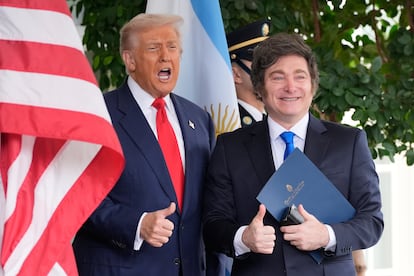
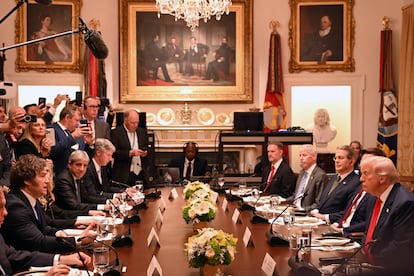
On Tuesday, U.S. President Donald Trump emphasized his support for Argentine President Javier Milei and made his backing for the country conditional on the populist leader’s victory in the October 26 legislative elections. These statements came during a meeting between Trump and Milei in the West Wing of the White House, scheduled after Washington promised a $20 billion currency swap to shore up the South American country’s economy.
“The election is coming up very soon. It’s a very big election. Victory [for Milei] is very important. Your poll numbers I hear are pretty good. I think they will be better after this,” said the U.S. president, who has declared himself open to quickly signing a free trade agreement with Argentina. “If a socialist or a communist wins, you feel a lot differently about making an investment,” he warned. “If he loses, we are not going to be generous with Argentina.”
“I’m with this man because his philosophy is correct. And he may win and he may not win — I think he’s going to win. And if he wins we are staying with him, and if he doesn’t win we are gone,” said the Republican, who has been full of praise for his counterpart. So much so that he has declared his support for him in the elections. “He’s MAGA all the way, it’s Make Argentina Great Again,” Trump said.
During the conversation, Milei emphasized that the currency exchange agreement opens “a path that allows us to move forward with peace of mind” and “show the world that ideas of freedom work.”
Milei needs Trump’s help like oxygen to breathe. Argentina is 12 days away from elections that will determine the make-up of the Congress that will accompany the far right leader until the end of the presidential term in 2027. The deterioration of the economy, a Central Bank without international reserves, and a peso under fire from the markets are jeopardizing Milei’s desire to gain deputies and senators, which will be key to passing the structural reforms he seeks. Defeat will leave him at the mercy of an opposition that will carry enough voting weight to pass laws contrary to the president’s wishes and, in an extreme scenario, even to push for impeachment proceedings.
The support of the United States will allow the libertarian to make it to the polls in one piece, at least as far as the economy is concerned. But the effect on the markets, and on voters, of Trump making his generosity conditional on the outcome remains unclear. When the Republican alludes to the danger of a “socialist” or “communist” victory, he is referring to Peronism in its Kirchnerist version. Milei agrees with this ideological viewpoint and has been stirring up what he calls “the Kuka risk [a derogative term for Kirchnerists]” during the campaign.
That risk may ultimately materialize. On September 7, Peronism swept the local elections held in Buenos Aires province, the largest, richest, and most populous in the country. Milei describes the Peronist governor of that province, Axel Kicillof, as a “communist dwarf.” If the Buenos Aires result is repeated at the national level on Sunday, October 26, Argentina’s economy will enter a scenario of unpredictable instability the following Monday. Much more so than now, as investors know that Trump will not be there with his hand outstretched, as he has warned.
The markets immediately grasped the implications of Trump’s message. When they were expecting the announcement of a possible trade agreement or even details of financial aid, what they got was a threat. Argentine debt bonds issued under New York law fell by up to 7%, and the Buenos Aires Stock Exchange, which had started the day with positive figures, turned negative in a matter of minutes.
The government rushed to exercise damage control, attempting to push the idea that Trump hadn’t made his aid conditional on the outcome of the legislative elections, but rather on the 2027 presidential elections. Milei’s spokesman, Manuel Adorni, wrote on social media that “if Argentina were to follow the path of socialism or take a step backward in 2027, none of this would happen.” Security Minister Patricia Bullrich said from Washington that Trump “will continue to support” Argentina after October 26.
The conditions set by the White House are also unclear. So far, only a few points have been clarified. Argentina will have to distance itself from China, currently its second-largest trading partner, and at the same time open up to projects by U.S. companies. Before his trip to Washington, Milei said he expects large investments in lithium, energy, copper, and rare earths. There will be “an avalanche of dollars. We’re going to have dollars coming out of our ears,” the Argentine president said in an interview. Tuesday’s meeting was the fourth face-to-face between Trump and Milei, but the first official one at the White House.
This is Trump’s second financial bailout of Argentina in seven years. In 2018, when his “friend” Mauricio Macri was in power, the Republican was instrumental in persuading the International Monetary Fund (IMF) to approve a $57 billion loan, of which $44 billion went to Argentina. At that time, Macri had lost control of the economy, with an unstoppable drain on dollars and the peso losing value day by day. The IMF’s aid was not enough for Macri to win the elections, and Peronism returned to power in 2019 under Alberto Fernández, the political heir of former president Cristina Kirchner.
In this second bailout, it is the U.S. Treasury that is coming to Argentina’s rescue. Perhaps aware of the previous experience, Trump has now warned that there will be no money if the resident at the Casa Rosada is not to his liking.
Sign up for our weekly newsletter to get more English-language news coverage from EL PAÍS USA Edition









































