
Milei suffers heavy defeat in Buenos Aires legislative elections
Cristina Kirchner’s party defeated the far-right candidates by more than 13 points in Sunday’s vote in a key Argentine province
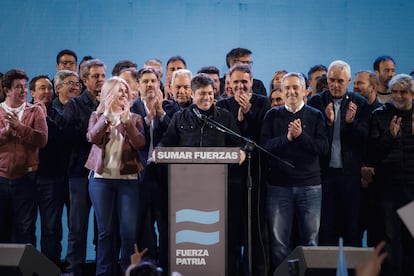

In Argentina, it’s never a good idea to write off Peronism — the dominant leftist movement for much of the past 75 years — too early. Javier Milei had to take note of that this Sunday night, much to his regret. The legislative elections in the province of Buenos Aires, where 40% of the national electorate lives, dealt a heavy defeat to the far-right president. The official results, with 96% of polling stations counted, gave Peronism — gathered in its various forms under the Fuerza Patria front — 47% of the votes in the general tally, against 33.8% for Milei’s La Libertad Avanza (Liberty Advances) party, a difference of more than 13 points. Not even its alliance with Pro, the party of former president Mauricio Macri — now reduced to a minor force within the ruling coalition — was enough to help the national government.
“Today we’ve had a clear defeat, and we have to accept it,” Milei said from his campaign headquarters in La Plata, the provincial capital. “They deployed the entire Peronist machine they’ve controlled for 40 years, and this would be their ceiling and our floor,” he added, warning right away that no one should expect major changes: “We will not backtrack even a millimeter on government policy; we’re going to accelerate the course even further. If we’ve made political mistakes, we’ll process them and do better to win in October.”
The Peronist Axel Kicillof soon after held his celebration, surrounded by candidates and local leaders loyal to him. Cristina Kirchner’s voice was heard, sending a recorded message from her home, where she is serving six years of house arrest after a corruption conviction. Kicillof then warned Milei that the polls had demanded a change of course. “The message from the ballot box is that you can’t govern for outsiders, for those who have the most. Milei, you have to govern for the people,” he said. “The elections showed that there is another path, and today we start walking it,” he concluded, with his eyes set on the national legislative elections and, in the long run, the 2027 presidential race. The rally closed, as always, with the Peronist anthem.
Sunday’s result is terrible news for Milei, who personally carried the campaign of an election that was initially irrelevant, insisted on nationalizing it, and turned it into a life-or-death battle against Kirchnerism, which holds power in the province. “We are going to put the last nail in its coffin,” he repeated over the past few weeks. “Liberty sweeps everything,” he liked to say.
As the polls stopped favoring him, he began speaking of a “technical tie.” On the eve of the election, the message from the Casa Rosada, the seat of government, shifted toward that of a “dignified defeat,” by less than five points, and the conviction that, whatever the gap, the far right would gain provincial deputies and senators. The real battle to watch, they insisted, will take place in just under two months, on October 26, when Argentines will elect national senators and deputies.
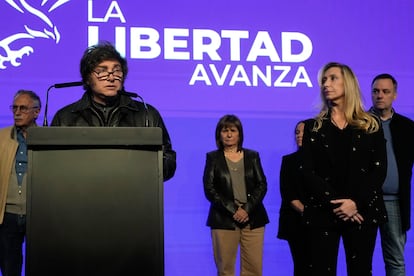
In the end, the scale of the defeat was beyond even the worst nightmares of Milei’s supporters. The nearly two months remaining until the national legislative elections now loom as an ordeal for the Casa Rosada. Market reaction on Monday is expected to be very negative. The economic team is finding it increasingly difficult to sustain the value of the peso against the dollar.
To prevent a rush to dollarize peso holdings, it first raised interest rates to 80% — triple the inflation projected for this year. Then it increased bank reserve requirements to 50% in order to reduce the supply of pesos in circulation. By midweek, it scrapped the currency bands agreed with the International Monetary Fund and sold U.S. dollars from the Treasury. At the time, Milei blamed the turbulence on what he called “the kuka risk” — that is, investor fears of a Kirchnerist victory. Now that prophecy has come true, and the outlook is far more negative than it was on Friday.

The defeat of Milei’s party has more to do with its own mistakes than with the merits of Peronism, which only barely managed to remain united amid the infighting between Governor Kicillof and his political mentor, Cristina Kirchner. The government failed to react to leaked audio recordings of a former senior official complaining about a corruption network in the purchase of medicines for people with disabilities. Responsibility for the scheme was pinned on Karina Milei, the president’s sister — the most powerful figure in the government and Milei’s emotional anchor. Days later, the publication of Karina Milei’s private conversations sent the Casa Rosada into a panic: there was a mole inside willing to do serious damage.
It was a direct hit to the government’s hull. Karina Milei cannot be replaced in the Cabinet, and she must now shoulder responsibility for an electoral strategy in Buenos Aires that ended in failure.
Weakened in government, the opposition grew stronger in Congress. In less than a week, it overturned the presidential veto of a law granting more funds for people with disabilities and gave preliminary approval to a bill limiting the use of presidential decrees. More combative behavior in Congress can now be expected.
The electoral drubbing will force Milei to recalculate, though it is far from clear how. The president has so far shown little inclination toward dialogue, and part of Sunday’s result can be traced to a combative style bordering on quarrelsome, resistant to building bridges with the opposition. All of it is seasoned with his conviction that he is carrying out a crusade fueled by “the forces of heaven.”
Peronism regroups
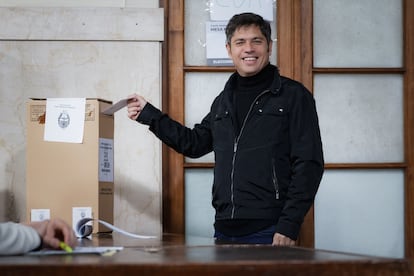
The big winner of the night was Governor Axel Kicillof, who had not dreamed of such a result. It was his decision to separate the provincial legislative elections from the national ones — at first to blunt Milei’s momentum, but also as part of his rivalry with Cristina Kirchner. The former president opposed the split from the very beginning, fearing that in October the mayors outside her camp would not throw their weight behind Kirchnerist candidates for Congress.
Kicillof can now claim he was right, and that his former political boss was wrong. His supporters want him to run for president in 2027 as the standard-bearer of a united Peronism. A victory was essential, and it will also have a soothing effect on the party’s internal battles.
The governor can now also establish himself as the leader of the opposition to Milei, to the detriment of other provincial governors from the interior who had sought to confront Milei with a federal-style coalition. Buenos Aires carries such electoral weight that any candidacy backed by Kicillof would inevitably overshadow the rest.
Sign up for our weekly newsletter to get more English-language news coverage from EL PAÍS USA Edition









































