
Spain: Straining at the seams
Despite a lower population density than other Western European countries, this nation of just under 50 million is struggling with crowded cities, insufficient investment in transportation, high electricity demand and the effects of mass tourism
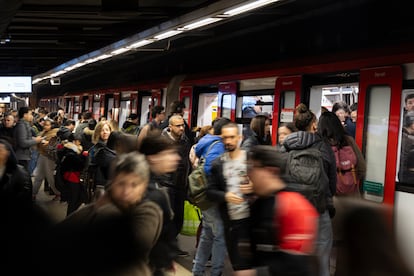
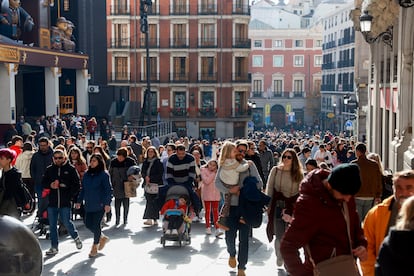
The unthinkable — regulating pedestrian traffic on sidewalks — was first considered by councilman Javier Barbero Gutiérrez a few months before Christmas 2017. For years, Madrid’s city center had been overflowing with people on some weekends. And on long weekends, it was literally packed. The level of congestion on the most popular streets resembled that of a concert, only instead of staying in one place, people moved in different directions. The narrower areas were a potential death trap. Barbero, head of the Health and Safety department, met with the police and a decision was made: on the peak days of December, Preciados Street would be used for going up from Sol, and Carmen Street for going down.
“It was heavily criticized. We were accused of taking away citizens’ freedom, but it’s a measure that has clearly remained in place because it was necessary. These kinds of crowds in transit areas create tense situations, and the line between that and a serious security problem is very thin,” the councilman recalls. The transformation of a city, or a country, never has a specific date to mark its anniversary, but some days become unexpected symbols, and that December 9, 2017 was one of them.
Last year, the city of Madrid surpassed 3.5 million registered residents for the first time and broke a record with 11.2 million tourists. This influx of people is further boosted by the 1.12 million commuters who arrive daily from outside the city to work there, compared to 790,000 in 2016. The number of trips on the metro and on buses has also broken historical records; the economy is booming, and the wider region of Madrid is approaching full employment.

Meanwhile, housing has become a luxury, the Atocha and Chamartín train stations have produced images of unprecedented chaos, and residents’ complaints about the filth have barely let up in recent years. In the city center, cleaning crews can be seen working all day long, but the garbage containers are constantly overflowing, fueled by the explosion of life and activity in the center.
There is an empty Spain, sometimes called the depopulated Spain, a reflection of uneven population distribution. Its opposite is the overcrowded, saturated Spain. We have never lived so crammed into so few places as we do now. The story of Madrid could be replicated, with some variations, for Barcelona, Palma, or Málaga, among other cities, and in coastal areas. The idea that the past was always better is false though; the data shows that today we have the largest infrastructure network to date. But the Spain that is approaching 50 million inhabitants, that has grown at a rate of half a million residents per year, that receives almost 100 million tourists annually, is being tested. There is an evident pressure on transportation, on housing, and on peaceful coexistence.
“This isn’t a two-speed Spain, but rather two different ways of occupying the territory. The population had never been so concentrated; we no longer speak so much about rural versus urban, as about coastal versus inland, and basically we are talking about four centers: the metropolitan areas of Madrid, Barcelona, Valencia, Málaga-Costa del Sol, which will soon surpass Seville, and the permanent population growth on the larger islands of the Balearic and Canary archipelagos,” states José María Ezquiaga, a specialist in strategic urban planning and former dean of the Madrid College of Architects. In his opinion, “a national urban policy is needed to promote more harmonious development, but this reflection must take place at a national level, because each territory acting separately only has a partial view of the problem.”
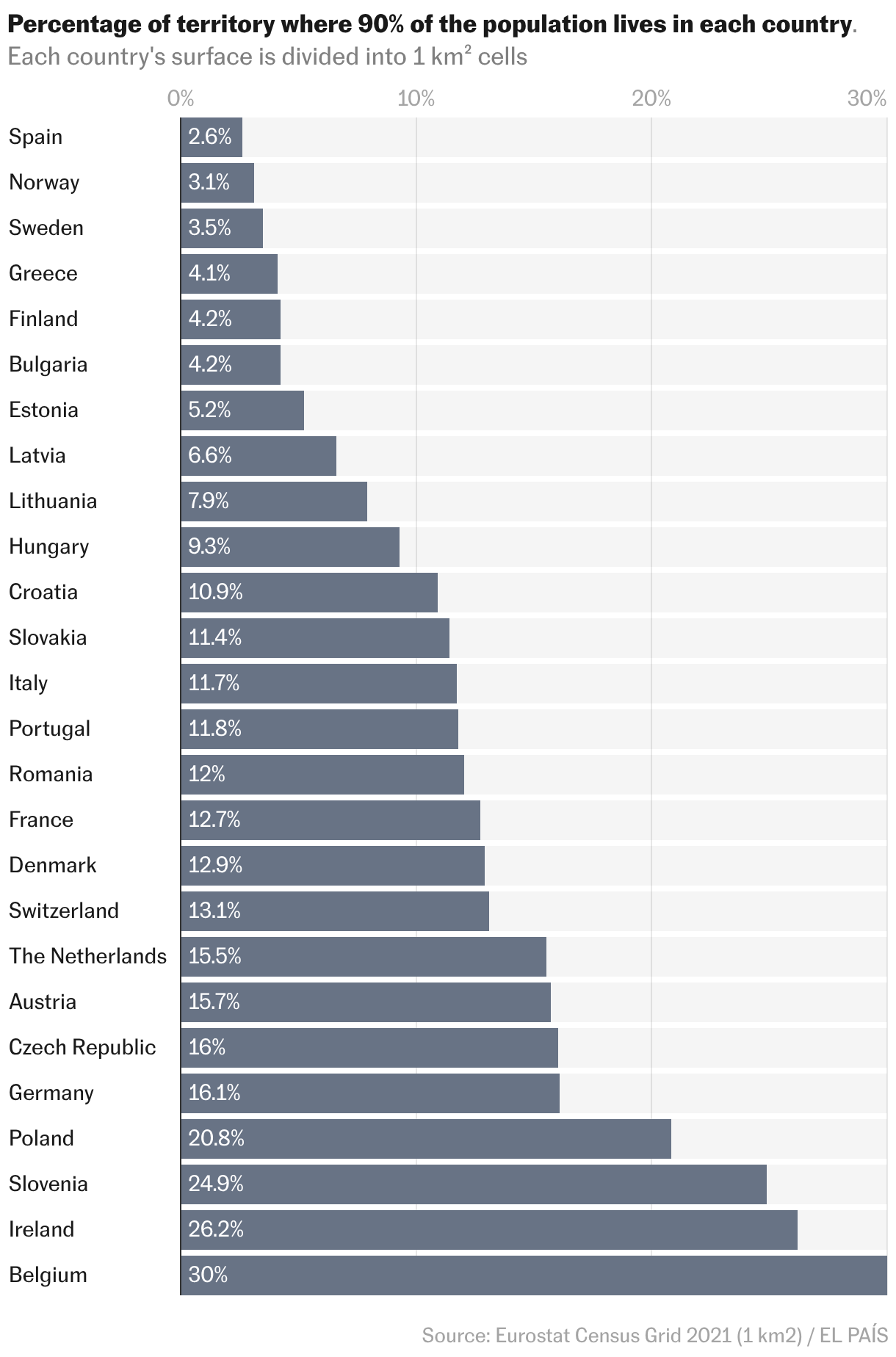
A handful of facts illustrate this concentration. Ninety percent of the Spanish population lives in 2.6% of the territory, a density unparalleled in Europe; the bulk of growth has occurred in these areas, and 30% of residents not born in cities have moved there since 2016. Catalonia, Madrid, and the Valencia region account for almost 60% of GDP growth over the last five years.
The most tangible direct effect is the rise in housing prices, which is devastating for society and the economy. The housing shortage isn’t a nationwide issue, but rather a problem in the parts of Spain where everyone wants to live. Between 2021 and 2024, Caixabank estimated a shortage of 765,000 homes, half of them in Madrid, Alicante, Barcelona, Valencia and Málaga. According to the same study, 39% of the overall price increase nationwide is due to a lack of available housing.
“I don’t see a problem of speculation in the residential market; we have a problem of insufficient supply in the areas where demand is highly concentrated,” says Jorge Galindo, a sociologist and author of Three Million Homes: How to Go from Scarcity to Abundance. According to data from Tinsa, Spain’s largest appraisal company, purchase prices rose at a double-digit rate in 11 regions last year, with record prices per square meter in Madrid (€3,799, $4,475), the Balearic Islands (€3,644, $4,292), and Catalonia (€2,549, $3,002).
The case of the islands requires a footnote. The housing deficit that Caixabank calculates, at 3.3% of the total stock of primary residences, is not particularly pronounced, which it attributes to the inherent difficulty of accessing housing, which hinders emancipation, and the obstacles to finding workers willing to relocate to the Balearic Islands.
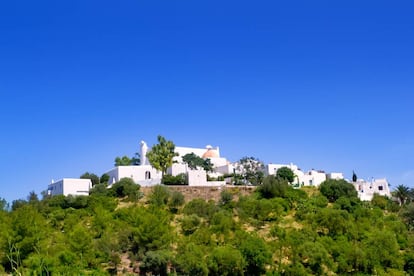
Newspapers are full of documented cases of teachers who take a plane every morning from Palma to work in Ibiza; there is also the case of José Juan, a man who came first in a competitive exam for a government job in a small town on the island of Ibiza, but had to give it up because he cannot afford to live there. The town is Santa Eulària des Riu, blessed with the most expensive square meter of land in Spain.
The journalist Joan Ferrer, author of the book Ibiza masificada (Overcrowded Ibiza) explains: “Ibiza is ground zero for excess tourism; we have 27 tourists per inhabitant, while in Mallorca this ratio is 17.4 to 1. This affects everyone, and overwhelms public services because many professionals can’t afford to live here. We’ve also normalized the fact that the waiter who serves your coffee, when his shift ends, goes to sleep in a van.” The pressure is also evident in waste management. The island’s landfill, Ca na Putxa, has been full for years, and the Balearic government has decided to start sending waste to Mallorca for incineration this summer.
Spain ended 2015 with a record 97 million visitors, and will most likely reach 100 million this year. The debate about tourist saturation or “tourism-phobia” (the devil is in the details) is being manipulated with false, maximalist dilemmas: yes or no to tourism. In reality, intermediate solutions are gaining ground. In Barcelona, a tourist mecca with 16 million foreign visitors last year, the city has decided to reduce cruise ship activity in the medium term and has an agreement with tour guide associations to reduce group sizes from 30 people to 15 if the tours take place within the Ciutat Vella district, Barcelona’s Gothic Quarter, a network of narrow streets and tiny squares where residents have difficulty getting around.
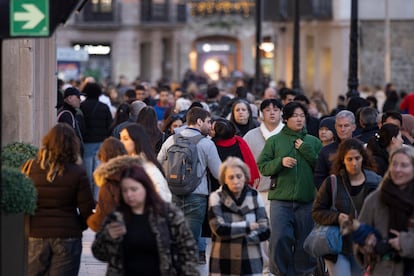
Martí Cusó, a high school teacher in his thirties and a member of the Neighborhood Association, explains the transformation of life on the streets where he grew up. “Children no longer have places to play, it’s much harder for people to stop and talk unless they sit at a table in an outdoor bar; in other words, public space has been privatized, but this is still a neighborhood with residents in it, and it seems that people are trying to forget that,” he emphasizes.
Spain already has a denser urban model than its European neighbors. A 2018 study by Alasdair Rae of the University of Sheffield in the UK compiled a series of maps used to calculate population density per square kilometer. The European champion was La Florida, a neighborhood in L’Hospitalet de Llobregat, in Spain’s northeastern Catalonia region, with 53,119 inhabitants, twice the population of Manhattan. But the problem, Cusó warns, “isn’t the density of residents if there’s enough space on the streets for life and services are functioning; the problem is the stifling of life outside the home, this privatization of public space.”
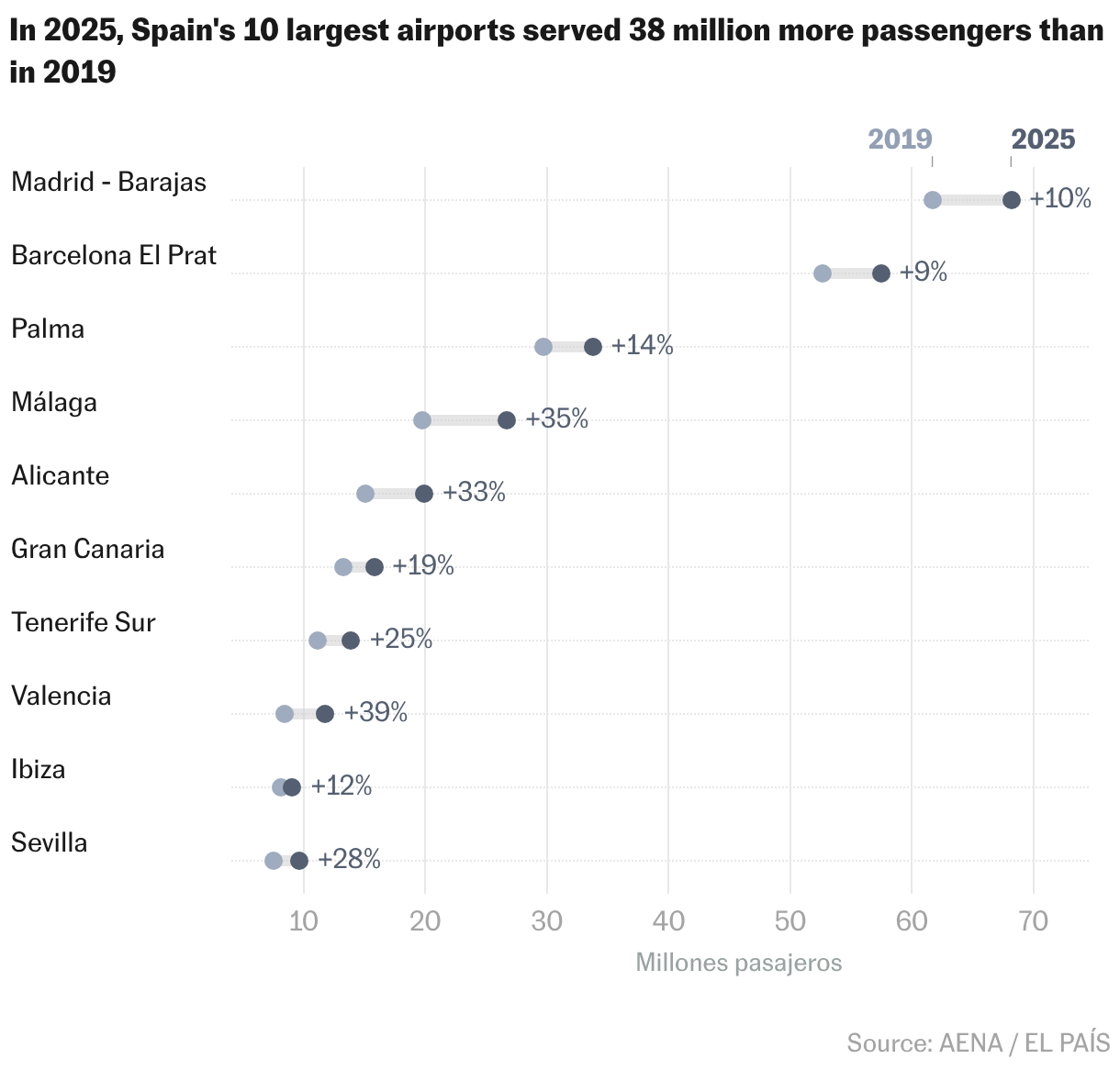
Airport traffic data speaks volumes: the 275 million passengers recorded by the entire Aena network in Spain in 2019, before the Covid shock, became more than 321 million by the end of 2025, with a record number of operations and also a record amount of freight transport.
The appeal of Madrid, Barcelona, Palma, Málaga and Alicante, the main hubs, explains this growth, which has occurred without any operational disruptions after a powerful wave of investment in the decade of 2000 to 2010. “Right after that came the crisis and the expanded airports were questioned a lot, and wrongly so. But now we are reaping the rewards of that effort, and it’s time for another strong wave of investment for expansions in Barcelona, Madrid, Málaga, Alicante, Bilbao, Valencia and Tenerife,” says Maurici Lucena, president of Aena.
The railway system, however, is in the eye of the storm. The Adamuz (Córdoba) accident on January 18, which claimed 46 lives, occurred after a long period of disruptions to the network and services, with the resulting delays and overcrowding at stations, which had already provoked outrage among users. Following the tragedy, safety measures have been increased, connections have been suspended, journey times have been lengthened, and the difficulties are expected to persist for quite some time.
The railway system, once a source of pride and a symbol of modernization thanks to its commitment to high-speed rail, faces an undeniable problem of wear and tear. The Minister of Transport, Óscar Puente, has acknowledged a €30 billion ($35 billion) investment shortfall in rail and the need to renew up to 500 trains in the coming years, but has blamed the previous government for this.
Trains and systems have aged while passenger numbers have grown. This is particularly evident in high-speed rail: with liberalization, two more companies — Iryo and Ouigo — now operate on the same tracks previously served by only one company, Renfe’s AVE. Competition has lowered prices and increased demand. Ten percent of passengers use these high-speed trains, double the figure before the pandemic. However, comparative data reveals that the problem lies not so much in the intensity of use (the Spanish train-to-kilometer ratio of 58 trains per kilometer is much lower than France’s 96, for example), but rather in the system’s adequacy. “It is necessary to identify bottlenecks in the infrastructure and stations, and implement the necessary measures,” concluded a report by the National Commission on Markets and Competition (CNMC).
Juan José Montero, a professor at the distance university UNED and an expert in railway regulation, agrees with this assessment. In his opinion, “there was a disconnect between the liberalization of the railways and the capacity of the stations.” “In the case of high-speed rail, demand has increased by families and young people who previously traveled by car or bus. In the case of commuter rail, there has indeed been a problem of overcrowding, after years of adjustments and insufficient staff replacement, coupled with an increase in commuters traveling to the capital every day,” he explains. “And all of this converges on the stations.”
Large metropolitan areas concentrate activity and employment, and this is palpable every morning in the train stations Montero mentions, as well as on the highways. “The reason for geographical mobility has always been the search for work and prosperity, and now we are more concentrated than ever because that work and prosperity are found in the capital cities and on the coast,” states Julio Pérez Díaz, a demographer and sociologist at the Spanish National Research Council (CSIC). “What is peculiar about Spain,” he adds, “is the intensity of migration, not the absolute numbers: adding 500,000 people a year to a country of 47 million inhabitants is significant, and it has to do with language, in the case of Latin America,” he adds.
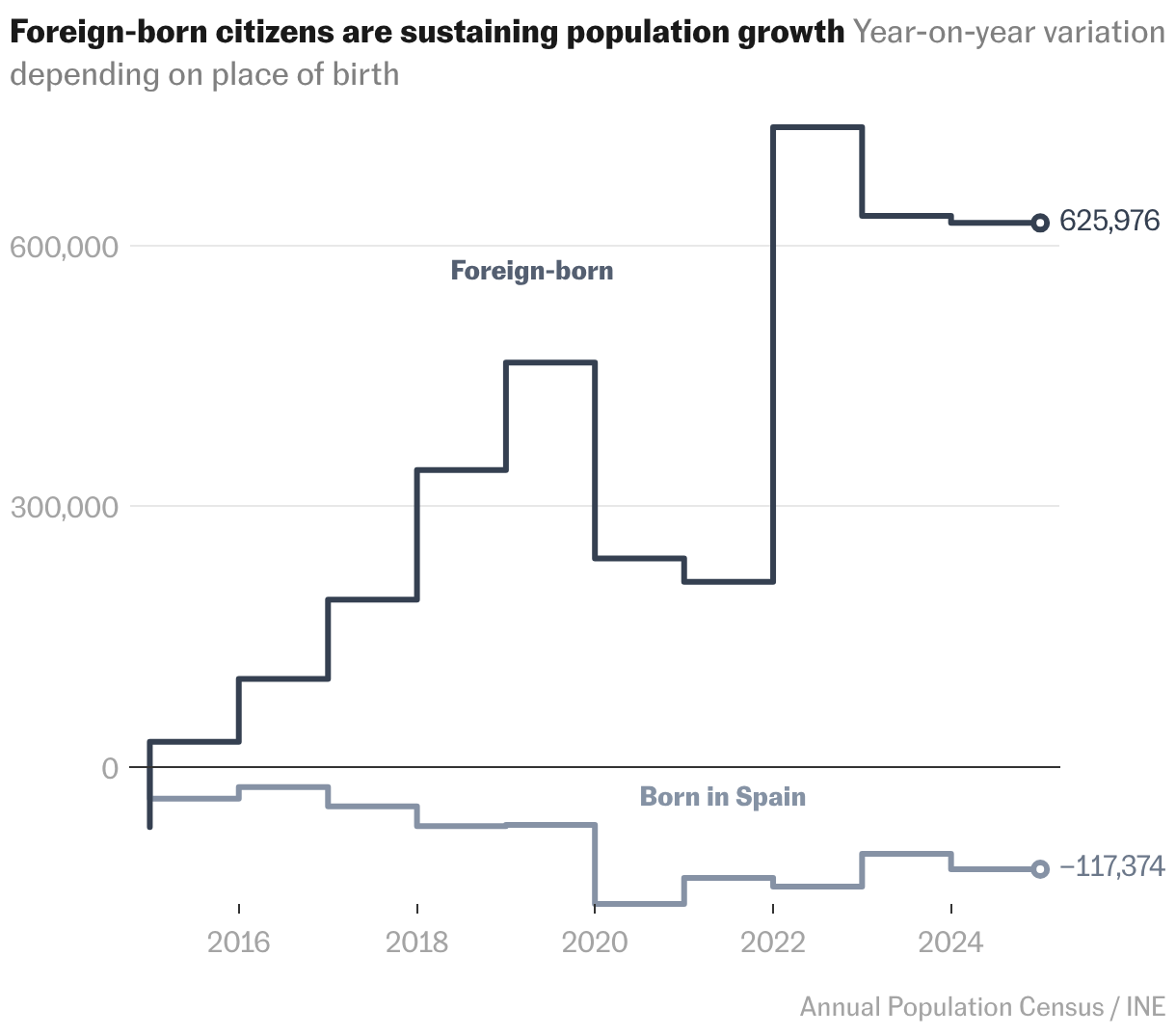
Spain has surpassed 10 million foreign-born residents for the first time, out of a total population of 49.5 million, according to data as of January 1, 2026, published Thursday by the National Statistics Institute. Without this influx of immigrants, the country would begin to shrink. The economy would not grow at the same rate, either. The incorporation of foreign workers accounts for almost half of Spain’s gross domestic product (GDP) growth since 2022, according to a Funcas report released this week. Even so, the phenomenon has ignited tensions in Spain, following a trend in the rest of Europe, and fueled extreme positions against foreigners.
The state of public healthcare and the waiting lists provide fertile ground for this battle, although the figures reveal a more complex reality. Healthcare spending has increased. However, the Ministry of Health itself has published reports admitting a shortage of 4,500 family doctors and 100,000 nurses by 2035 to reach the European Union average.
Waiting times for hospital appointments have skyrocketed in the last 10 years, from 65 days in 2014 to 105 in 2024, according to the latest annual report from the National Health System. Of the 20 EU member states that provide data on healthcare professionals to Eurostat, Spain ranks eighth in the number of practicing physicians per 1,000 inhabitants, and seventh in the number of medical staff working in hospitals.
“The seams are bursting due to the waiting lists; visits to family doctors have decreased while emergency room visits have increased — an anomaly explained by the collapse of primary care,” notes José Ramón Repullo, professor of health planning and economics at the National School of Public Health. “Many experts believe,” Repullo continues, that the problem “is not so much demographic, although that certainly doesn’t help, but rather stems from internal drivers of spending that would require improvements in governance and management.”
Some of the challenges stem from demographics; others, from demand. Economic growth has also encountered bottlenecks in the electrical infrastructure. Aelec, the trade association representing major companies like Iberdrola, Endesa, and EDP, warned last December that it had to reject nine out of ten access requests due to the saturation of electrical substations, which are commonly referred to as nodes. According to the latest available data, 88% of these nodes are saturated, meaning they have zero capacity.
This congestion not only affects the activity of industrial companies or data centers, which account for a significant portion of the demand, but also the development of new housing. “Since 2014, we have been investing below what is needed; in some cases, this is due to legal caps, in others to complaints about the compensation; added to this is the slowness of local authorities in granting permits. There is no short-term solution to this, unless flexible access to the grid is developed, as is being done in the Netherlands and the United Kingdom, and unused capacity is freed up,” says Joaquín Coronado, a veteran of the sector and now president of Build to Zero.
The problem is a reality; the debate revolves around whether regulations and compensation discourage growth, whether companies aren’t performing to their full potential, or a combination of both. “The renewable energy boom and the expected electrification of demand have driven up requests for access to the electricity grid. Contributing factors to the current congestion include regulations that haven’t sufficiently boosted investment, very slow administrative procedures, a monopolization of access by phantom, immature, or unrealistic projects, and insufficient use of available grid capacity,” says Luis Atienza, former president of Red Eléctrica. “When it comes to investing in electricity grids, it’s much better to overinvest than underinvest, especially for Spain, which will have the most competitive electricity in Europe thanks to renewables,” he adds.
Some of the challenges are linked to the age-old danger of dying from success. During the pandemic, some dared to speak of the death of cities. This news, as Mark Twain famously refuted his own death, has proven to be exaggerated. The metropolis has historically been the “El Dorado” of the working classes, and migration to them is a global phenomenon that began with the Industrial Revolution. It continues to be so. This latest wave is advancing amidst a new global order, facilitated by digitalization, and requires rethinking the structures of the entire country. That much-desired piece of land, the bustling Spain, the one that needs to bring order to its own pedestrians, is longed for, to a large extent, because of the problems of rural depopulation.
Sign up for our weekly newsletter to get more English-language news coverage from EL PAÍS USA Edition