
Madrid, the second region in Europe with the most roundabouts thanks to urban speculation: One for every 30 intersections
For years, writers like Erik Harley and the collective Nación Rotonda have examined this phenomenon, using it as a metaphor for Spain’s construction frenzy
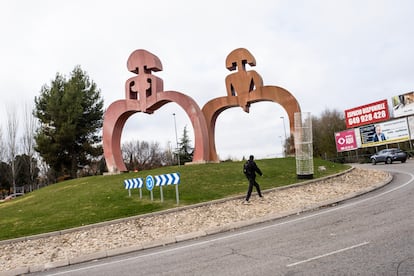

You can trace the echoes of this historic rivalry by driving from roundabout to roundabout. Leganés (population 194,000) and Getafe (190,000) — two cities in the Madrid region — have always kept a wary eye on the neighbor across the way.
Football, unsurprisingly, has perhaps best represented the competition between the two municipalities. Before both cities simultaneously reached the First Division, they spent a long time dueling in Second and Third Division. It was the late 1990s. While the fans vibrated inside unremarkable stadiums during those heated matches, real estate developers experimented with these towns as if they were playing Monopoly. The construction boom fueled growth south of Madrid, and each new development had the same cherry on top: a roundabout. In this way, Leganés and Getafe began competing in urban design as well, encouraged by their mayors.
“It was incredible, a roundabout frenzy. They multiplied everywhere,” says Erik Harley, a 32-year-old urban studies expert, in awe.
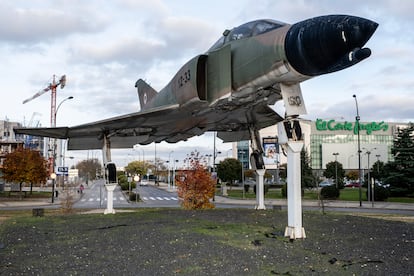
Due to its proximity to an airbase, Getafe began decorating its roundabouts with fighter jets. But the craze for creating unique roundabouts went so far that a giant bed frame was installed on Calle del Greco, while a fighting bull was put up at the entrance to the A-42 highway.
Leganés, for its part, has an endless hodgepodge of structures, and no one is clear on what they mean. The exact number of roundabouts in each municipality is unknown. Nevertheless, both have helped Madrid become the second region in Europe with the most roundabouts, after Nantes in France.
One day, at the end of Spain’s COVID-19 lockdown, when David Martínez, a man in his 40s, wanted to play at being an “artistic” photographer. In a melancholic spirit, he tried to reinvent his neighborhood, La Poza del Agua, in southern Leganés, and took his Nikon D40 with a telephoto lens to the roundabout at the town’s entrance to capture the sunset.
That act stirred something within Martínez, who has amassed thousands of photographs of this roundabout, which is decorated with seven dolls wearing skirts, each a different color. Martínez claims the roundabout is called For Women’s Rights (although there’s no record of this) and attributes to the artist Eladio de Mora-Granados. “All my works have a double reading, but what I try is that the audience smiles when they see them,” says Eladio.
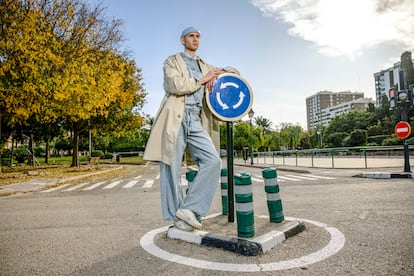
“I don’t smile at this roundabout. I come here to think,” says Martínez as he’s led around by his dog, Chulo. “When I was little, I hardly remember any roundabouts in Leganés; now, you run into one every 500 meters. It redirects traffic, but it also slows it down. Honestly, this is the only one I like. There are some that are like rusty iron; they say they’re sculptures, but I don’t see them at all. I don’t understand them. And what you don’t understand, you can’t like,” he concludes.
Erik Harley has just published his fifth book, Pormishuevismo. Rotondas & mamotretos (Pormishuevismo. Roundabouts & Monstrosities), in which, through social critique and an accessible approach, he examines the phenomenon of roundabouts in Spain. Spain is, after France, the country with the most roundabouts in the world, with 591 per million inhabitants, according to a Statista study citing figures from the website www.erdavis.com. Madrid leads the country, with one roundabout for every 30 intersections.
“Roundabouts are a metaphor for those wounds in the urban landscape that explain the concept of overdevelopment,” says Harley, whose book is partly inspired by a previous project called Nación Rotonda (Roundabout Nation), launched in 2013 and led by architects and engineers who addressed urban planning disasters and real estate sprawl. “They explain why we have confused quantity with quality, why we have confused destroying nature with generating progress. The roundabout is an excuse to talk about all of that.”
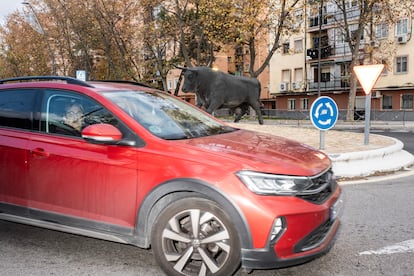
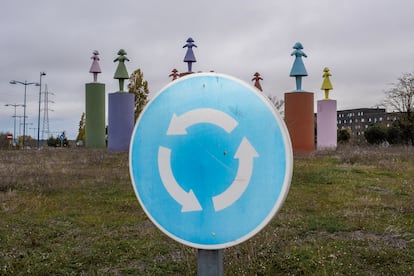
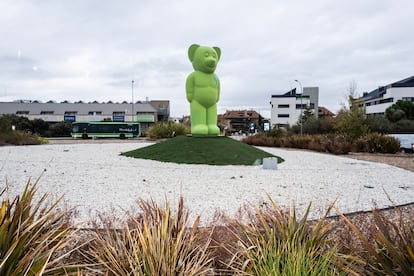
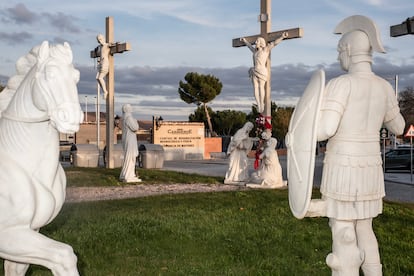

In 2015, Roundabout Nation, comprised of Miguel Álvarez, Esteban García, Rafael Trapiello, and Guillermo Trapiello, published their eponymous book, which is aimed to “serve as a warning.”
“The reality is that it hasn’t worked out that way; we’re still trying the same solution as 25 years ago,” says Esteban. “Construction is geared towards maximizing developers’ profits. It’s all the same, no matter which city in Spain you’re in. The unique has become generic. There’s no identity.”
Harley continues: “The Madrid led the runaway urban development of the property bubble and exported it. It was a kind of testing ground where any experiment was valid if it was profitable, and roundabouts are the best example of this.”
Rafael Trapiello agrees: “Madrid is the country’s center of gravity, the city that attracts the most internal and external immigrants. It has had a very strong need for growth, which is why developments have been carried out in a particularly unrestrained way here.”
Just as Alberto Ruiz Gallardón, the former mayor of Madrid, sought to secure his place in history by putting some of the M-30 ring road underground, many mayors of towns and municipalities pursued the age-old dream of immortality by installing pharaonic roundabouts that cost millions of dollars.
“For me, it speaks to something very human: the fear of disappearing from the official narrative,” says Harley. “It’s highly symbolic that these people feel the need to make a statement by leaving behind something physical mark, the bigger, the better. They think that no one will remember them for their social policies, but rather for their roundabouts. It makes no sense.”
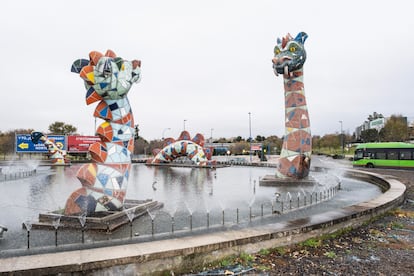
Among all these “monstrosities,” Harley singles out the so-called “Monster of Leganés,” a monumental work built from fiberglass, resin, polyester, steel, and colored tiles, located a few meters from the Butarque stadium. Eladio de Mora, the artist favored by mayors and councilors, created it as well. Not content with a single figure, Eladio added another monster “because the fountain looked too empty with just one animal,” as he stated in 2009.
Francisco José De la Poza, 20, and Carlos de Gregorio, 22, see this monster, known as Nesi, every day. Both work in a nearby technology park and return home to Fuenlabrada by bus. “Leganés is in a league of its own when it comes to roundabouts; this is top-tier,” says De la Poza. “In my neighborhood, I don’t see these crazy designs, but here they’re the norm. Sometimes they’re so ugly that you’ll miss them when they’re gone. I suppose the strategy is to slow down the cars. And they’re succeeding; the entrance and exit to Leganés is a daily traffic jam.”
Just a few minutes away, at the entrance to La Fortuna, €150,000 ($176,000) of public money was invested in a six-meter-tall Menina and Menino sculpture by the artist Máximo Riol.
Examples abound in the city of Madrid as well. Calatrava’s obelisk in Plaza Castilla embodies the “failure” of this hyper-constructionist and speculative frenzy. A Solomonic sculpture that cost €14 million ($16.5 million), €5 million ($5.9 million) of which was ultimately paid by the Madrid City Council. “The people of Madrid paid 30%, and it barely had time to be inaugurated before it stopped working,” says Harley.
The city eventually stopped maintaining it due to the high cost—about €150,000 ($176,000) per year. “It’s very sad that we build roundabouts that are like golden poles when there are still people, in Cañada Real, for example, who can’t afford a roof over their heads and are also without electricity,” says Harley. “These kinds of urban landmarks don’t celebrate anything shared, they don’t celebrate citizenship, they celebrate difference, classism, and the fact that power isn’t equal for everyone.”
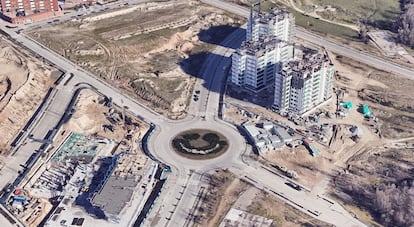
Rafael Trapiello, an engineer better known for his work as a photographer, classifies roundabouts into two types. On one hand, there are “those with sculptures” or extravagant elements in the center. According to the expert, many are financed through a federal government program that allocates 2% of the budget for public works to art and cultural projects.
On the other hand, his personal favorites are the roundabouts that contain designs only visible from the air. For example, the collection of roundabouts he shows on Google Maps in the Nuevo Tres Cantos neighborhood, where against an empty horizon, amidst half-finished buildings and in the middle of nowhere, there’s a roundabout shaped like a smiling face, another like a baseball, another an arrow, a cross, or a lifebuoy. “It sounds like a joke, but it’s real,” he says.
Madrid, by its very design, is essentially one giant roundabout: the M-30, the M-40, the M-50. “Cities without geographical features are usually organized with ring roads,” says Trapiello. “What’s happening with gentrification is a very apt analogy with roundabouts. I still refuse to believe that the center of Madrid will end up becoming a giant roundabout sculpture. Although we are heading in that direction, towards becoming a tourist attraction.”
Sign up for our weekly newsletter to get more English-language news coverage from EL PAÍS USA Edition









































