
Living in a motorhome due to soaring housing prices in Madrid: ‘I got used to it quickly, but I don’t idealize it’
Sales of these vehicles have multiplied in the last decade in Spain, where a lack of affordable housing has become a major social concern. Although the country trails far behind others such as France in its cultural acceptance of this lifestyle, more people are jumping on board
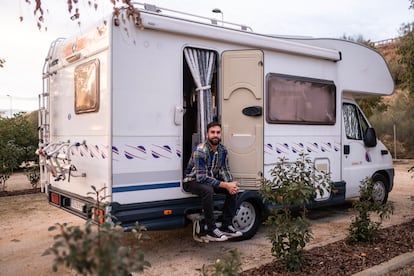

The taxi driver got the wrong impression last night. In the middle of one of those wide, deserted avenues in a typical new residential area on the outskirts of Madrid, Antonio asked the driver to stop the cab in front of a large supermarket. Before collecting the fare, the man stuck his head out the window and peeked at the top floor of a modern, 10-story building next to it. “Apartments here must cost a fortune, right?” he asked, sounding impressed. Antonio shrugged and chuckled to himself.
The taxi left, and Antonio swerved away from the building, where only 20-square-meter (215 sq ft) studios remain available for sale at a price of €210,000 ($244,000). In this neighborhood to the north of the Spanish capital, a one-bedroom apartment costs around €600,000 (close to $700,000).
Antonio headed towards a discreet, sandy parking lot surrounded by vegetation where he currently has his home. It is the cheapest housing in this area, and possibly in the entire city: a 2003 Fiat Ducato Carioca camper van that he bought secondhand in 2019 for €22,000 ($25,500). There, as he does every night, he slept soundly.
Antonio Doménech, 37, was born in Alcoy, in the Mediterranean province of Alicante. He has been a public school worker since he passed the last round of competitive examinations for primary school teachers held in the Madrid region in 2024. After several attempts, he has finally obtained a permanent position, although he is still without a definitive school assignation. No one at the school where he currently teaches — which has more than 1,000 students — knows that he lives in a camper van that he parks around a mile away. He shows up in the mornings on an electric scooter, as if he had just stepped out of one of those massive apartment blocks. “I don’t mind if people know, but I’m not going to be the one to tell them. If they find out, it’ll be because they’ve discovered it on their own,” says Antonio, who, for security reasons, prefers not to reveal the name of the neighborhood.
Antonio’s decision to move into a motorhome stemmed from a “mathematical reflection.” Fed up with sharing apartments in Madrid, where he spent most of his time in a tiny room, Antonio wondered, if he could live in such a small space, “why not in a motorhome of the same dimensions?” In 2019, when he was working as a gym instructor, rent ate up most of his salary. “Plus, commuting to and from work and his study center took me almost four hours a day. ”Being in Madrid didn’t allow me to do anything but work for a living,” he recalls. He found inspiration in YouTube videos, like the ones he still uploads to the platform today. “It was the only viable option I found to gain some independence. For me, it was the perfect plan, but I knew I’d face criticism,” he says. To convince his parents, for example, he prepared a computer presentation going over the details with images and financial calculations.
After renting rooms in numerous apartments in more central parts of Madrid, from Plaza de España to Aluche and Torre Arias, Antonio bought the “Dromolola” — as he’s named his motorhome. His first night in it was January 3, 2020, in a parking lot in Campo de las Naciones, not far from the airport. Since then, the formula has always been the same: living near his workplace “to make life easier.” “I got used to it quickly. Although I don’t like to idealize this lifestyle, because it has advantages but also many drawbacks. I don’t claim this is the ideal home because it isn’t. But for me, at this stage of my life, it’s been the right choice,” he confesses.
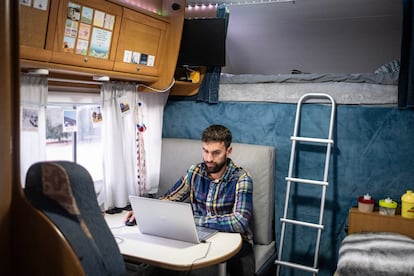
Antonio passed his teaching exams by studying in this living room, where almost every object is foldable and has a dual purpose. Once he made it onto the substitute teacher list, he realized that his camper van gave him a significant advantage over the other applicants. “The first positions they offer are always in the middle of nowhere,” he explains. “For someone from Alcorcón or Fuenlabrada, going all the way to Velilla de San Antonio or La Cabrera is impossible. That’s why people always reject them. It can take them almost two hours to get there because of the morning traffic jams or the lack of public transportation. For me, it was very simple; I could park right at the school doors and live there,” he continues. Thus, by taking the offers that others rejected, Antonio accumulated points and moved up the list much faster.
After six years, and having secured a stable job paying around €1,900 ($2,200) a month, he could now afford a mortgage or a rental, but the numbers — just like in 2019 — still don’t add up. “I’m living in a motorhome right now because I want to, not out of necessity. Obviously, if housing prices were different, I’d move to a house, which is my future plan. The thing is, after this satisfying experience in the motorhome, I’ve become more demanding, and I’m not willing to be financially strapped like I was for 10 years,” he explains. “If I had discovered this when I was 25, I wouldn’t have wasted thousands of euros on room rentals, and maybe I could already afford a house by now,” says Antonio, whose monthly expenses are under €100 ($116). For electricity, he uses two solar panels and two lithium batteries.
Three hours of sunlight a day is enough. Heating runs on propane gas, and he gets water at gas stations, where filling his 100-liter tank is free. He gets his internet access through unlimited data plans. Working a fixed schedule Monday through Friday, he barely spends any money on gas on weekends. Antonio defends his decision and points out, “There are many more people like me. Not just in Palma, but also in Madrid. People who find in a motorhome a combination of affordability and freedom. People who don’t want to, or won’t, go along with the madness we’re experiencing with housing in Madrid. I’ve heard of other cases, for example, in Moratalaz, Alcalá de Henares, the Sierra mountains, and Fuenlabrada,” he notes. Just a few miles from his parking spot, for instance, near a subway station in Hortaleza, there are several people living in motorhomes and converted cars that blend in with other vehicles.
In Spain, the number of motorhome owners has multiplied in the last decade. While 2,491 motorhomes and camper vans were registered in 2015, that number rose to 6,459 in 2024, according to data provided by ASEICAR, the Spanish Caravaning Industry and Trade Association. Last year, the Madrid region had the third-highest number of registrations after Catalonia and Andalusia, which attract the majority of the market due to their coastlines. ASEICAR defends motorhomes as a form of leisure, “not housing,” and insists on denouncing the fact that motorhomes cannot be the solution to the lack of affordable apartments in tourist-heavy areas, with a special mention for the problems in Palma de Mallorca. Current regulations allow people to park their motorhomes on public roads and to stay overnight in them. What is prohibited is “camping,” that is, extending any protruding elements such as awnings, ladders, tables or chairs.
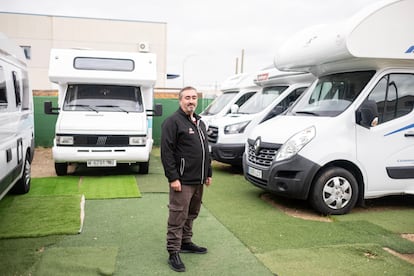
“The reality is that the housing crisis is giving our sector the final push it needed,” says José Talaván, 53, who works for Camper Van Madrid, a company that buys and sells motorhomes in Humanes. “We’re selling between five and eight a month. Before this, the average was one or two. Many of our customers want one to quit their rentals and live in the motorhome. Last week a woman came in with her dogs, and this morning a young man called. In Madrid, it’s not yet a phenomenon drawing thousands of people, but you can find quite a few cases,” Talaván explains. “Spain is 10 years behind France, where motorhomes are a cultural thing,” he notes.
Over a bowl of vegetable soup he’s heating up in the kitchen at the back of the Dromolola, Antonio confesses that he hasn’t forgotten about house hunting. He still frequently uses apps like Idealista, but now only with a view to buying, not renting. He recently visited properties and was interested in a 37-square-meter (400 sq ft) studio apartment in the centrally locate neighborhood of Tribunal that was initially listed at €215,000 ($250,000). “Three hours after seeing it, they called me to tell me it had just been sold for €240,000 [$279,000] to a Spaniard who wanted it as an investment,” he recalls.
Sign up for our weekly newsletter to get more English-language news coverage from EL PAÍS USA Edition









































