
High-speed train crash in Spain: A fatal accident in 20 seconds
The derailment of an Iryo train, followed by the collision of an Alvia train traveling in the opposite direction, caused a railway tragedy: 41 dead, more than 120 injured, nine of whom remain in the ICU
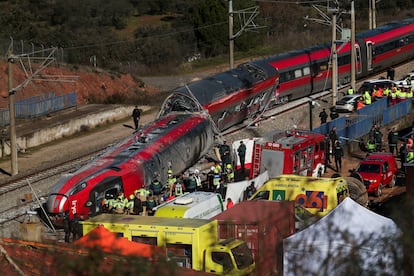

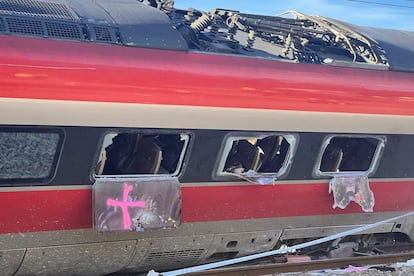
At 7:45 p.m. on Sunday, a 33-year-old consultant traveling from Málaga to Madrid in carriage number six of the high-speed train run by Spanish company Iryo, who prefers to remain anonymous, began to feel the train vibrating excessively. Then she noticed it swaying, lurching from side to side. Suitcases and bags tumbled from the overhead luggage racks, and glasses, laptops, and other items on the tables fell to the floor. The passenger, who was seated at the time, remained in her seat but saw the attendant pushing the food and beverage cart fall to the floor, unable to regain his balance. “Then the train stopped and the lights went out,” the passenger recalls.
At 7:45 p.m. and 20 seconds later, Rocío Flores, 30, who was sitting in carriage eight of the high-speed train run by Alvia traveling from Madrid to Huelva, felt such a violent jolt that it literally ripped her from her seat and propelled her several meters over the seats in front of her. She landed in the aisle and, bewildered and terrified, sincerely believed she wasn’t going to get out of that carriage. Moments later, she called her parents, convinced it would be the last time she called them. She told her mother she loved her.
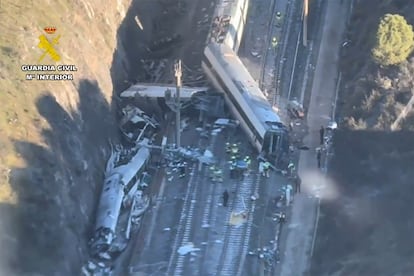
Neither of the two women knew at that moment — and it would be several hours before they found out — what had just happened, what had just happened to them. The Iryo train, traveling at 210 kilometers (130 miles) per hour and carrying 300 passengers, derailed for reasons still unknown, and three carriages, numbers six through eight, occupied the parallel track. Twenty seconds later, the driver of the Alvia train, who died in the accident and was traveling in the opposite direction at 205 kilometers (127 miles) per hour, crashed head-on into these last two carriages of the Iryo. He had barely 20 seconds, not enough time to react, between the derailment and the collision.
Neither train was exceeding the speed limit. But, due to a basic law of physics, the trains — and the passengers — experienced an impact equivalent to hitting a wall at more than 400 kilometers (248 miles) per hour. After the impact, the first two carriages of the Alvia train, carrying 53 passengers — including a friend of Rocío Flores — traveled nearly 200 meters before plunging down a four-meter embankment against a rock face that ran parallel to the track. The Iryo train continued on its track, traveling in the opposite direction, with its last three carriages derailed, swaying and lurching, until it came to a stop at the Adamuz maintenance station, about 700 meters from the other train. Then the power went out.

As a result of this accident, the third most serious to have occurred in Spain since the 1970s, at least 41 people have died and 122 have been injured. As of Monday evening, 41 people are still hospitalized, nine of them very seriously.
After the initial shock, terror, and surprise, the consultant, who was returning to Madrid for work on Monday, gets up from her seat. She hears the workers asking any doctors and nurses on board to move to the back of the train, to carriages six, seven, and eight, the most damaged. Her carriage, No. 6, was only grazed. She watches as some people she assumes are doctors run toward the back of the train.
Then she hears another worker, with remarkable composure and determination, ordering passengers without medical knowledge to move to the front carriages. He urges them not to leave the train for safety reasons. An hour later, they are allowed to go outside. It’s very cold. Through calls from friends and acquaintances — more up-to-date on the news than she is — she learns that her train has collided with another. But she doesn’t see any other train anywhere. At that moment, the television reports that there have been at least some fatalities in the accident. The traveler knows this, because someone, very soon after, even before they were allowed to get off, had told her that there was a dead body in her own carriage. She begins to see people limping along, shivering with cold, from the end of the track, coming from the other train, the one she can’t see, and it is then that she realizes what her friends are telling her is true.
Perhaps one of the people the traveler sees moving toward them is Rocío Flores, who has already convinced herself that she won’t die in that corridor and who, along with the rest of the passengers who were with her in the carriage — No. 4, the least affected — are making their way out as best they can. She notices that her chest hurts, that she has bumps on her head, and she feels like vomiting. She sees that she is injured — or at least not unharmed.
But as she moves forward, and sees Civil Guard officers and doctors, she notices a man lying near a ditch without legs and, a little further on, she sees another corpse. She moves forward alongside her friend Lola, who was with her in the carriage. Her other friend, Elena, who was traveling in carriage No. 1, is missing. The three had gone to Madrid to take a civil service exam for prison officers.
“Don’t look at the ground,” Rocío tells herself, repeating it aloud to Lola so they won’t focus on the bodies. But it’s impossible to look away. Every few steps she stops and vomits. The two women see a boy walking barefoot, covered in blood. They approach him, take the backpack he’s carrying, and put it on themselves. They ask every police officer they encounter about their friend Elena.
In Adamuz, a town of 4,100 people in Córdoba province nestled between the Guadalquivir River and the Sierra Morena mountains, the news of the accident on the high-speed rail line near their town spread quickly. The mayor of Adamuz, Rafael Ángel Moreno was alerted by the 112 emergency services. He headed to the scene, along with Antonio Ruiz, the local police chief, and his two officers. Along the way, the police chief went over things he couldn’t forget, like ensuring the municipal pavilion was heated.
In the darkness, using flashlights, they discovered groups of disoriented passengers wandering around the area. Through the town’s WhatsApp groups, word spread that help was desperately needed, that the first priority was to get people out of the train cars and transport the injured to the town. Gonzalo Sánchez is one of the first to arrive. He finds an injured man who begs him to rescue his mother from a carriage that no one dared approach because it might tip over completely. Realizing how useful his quad bike could be on such steep terrain, he heads back to the town to get it. He spends much of the night transporting rescuers on the outbound journey and injured people on the return.
Gradually, the death toll reported in the news begins to rise: nine, eleven… Past midnight, Spanish Transport Minister Óscar Puente holds a press conference, stating that after speaking with “railway experts,” the accident was “genuinely strange”: it had occurred on a straight stretch of track, with trains running below the permitted speed, on a track that had been “completely renovated.” No one dares speculate on the cause. An investigation is launched to clarify what had happened. A multidisciplinary team of experts will comb the stretch of track where the derailment occurred, centimeter by centimeter. The group will operate under the supervision of the Railway Accident Investigation Commission (CIAF), an independent body under the Ministry of Transport. A judicial investigation has also been opened and officers from the Judicial Police Unit of the Civil Guard have already begun taking statements from several witnesses, including both travelers and train personnel.
In Adamuz, long before Puente appeared, text messages were circulating from cell phone to cell phone. One of them read: “Blankets and water are urgently needed to take to the municipal building due to the derailment of two trains in Adamuz. Any help is needed; the caseta is open.” What is called the “caseta” is actually a municipal hall the size of two basketball courts with a very high roof. Residents go there with blankets, bottles of water, sweets, and juice. One of them is Mónica Naranjo, who brings blankets but doesn’t have the heart to stay and help. She goes back home and, along with her 15-year-old daughter, stays up all night, crying and thinking about the people she has just seen at the sports center.
The owner of the grocery store opens to supply everyone with cold cuts for sandwiches. The bakery does the same. The owner of an aluminum carpentry workshop loads a generator and takes it to the trains to illuminate the scene where more and more rescue teams are trying to help the injured. The municipal hall, hastily converted into an emergency clinic, receives the injured. Some walk in on their own, carrying their travel bags, like the consultant. Others arrive in serious condition and are rushed to hospitals in Córdoba or Andújar. Rocío Flores finds her parents there; they have come from Huelva. She continues to vomit and the doctors fear she may have a concussion and recommend she be taken to the hospital. She still hasn’t heard from her friend Elena.
Elsewhere in town, the families of passengers like Elena, who are missing, who aren’t answering their cell phones, whose whereabouts are unknown, begin to gather. They will spend that agonizing night waiting for news that never comes.
By morning, the death toll has reached 40. The townspeople are proud of what they have done and saddened by what they have seen. Mónica Naranjo cleans the floors of the Municipal Hall, where there are still hundreds of blankets piled up and boxes full of water. The streets are swarming with journalists. Strange trucks carrying heavy machinery drive along the roads surrounding Adamuz. The machinery will be used to lift the train cars and the maze of twisted iron, because there are still bodies lying beneath the trains.
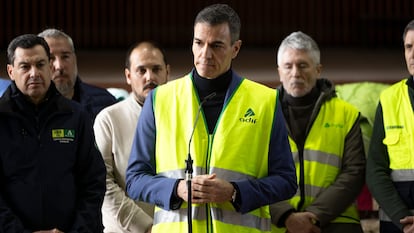
Shortly after 2 p.m., Spanish Prime Minister Pedro Sánchez, from the Spanish Socialist Party (PSOE) and Andalusian Premier Juan Manuel Moreno Bonilla from the Popular Party (PP) appear in Adamuz. It was an image of national unity in the face of tragedy. Sánchez thanked Moreno for his work and tone and promised to clarify the cause of the accident as soon as possible: “We are all asking ourselves how this happened, what happened.”
Meanwhile, some passengers remain missing. Their relatives — their parents, their siblings — arrive at the Poniente Civic Center, arm in arm, silent, their eyes lost in something only they can see. It’s a constant, heartbreaking trickle of people submitting to DNA testing to identify the body of their loved one and finally lay them to rest.
But amid all the horror, there are small moments of relief. Rocío Flores was discharged on Monday morning. She has a bruised rib, but it isn’t broken. The bumps on her head are just that — bumps. And at 4 a.m., while lying in her hospital bed, she received a call from her friend Elena, who was in the ICU at Reina Sofía Hospital in Córdoba but out of danger. All three friends who had gone to Madrid on Sunday to take the civil service exam survived. “The strange thing is that, with all this going on, I don’t remember anything about the exam.”
Sign up for our weekly newsletter to get more English-language news coverage from EL PAÍS USA Edition









































