At least 41 dead in collision between two high-speed trains in Spain
Prime Minister Pedro Sánchez has canceled his trip to Davos and will visit the scene of the accident. The Transport Ministry warns that the death toll could rise
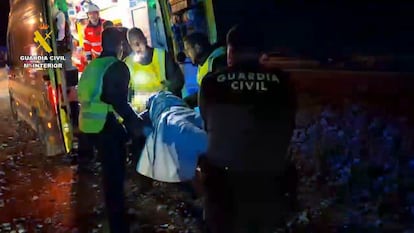
The derailment of two high-speed trains in Adamuz (Córdoba) on Sunday has caused at least 41 fatalities and dozens of serious injuries, with victims already transferred to hospitals, according to sources from the Civil Guard and the Andalusian emergency services. Forty-eight people remain hospitalized, 12 of them in intensive care units in the city of Córdoba. An Iryo train traveling from Málaga to Madrid derailed shortly after 7:30 p.m. and fell onto the tracks where an Alvia train was traveling at 200 kilometers per hour (125 mph) in the opposite direction toward Huelva. One of the fatalities was the driver of the second train. A total of 484 passengers were affected on both trains, and the reasons for the derailment are unknown at this time. Minister of Transport Óscar Puente spoke to the press after midnight and predicted that there may be more fatalities, although he did not want to speculate on the number. Puente pointed out that the track was in good condition, having been renovated in May, and therefore described the accident as “very strange.” The Andalusian regional government has requested the intervention of the Military Emergency Unit (UME) to assist in the rescue efforts, and sources from the regional government have confirmed that the specialized army unit is already in the area.
The Iryo train had departed from Malaga at 6:40 p.m. bound for Puerta de Atocha (Madrid) when, at 7:39 p.m., it derailed near Adamuz. Specifically, the rearmost cars (six to eight) came off the tracks and crossed the path of the Alvia train from Madrid to Huelva, which was traveling at 200 kilometers per hour parallel to the Iryo train at that moment. The Iryo train then caused the Alvia train to derail and fall down an embankment about five or six meters high, according to official sources. There were about 50 people traveling in the cars that crashed. The Iryo was not traveling at such a high speed — although it has not yet been determined how fast it was going — so it was able to brake shortly after the accident. The deceased train driver was 27 years old. Sources close to the investigation report that all of the seriously injured passengers (30 in total, five of whom are in critical condition) have already been taken to the hospitals that have been mobilized.
Shortly after the accident, Puente traveled to Renfe’s H-24 emergency center at Madrid’s Atocha station to monitor developments. After midnight, he appeared at a press conference to explain that all those trapped had been rescued and taken to six hospitals in Andalusia, and announced the creation of an independent commission of inquiry, as required by law, to clarify the circumstances of the accident. The minister expressed his surprise that the Iryo train had derailed and collided with the Alvia train, where most of the fatalities occurred. “The Iryo train is practically new and the track has also been renovated. Specifically, replacement work on this section was completed in May. The accident is extremely strange, as it happened on a straight line. All the experts we have consulted are extremely baffled,” he said.
The mayor of Adamuz, Rafael Moreno, was the first to arrive at the scene of the accident with the local police and saw at least one body several meters from the point of the accident. “I saw a passenger who was torn to shreds. We were the first to arrive, and there was a body cut in half. But there was no light; it was nighttime. The scene was horrific,” he said in conversation with EL PAÍS.
In an official statement, Iryo said it “deeply regretted what had happened” and that it had activated “all its emergency protocols.” Passengers on both trains had to be evacuated, according to state-owned railway infrastructure manager Adif, and service was suspended on the high-speed line between Madrid and Andalusia. The minister noted that incidents affecting train traffic can last for weeks. For the time being, the railway administrator has also confirmed that service between the capital and Córdoba, Seville, Málaga, and Huelva will remain suspended throughout Monday.
For its part, Renfe also issued a statement after 11:30 p.m. indicating that its president, Álvaro Fernández Heredia, is traveling to the accident site. Information points for family members have been set up at the affected stations, and a psychological assistance group has been set up in Madrid, Córdoba, Huelva, and Seville to assist both the victims and their families.
“There are many injured, I’m still shaking,” said María San José, 33, a passenger in car number six of the train traveling from Málaga to Madrid. Cars seven and eight collided with the front of the other train. San José told this newspaper that the passengers suddenly began to feel vibrations: “And lots of banging, suitcases started falling, and more banging until the train stopped,” explains San José. “We thought it was a derailment, but when we got out we saw the twisted carriages and two carriages from the other train upside down,” she added. “We don’t know anything, we still don’t understand what happened or how many people may have died.”
The chief fire officer in Córdoba, Paco Carmona, explained on state broadcaster TVE that crews have been rescuing people with all kinds of injuries, including “cuts, bruises, contusions, open fractures...” He also said that it is difficult to access the affected carriages because they are “twisted” and there is “scrap metal,” seats, and all kinds of obstacles that make it difficult to reach the victims. “We have two trains about 800 meters apart, and we have already finished removing the dead and injured,” he added, referring to the Iryo train.
A journalist from TVE who was on one of the trains, Salvador Jiménez, also described how a strong impact that felt like an “earthquake” shook the car. From that moment on, they grabbed the emergency hammers to open doors and windows and began to leave the train. The journalist described in a television interview that there had been several hours of “great uncertainty” and that, at this moment, they were waiting to find out how they would be transported away from the scene by bus.
Prime Minister Pedro Sánchez reported on his Twitter account that the government “is working with the other competent authorities and emergency services to assist the passengers” and in a second message, at around 1 a.m., he expressed his condolences to the families of the victims: “Today is a night of deep sorrow for our country due to the tragic train accident in Adamuz.” Sánchez has canceled his planned trip to the World Economic Forum in Davos to travel to the scene of the accident.
The Royal Household also expressed its condolences “to the families and friends of the deceased” and has assured that it is following the aftermath of the accident “with concern.” “Our love and wishes for a speedy recovery to the injured,” the royal family said on X.
Sign up for our weekly newsletter to get more English-language news coverage from EL PAÍS USA Edition