
Cuba, Donald Trump's next target
The US president warns almost daily that the island ‘is in its last moments’ and must negotiate an agreement
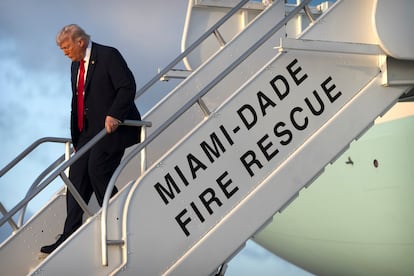

Since the January 3 attack on Venezuela, when Nicolás Maduro was captured, U.S. President Donald Trump has repeatedly insisted that Cuba’s regime is about to fall. He has said that it must reach an agreement with the United States to avoid terrible consequences. Since the beginning of the offensive against Iran, these statements have become daily, making clear that Trump — convinced that his forces are invincible — sees Havana’s government as the next target on his list, once the operation in Iran is declared over.
Ending Cuba’s communist regime — nearly 70 years after Fidel Castro entered Havana from the Sierra Maestra — has long been a major goal for both Trump and U.S. Secretary of State Marco Rubio, the son of Cuban immigrants raised in Miami’s fiercely anti‑Castro environment. It is also a fervent aspiration of many Cuban exiles in South Florida and of Republican lawmakers for whom the votes of that community are essential.
Trump’s most recent statements about Cuba came on Saturday, during the presentation of the Shield of the Americas, a new alliance of 13 Latin American countries led by right‑wing governments. At his golf club in Doral, near Miami — where Trump had decided the meeting should be held — the president announced the creation of a new military coalition to combat drug trafficking, which he described as the only path to success. It was the star announcement of an event meant to highlight the United States’ commitment to Latin America, at least to governments that are ideologically aligned. “As we achieve a historic transformation in Venezuela, we’re also looking forward to the great change that will soon be coming to Cuba,” Trump said.
The island, he argued, “is in its last moments of life as it was. It will have a great new life, but it is in its last moments of life as it is.” But he added that his attention “right now” is focused on the war in Iran: he moved up his appearance in Miami in order to arrive in time for the repatriation ceremony for the bodies of U.S. soldiers killed in Iranian attacks at the start of the conflict.
In his remarks, Trump repeated — for the third time in as many days — that the Cuban government will not be able to survive now that it has lost the economic support it received from Venezuela. That government, he argued, is therefore interested in negotiating some kind of exit with Washington. “They want to negotiate,” Trump said. He also stated for the first time that he himself is involved in those talks, which are led by Rubio. U.S. media report that the Cuban government is represented in those contacts by Raúl Rodríguez Castro, the grandson of Raúl Castro, the regime’s strongman.
Trump did not, at any point, mentioned the possibility of using force to bring about regime change on the island. On the contrary, he has consistently maintained that it will not be necessary, arguing that the country is too economically strained to withstand another blow — specifically the one he delivered by pressuring Caracas to withdraw its financial support and by threatening sanctions against governments that supply oil to Cuba.
Meanwhile, he has been taking steps to link the Cuban and U.S. economy. On February 25, he began allowing U.S. fuels, such as diesel, to be supplied to the island’s private sector, despite the embargo Washington has maintained for more than six decades. Trump himself has recently spoken of the possibility of a “friendly takeover” of the island, in an apparent reference to this gradual economic approach.
In parallel, the U.S. Department of Justice has formed a task force to examine possible federal charges against officials or entities of the Cuban government, according to reporting this week by The Washington Post. Federal agencies, including the Treasury Department, will be part of this group, which could indicate that the Trump administration is considering new sanctions against the island.
The Department of Justice used a similar strategy with Venezuelan leaders. Last year, it labeled Nicolás Maduro and several members of his government as “terrorists” and accused him of collaborating with criminal organizations such as Venezuela’s Tren de Aragua or Mexico’s Sinaloa Cartel to bring drugs into the United States. “[Maduro] is one of the most powerful drug traffickers in the world and a threat to the national security,” Attorney General Pam Bondi said last summer. At that time, the U.S. government doubled the reward for Maduro’s capture to $50 million.
Trump’s Latin American allies are also tightening pressure on the regime. Ecuador, under President Daniel Noboa, announced on Thursday the expulsion of Cuba’s diplomatic mission in Quito after accusing it of espionage. A day earlier, the Ecuadorian government and the U.S. military had announced a joint operation between their armed forces against “narcoterrorism.”
“I just want to wait a couple of weeks,” said Trump on Friday during a meeting at the White House with the Inter Miami soccer club, winner of the MLS league last season. “[Rubio’s] waiting, but he says, ‘let’s get this one [Iran] finished first,’” Trump added on
“What’s happening with Cuba is amazing,” Trump added at the meeting, which was attended by Republican legislators from Florida and businessmen close to the Cuban exile community. “And we think that we want to finish this one [Iran] first, but that will be just a question of time before you and a lot of unbelievable people are going to be going back to Cuba, hopefully not to stay. We want you back and we don’t want to lose you. We don’t want to make it so nice that they stay. But some people probably do want to stay. They love Cuba so much. I hear it all the time.”
Sign up for our weekly newsletter to get more English-language news coverage from EL PAÍS USA Edition









































