
Was grandpa a Nazi? Germans rush online to search the newly released National Socialist archive
More than 1.5 million people are looking up relatives in the digitized membership files now published by the United States
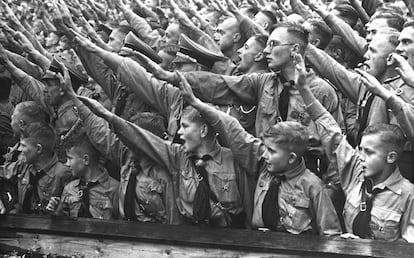

Was it the grandfather who was a Nazi? Or the great‑grandfather? Or the grandmother? These are difficult questions to answer. Many families kept silent, and their children — perhaps out of fear of learning the truth — never asked. They moved on, pushing aside everything lived during the Second World War. But now the digitized membership files of the Nazi Party are available to everyone. There’s no need to ask anyone anymore; a few clicks is all it takes.
Being able to delve into one’s family history so easily has unleashed a wave of searches, which has momentarily overwhelmed the server of the U.S. National Archives, which published some 12 million digitized files of the National Socialist German Workers’ Party (NSDAP) on the internet at the end of March.
No more tedious requests — now you simply type a name into a search bar. And to make it even easier, the German weekly Die Zeit has created an online tool using those records, sparing users from navigating a digitized microfilm. A simple search engine displays the membership card directly. According to the U.S. National Archives, more than 1.5 million people have accessed the microfilms since they were published online. Meanwhile, Die Zeit says it has received “millions of visits,” and that the search tool has been shared “thousands of times.”
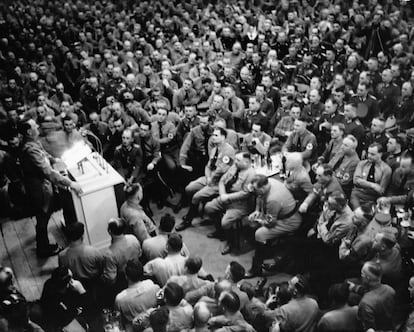
More than 80 years after the end of World War II and the Holocaust, in which some six million Jews perished, many families are still discovering that one of their relatives had been a member of the Nazi Party. It’s important to remember that in 1945, shortly before its collapse, the NSDAP had 8.5 million members out of an adult population of around 55 million.
“We knew absolutely nothing,” explains Michael Dickreiter about his family’s past. “Our daughter and our eldest grandson, who is studying political science, called us, horrified when they discovered that my father had been in the party,” he says by phone from Konstanz, in southern Germany, about his father, Hans, who was born in 1907. “I was stunned, because, honestly, from everything I know about him — and I knew him for many years — it seemed completely impossible to me that he belonged to that ideology.”
His daughter and grandson were the first to find out through Die Zeit. Dickreiter, 84, opened the search engine later. “My first thought was that perhaps his boss had forced him to join. My father wasn’t in the war because he was declared indispensable. He didn’t have to go into the army. And perhaps that was the price, I thought. But it’s not true. His bosses weren’t in the party.”
Dickreiter also looked up the names of his father’s three brothers and sister. His aunt wasn’t in the party, but his three uncles were. Two of them were teachers and joined on May 1, 1937. “You know that between 1933 and 1937 it wasn’t possible to join. That is to say, they had probably been thinking about it for two or three years.”
But the real shock came with the third brother, Uncle Eugen, who worked in metalworking. “We always had the impression that he was a communist,” says Dickreiter. His uncle Eugen, who emigrated to the U.S. in 1936 and returned to Germany in the 1950s, joined the party in 1927, something Dickreiter couldn’t have imagined until he saw his Nazi membership card. “But you have to understand that it was a workers’ party. It wasn’t a party of intellectuals,” he says.
At that time, being a member meant publicly declaring support for the ideology. It’s important to remember that men were required to serve in the Wehrmacht (the unified, regular armed forces of Nazi Germany) — unless exempt — but they were not required to join the party, although in some professions there was strong social pressure.
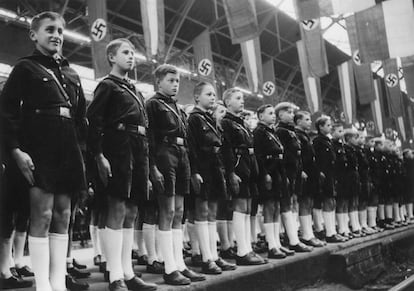
Hans, who was working in the fuel business at the time, joined the party in 1941. Dickreiter admits that the fact he didn’t join very early on is somewhat reassuring. However, he recalls discovering a Nazi flag in the attic of their house once, but assumed it was commonplace at the time. Like in many families, he never spoke to his father about that period. “He never said anything about it, and of course, I never asked him about it either.” Now, he has no intention of delving further. “For me, the matter is closed,” says Dickreiter, adding that he will discuss everything with his children again.
The “inability to mourn” diagnosed in the 1960s by psychoanalysts Margarete and Alexander Mitscherlich in postwar German society — along with the “derealization” of the past — also encompassed the tendency to hide or ignore former membership in the NSDAP. Later, the early‑2000s study Grandpa Wasn’t a Nazi showed how, in many families, the belief persisted that their own relatives had not been Nazis, that they had somehow opposed the regime. But opposition and resistance were the exception.
“It must always be said that it was also a two-sided pact of silence. I think this narrative of silence is, in part, a justification for the next generation, because it explains why one didn’t ask questions. So now the grandchildren must also ask their parents: ‘Why did you tell me false stories about my grandparents?’” says historian Johannes Spohr, who helps investigate family history through the organization Present Past.
In his view, the desire to know has grown markedly over the past five years. He says interest increased “considerably,” and now, with this simplified access to the archives, it is “extremely appealing.” The reluctance until now stemmed from fear of the archives and “inhibitions when addressing the subject itself, which for a long time were very pronounced, for example, in the form of rejection, denial of guilt, and repression.”
“These mechanisms have been present for decades, but in recent years, they have weakened in some social circles. This is probably due to the passage of time, but also to the decline in loyalty to older generations, as well as current political and social developments, such as the rise of right-wing movements,” explains Spohr, who acknowledges that for younger people it is “somewhat easier to ask certain questions.” But, at the same time, he warns of that some people see having a Nazi past as “a source of pride.”
Until the U.S. archives were published, the only way to consult these records was through Germany’s Federal Archives, and only after submitting a formal request and meeting a series of legal requirements. “The Federal Archives are currently seeing a notable surge of interest in NSDAP membership files,” says spokesperson Elmar Kramer, describing the recent wave of attention. “In recent years, we have received more than 75,000 inquiries annually about individuals from the Nazi era — whether related to the NSDAP, the Wehrmacht, or other topics,” he adds, without offering further detail.
But the NSDAP files reveal far less than many people expect. The few surviving sheets provide no information about why someone joined. Spohr recommends turning to the Federal Archives and also to the Wehrmacht collections. “You have to keep digging — that’s when it really becomes interesting.”
Furthermore, the NSDAP files are not complete; some were destroyed. The fact that a large portion of them survived is due to Hanns Huber, the director of a paper mill in Munich, who, shortly before the end of the war, disobeyed the order to destroy the tons of index cards and instead hid them.
After the war, they were confiscated by the U.S. military and transferred to a specially created archive in West Berlin: the Berlin Document Center. The Nazi documents remained under U.S. administration and were used, among other things, for the Nuremberg Trials of war criminals. The German Federal Archives took possession of the documents in 1994, and it was agreed that the microfilm copies would remain in U.S. hands.
Sign up for our weekly newsletter to get more English-language news coverage from EL PAÍS USA Edition









































