
Bolivia orders arrest of Evo Morales for failing to appear at child trafficking trial
The former president, who is in hiding in the Chapare coca-growing region, is accused of impregnating a minor while he was in office
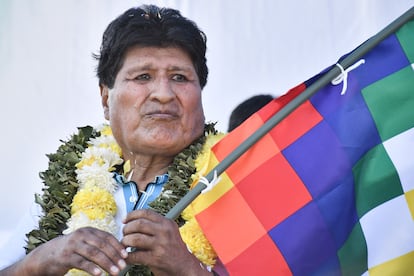

Bolivian Judge Carlos Oblitas declared former president Evo Morales (2006-2019) in contempt of court on Monday for failing to appear before the Tarija court where he is being tried for human trafficking, specifically for allegedly impregnating a 15-year-old girl while he was president. The court order includes an arrest warrant and a travel ban, as reported to the press by Supreme Court Justice Grover Mita. Morales’ legal team had already announced last week that their client would not appear, considering the case a “political persecution” and alleging irregularities in the criminal proceedings.
The former president’s lawyer, Wilfredo Chávez, called a press conference last Wednesday to denounce the improper notification process. “They should be notified personally, and only then should the trial begin; notification by edict was not appropriate.” Morales has evaded Bolivian justice since going into hiding in 2024 in his stronghold of Chapare, a coca-growing region where he maintains strong social support.
The defense’s arguments were refuted Monday by Mita, who asserted that the Code of Criminal Procedure allows for notifications in person or digitally: “The procedure is valid; the court has opted to make notifications through various means, indicating the day and time.”
The Prosecutor’s Office claims to have gathered more than 170 pieces of evidence to initiate a trial against Morales. The case dates back to 2020, during the brief interim presidency of Jeanine Áñez. At that time, images and text messages between the Indigenous leader and a teenager at least 40 years his junior were leaked. The Public Prosecutor’s Office maintains that the victim’s parents accepted the relationship between the former president and their daughter in exchange for political and economic favors; therefore, the mother, a fugitive in Argentina, is also under investigation. The now-defunct Ministry of Justice filed a complaint against Morales at the time, but the case was dismissed months later with the arrival in office of Luis Arce, Morales’s former economy minister and close associate.
The case was reopened in 2024, amid the fratricidal war between Arce and Morales. A first arrest warrant was issued against the former president for failing to appear to testify during the investigative phase. Morales decided to take refuge in the tropical Chapare region of Cochabamba, his political stronghold, known for its coca production and where he forged his union and political career. There, hundreds of farmers and coca growers protect him with makeshift spears and shields fashioned from tin cans.
The case has resurfaced amid heightened tensions between Morales and current President Rodrigo Paz. Morales is organizing a march to La Paz, the seat of government, starting Tuesday, to protest the government’s “neoliberal and privatizing policies,” which he blames for the over 20% inflation forecast by several institutions. Meanwhile, Paz has denounced an attempt at destabilization and, last Friday, through the Vice Ministry of the Interior, presented alleged audio recordings attributed to Morales in which he ordered the city of La Paz to be “besieged.” However, these recordings were refuted by national fact-checking organizations, which assert that they date back to last year, during the conflict between Morales and Arce.
Sign up for our weekly newsletter to get more English-language news coverage from EL PAÍS USA Edition









































