
Andes hantavirus: Deadly 2018 outbreak shows it is not only transmitted through close contact
The analysis of 34 infections after a party in Argentina confirms community transmission and the role of superspreaders — a pattern that may echo the situation aboard the ‘MV Hondius’
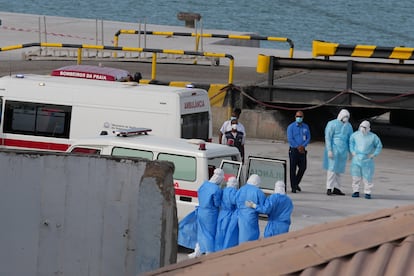

The Andes virus, responsible for the outbreak on the MV Hondius that has already caused three deaths, does not spread only through close contact. That’s the conclusion of a scientific study that analyzed an outbreak of this same strain in Argentina in 2018 and 2019: there were 34 infections and 11 deaths.
Most scientific papers explain that hantavirus transmission occurs from rats to humans and that human‑to‑human contagion is rarely documented. It happens only with this strain and, until now, has been limited to very close contact — in hospital settings or through sexual contact. But this 2020 study confirms the existence of superspreaders: people who, because of their viral load and social activity, can transmit the virus at a rate of 2.12, meaning one person infects an average of 2.12 others. At the start of the COVID-19 pandemic, the coronavirus had a rate close to 3.
This does not mean it has pandemic potential, but it does show that an Andes virus infection cannot be treated as a mere rodent‑borne issue: community transmission is possible.
The outbreak in the study occurred in Argentina, in the provinces of Chubut, Neuquén, and Río Negro. After the virus was introduced from a rodent reservoir, transmission began with three symptomatic individuals who attended crowded social events — a birthday party, a funeral, and a doctor’s appointment. Once 18 cases had been confirmed, health authorities imposed isolation measures for people with confirmed infections and for possible contacts. The number kept rising until it reached 34 cases in total. “The resulting reduction in the number of cases suggest that these measures limited the person-to-person spread,” the experts note in the study.
Tedros Adhanom Ghebreyesus, director‑general of the World Health Organization (WHO), on Thursday compared the outbreak on the MV Hondius to the one that occurred at that birthday gathering in Argentina in 2018. He said that in both outbreaks, there was a concentration of people in an enclosed space. “That appears to be the case in the current situation,” he said at a press conference. The Who chief urged the world to take note of the lessons learned in Argentina at the time. Measures such as contact tracing and isolation are needed to break this chain of transmission, he said.
Scientists traced the first event of person‑to‑person transmission. It happened at a birthday party with roughly 100 guests. “It was a formal party, with tables and about 100 people,” explains Gustavo Palacios, lead co‑author of the paper and a microbiologist at Mount Sinai Hospital in New York.
Patient 1 attended the party but didn’t stay long — about 90 minutes — because he began feeling unwell and developed a fever. Five people who had been seated near him later reported symptoms consistent with hantavirus pulmonary syndrome between 17 and 24 days after the gathering. “In fact, there was a sixth infected person who hadn’t been sitting nearby, and we couldn’t understand why,” Palacios recalls. “But then we learned they had run into each other in the bathroom and greeted each other there.”
One of the people infected at the party — Patient 2 — was the most likely source of six subsequent infections, owing to his active social life. Patient 2 died 16 days after the onset of symptoms, and his spouse developed a fever during his wake. Another 10 people who attended the funeral and had close contact with a different infected individual, Patient 9, fell ill between 14 and 40 days after the service. The remaining 12 patients had been in contact with at least one person who had previously shown symptoms.
Reasons for calm
“We need to put all of this into context,” says Palacios. “There are fewer than a thousand documented cases of this virus. And in most cases, we don’t see secondary transmission chains.”
His case study, published in the prestigious medical journal The New England Journal of Medicine, was unusual because of how explosive the spread was. And even then, it remained fairly contained: once the authorities advised those affected to isolate voluntarily, the transmission rate dropped to 0.96. “In other outbreaks, transmissibility doesn’t fall that quickly,” Palacios notes.
Another reason to be reassured is that this is a transmission chain with limited links. At a certain point, the virus simply stops spreading. “With hantaviruses, there’s a dead end — a point where transmission dies out. After three rounds of transmission, which is the most we’ve ever seen, it doesn’t go any further,” the microbiologist explains.
This is not the case with viruses like influenza or coronavirus, which tend to spread exponentially. It resembles mpox (formerly monkeypox) more closely, another disease Palacios has studied extensively. “With monkeypox, for example, we showed it can transmit across seven generations, and even then we described it as having low transmissibility,” he says.
The work by Palacios’s team was pioneering. At the time, scientists suspected that the Andes virus — the most virulent member of the hantavirus family — was also the only one capable of spreading from person to person. But this had never been scientifically demonstrated. In this case, researchers used serological testing, contact tracing, and genomic analysis to confirm human‑to‑human transmission.
“We need to reassess the threat posed by this virus,” Palacios said in a press release following the 2020 study. “The lack of approved medical treatments, the potential for widespread transmission, and the high case fatality rate of the infection should raise concerns.”
The Andes virus had a 32% mortality rate last year in Argentina. When complications arise, it can develop into another illness, hantavirus pulmonary syndrome, which has a 38% mortality rate.
European and Asian hantaviruses are far less virulent. Even the strain found in the United States, which has a similar mortality rate, does not spread between humans. Perhaps for that reason, Palacios recalls, it wasn’t easy to convince the global virology community of the danger and contagious potential of the Argentine variant. Even years later, some studies have played down these concerns, limiting transmission to hospital or sexual contexts — a view echoed in recent press coverage and still held by many experts.
But Palacios uses a different definition of close or high‑risk contact: “The one we used in this study — which was quite strict — was a person who had been within one meter of an infected individual for at least 30 minutes.”
Sign up for our weekly newsletter to get more English-language news coverage from EL PAÍS USA Edition









































