
When the USSR won the race to the Moon, although they missed a note in ‘The Internationale’
After more than a dozen failures, the ‘Luna 9’ achieved the first controlled landing on the satellite in 1966 and sent the first images from the surface

[Excerpt from the book Robots hacia la luna by science writer Rafael Clemente, in which he recounts in detail the incredible history of lunar exploration]
While the United States was still struggling to obtain its first close‑up images of the lunar surface, the Soviet Union had already moved on to the next phase of its program. This time, the objective would be a controlled descent to observe the landscape from the ground itself, not from above, through the cameras of a spacecraft destined to crash.
A spacecraft capable of landing on the Moon would be far more complicated than the first impact probes. With no atmosphere, it would be impossible to use a parachute. The only way to slow down a spacecraft was with a retro-rocket whose thrust would have to be adjusted so that it reached the ground at almost zero speed.
An altimeter radar would be needed to measure flight altitude, along with a computer to regulate engine thrust based on its readings. All of this would have to be autonomous, since the 238,855 miles separating the Moon from Earth introduced a communication delay of more than a second. A one-second delay each way in sending commands was unacceptable during such critical maneuvers. That brief interval would be enough to turn an operational spacecraft into just another crater in the rugged lunar landscape.
However, the Moon offers an additional advantage: with a gravity six times weaker than Earth’s, descents are less violent. Even so, free-falling probes like the Rangers impacted at 10,000 kilometers (6,213 miles) per hour.
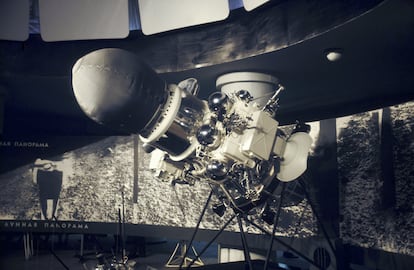
Soviet engineers built their spacecraft around a braking motor and its fuel tanks. Outside, in separate boxes, were the altimeter, the orientation system, and other electronic and thermal control equipment, since their delicate components required reasonable temperatures and direct sunlight posed a constant danger.
The object to be placed on the Moon was a roughly spherical capsule, located just above the spacecraft. It was protected by an airbag to cushion the impact. Once on the ground, it assumed a vertical position, like a roly-poly toy, and deployed four “petals” that revealed the panoramic camera. This camera was positioned just 60 centimeters above the surface, and this, combined with the Moon’s small size, meant that the horizon appeared very close, much closer than an astronaut standing on the surface would see. In return, it offered excellent detail of the terrain’s texture.
The radar altimetry measurements were accurate enough to bring the capsule to a very low altitude, but they couldn’t guarantee zero velocity. During the terminal landing phase, the probe extended a five-meter boom. Upon contact with the surface, a spring — located between the spacecraft and the capsule — was released, and the capsule was propelled upwards, thus compensating for its remaining velocity. The airbag would make the impact more bearable.
It was not easy. Over three years, between January 1963 and December 1965, the USSR suffered at least a dozen failures: five officially acknowledged as such by being named “Luna,” plus another seven that were never announced or were concealed under the designation “Kosmos.”
Finally, on February 3, 1966, the Russian efforts were rewarded with success. At an altitude of 75 kilometers (46 miles), the spacecraft, in freefall toward Oceanus Procellarum, righted itself vertically, jettisoned its side compartments to eliminate dead mass, deployed the contact sensor rod, inflated the two airbags, and activated its braking motor. In less than a minute, the speed was reduced to a few miles per hour when it was only about 200 meters from the ground.
When the touch sensor made contact with the ground, the capsule, still encased in its protective balloon, leaped upwards, gently landing and bouncing off the dusty surface. A timer triggered the deployment of the two airbag halves and the opening of the four petals that helped stabilize the craft. Four antennas, as flexible as a measuring tape, unfurled, and the camera activated, sending back to Earth the first panorama captured in situ on our satellite.
The camera used a rotating mirror installed inside a turret just six centimeters high at the apex of the capsule. This allowed it to record a complete 360-degree panorama.
It was a breakthrough that Soviet technicians kept to themselves with the same excitement they had felt years before when releasing the first photos of the far side of the Sun. But this time, someone was going to beat them to it. The radio astronomers at Jodrell Bank knew the transmission frequencies of these probes and routinely tracked their movements (the Russians themselves had provided them in order to have an impartial witness to confirm their successes).
Surprisingly, the signals received from the Moon were not encrypted and followed an almost standard format for sending telephotos.
Within hours, the team led by Sir Bernard Lovell reconstructed the first photograph of the Moon and distributed it to news agencies. They lacked only scale references on both axes, so the image was distorted, like a painting by El Greco. But otherwise, it showed the regolith structure in great detail.
A lost note
After the Soviet spacecraft Luna 9 achieved a soft landing, the next challenge would be to put a probe into orbit around our natural satellite. NASA was preparing a series of photographic probes for that purpose, but once again, the Russians would beat them to it.
As on other occasions, the USSR Council of Ministers was keen to commemorate the upcoming Party Congress with some spectacular space demonstration. A lunar satellite seemed like a good option. And so it was: Luna 10 was launched on March 31, 1966, with that objective.
To enter lunar orbit, the spacecraft must slow down so that it can be captured by the Moon’s gravity. Without this maneuver, the spacecraft would continue on its path, lost in interplanetary space.
In the case of Luna 10, Russian engineers decided to use the same braking engine that had performed so well during the landing of Luna 9. In fact, the central body of both spacecraft was almost identical. Only the descent capsule had been replaced by a small satellite loaded with instruments: radiation, meteorite, and magnetometer detectors, as well as a simple gamma-ray spectrometer to attempt a first estimate of the Moon’s chemical composition.
Also on board was an electronic oscillator programmed to transmit radio beeps that reproduced the notes of The Internationale. It was the political concession demanded by the Politburo. The technicians tested it on the last day of the voyage, just before reaching their destination, and the melody sounded good. Everything was ready.
On April 4, Luna 10 entered orbit. Congress, which had been in session for almost a month, was in full session, eagerly anticipating the announced surprise. But to their dismay, the technicians noticed that one of the notes of the anthem was missing. Without hesitation, they played the recording made the previous night over the auditorium’s sound system, assuring everyone that it was coming live from the Moon. All the delegates applauded, and the country’s technological prestige remained intact.
Powered solely by its batteries, Luna 10 transmitted data for a couple of months. Two more orbital probes followed that same year, both designed to obtain detailed photographs of the surface.
It’s clear that to fulfill their photographic mission, these vehicles had to be oriented with their camera lenses pointing downwards. The Luna 11’s stabilization system did just the opposite; it transmitted 40 images that showed only the blackness of space. The next one in the series would be more successful: its photos — around 50 of them — made it possible to distinguish details a few dozen meters across.
Finally, Luna 13, which followed later that same year, was again a lunar lander very similar to the first. It touched down on Oceanus Procellarum, not far from the first one.
This time, the main novelty consisted of two deployable arms at the ends of which two scientific instruments had been installed: a gamma ray source with sensors to measure the density and temperature of the terrain and a penetrometer.
The penetrometer — which measures the hardness of materials by the depth of penetration of a needle — was an arm with a simple titanium point at its end, resting against the ground, and a small gunpowder rocket above it. When ignited (it only allowed for one test), it caused the point to penetrate almost five centimeters into the ground, thus providing a valuable indication of its mechanical properties.
The Luna program would still see one more launch (an orbital probe) before concentrating on the design of a much more advanced model, one that would compete directly with U.S. efforts to reach our Moon: a robot capable of collecting samples and bringing them back to Earth.
Sign up for our weekly newsletter to get more English-language news coverage from EL PAÍS USA Edition









































