
The Moon: The new stage for the space race between the United States and China
Beijing aims to send astronauts to the Moon before 2030 and establish a base there in cooperation with Russia within the next decade. NASA, which has accelerated its lunar efforts with the Artemis program, considers it its ‘greatest competitor’

China entered the space race late, emerging as a new competitor just after the collapse of the Soviet Union, the United States’ great rival during the decades of the Cold War. But its steady progress, always at a good pace, has meant that Washington is increasingly aware of China’s growing momentum. Following NASA’s Artemis 2 mission, the first crewed mission to orbit the Moon in half a century, which reached its climax when its astronauts gazed upon the far side of the satellite, the next four years will be crucial in the competition.
The People’s Republic of China has set the goal of having its astronauts, the so-called taikonauts (a word derived from taikong, meaning cosmos in Chinese), set foot on the Moon before 2030, and intends to establish a permanent base on the lunar surface within the next decade, in collaboration with Russia. It has already successfully landed a rover on the far side of the Moon and returned with samples; it has also sent a probe to Mars, a planet that is also on the horizon for manned missions, albeit a much more distant goal, starting in 2040.
Space is one of the great battlegrounds between the two superpowers. In this arena, not only are scientific and technological capabilities measured, but also the impact of both countries in terms of soft power and the dreams they instill in future generations. Will the astronaut posters hanging in children’s rooms two decades from now bear Asian or Western faces? Which flag will fly first on Mars?
The United States is quite explicit about how obsessed it is with the trajectory of the new contender. Billionaire Jared Isaacman, the administrator of the U.S. space agency appointed by President Donald Trump, often cites the rivalry with China, which he has referred to as its “great competitor,” regarding the establishment of U.S. bases on the Moon in the coming years.
“We’re going to do everything necessary to get back to the Moon, and never let anyone else take it over again,” said Isaacman. “The difference between success and failure will be measured in months, not years,” he added regarding the return of astronauts to the satellite, which the United States plans to achieve before Trump’s presidency ends in 2028.
China never officially mentions the existence of a space race like the one during the Cold War. But the government does occasionally take jabs at its rival. In December, the official Xinhua news agency, controlled by Beijing, listed the reasons why it will be “difficult” for the United States to meet its timeline for returning to the rocky celestial body.
“Getting astronauts to the Moon depends on years of consistent political commitment and stable funding,” an editorial stated. “The American political system is prone to abrupt changes brought about by leadership shifts and partisan disputes, making it ill-suited for long-term projects that extend beyond a single presidential term.”
Governed by a single party, and without a true parliament to act as a check on power, China does not face budget gridlock that forces spending cuts or midterm elections that prompt a readjustment of priorities. The country progresses under the guidance of the state, which aligns industries, financing, and interests. In the latest five-year plan, the political, social, and economic roadmap for the next five years, approved in March — with 2,758 votes in favor, one against, and two abstentions in the National People’s Congress — the communist authorities have included the aerospace sector among the “strategic industries of the future.”
“The Chinese manned Moon landing is just one step in its long-term plan, established decades ago,” Chen Lan, an independent analyst of the Chinese space program and co-founder of the now-paused unofficial publication Go Taikonauts!, commented via email. “Generally, the Chinese agenda is not influenced by external factors. The United States sees it as a race; China does not.” Chen believes that the pace of the program set by Beijing will not change regardless of the success or failure of Artemis 2. “Chinese engineers are simply observing, without pressure.”
This analyst states that China excels in long-term planning and execution. “It has a sound decision-making mechanism, designed to minimize the influence of interest groups with regional or short-term objectives. Furthermore, the Chinese education system trains a large number of engineers and scientists, which also represents an advantage over Western countries.” However, he believes that China is somewhat behind in the commercial space sector: it needs five to 10 years to catch up with the United States in areas such as reusable launch vehicles.
Officials from China’s Manned Space Agency (CMSA) assert that preparations for its crewed lunar mission are “progressing satisfactorily,” and that the development of the Long March-10 rocket, the Mengzhou manned spacecraft, the Lanyue lunar lander, and the Wangyu lunar rover is “on schedule.”
In addition, the Chang’e-7 (2026) and Chang’e-8 (2029) scientific missions for robotic exploration of the satellite’s south pole are following the planned schedule; their experiments are expected to serve as a basis for establishing the future International Lunar Research Station (ILRS), the Chinese complex.
Although not officially considered a race, the conquest of space has been viewed in China with patriotic fervor ever since it first launched a satellite into orbit in 1970, 12 years after the American Explorer 1. At that time, China was a poor nation, ravaged by the brutal Cultural Revolution, and lagging behind the West. The country saw that launch as an opportunity to shake off the weight of what in China is called “the century of humiliation.” The renowned Chinese science fiction writer Liu Cixin often recalls this event as one of those moments that marked him as a child and spurred him to imagine new worlds.
The Asian giant’s stellar moments arrived as the turn of the century approached, as its development accelerated and it ascended to the pantheon of leading powers. In 1999, it successfully launched its first unmanned spacecraft, Shenzhou (“divine ship” in Mandarin). This was its introduction to the space race. In 2003, Yang Liwei, aboard Shenzhou-5, became China’s first astronaut. Since then, manned launches have become increasingly frequent; 28 taikonauts have accumulated experience in the weightlessness of space; none of its manned missions have failed.
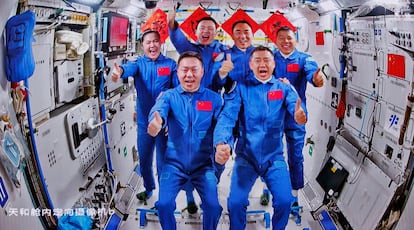
China is also the only country with an independent orbital platform, a result of its rivalry with Washington. Beijing began developing Tiangong (“Heavenly Palace”), a kind of floating laboratory, after the United States barred it from accessing the International Space Station in 2011. Its first module was launched into orbit in 2021 and became operational in 2022. Its three crew members rotate every three months.
“May the vast expanse of space bear witness to the boundless loyalty of China’s space soldiers,” Commander Chen Dong remarked a year ago, leading one of these relief missions, just hours before launching from the historic Jiuquan base in the heart of the Gobi Desert. Dozens of people waved red flags to the rhythm of an orchestra playing national anthems. “The motherland and the people await your safe return,” read the banners.
Six months later, their mission would suffer a setback. Their return had to be delayed due to the risk posed by the “suspected” impact of “a small piece of space debris” on the spacecraft in which they were to return to Earth. Finally, the three taikonauts returned safe and sound.
The Jiuquan Satellite Launch Center, the military-controlled base to which EL PAÍS had rare access, is an almost sacred place in Chinese cosmic mythology. Opened in 1958 as a test range for intercontinental ballistic missiles, it has been the launch site for several major Chinese space missions.
Inside the compound, amid messages of encouragement for astronauts and rocket sculptures in the roundabouts, a billboard featuring President Xi Jinping in military uniform encourages “exploring the vast universe” and building a “powerful space nation.”
Zhang Wei, a researcher at the Center for Space Applications of the Chinese Academy of Sciences, speculated during that visit why, more than five decades after the last Apollo mission in 1972, the Moon has become a place to return to: until now, lunar exploration had primarily focused on studying the satellite; this “more scientific” approach has given way to a stage of “lunar utilization” that requires the capacity “to explore and excavate.” He mentioned resources that could be exploited, such as the Moon’s solar energy, lunar ice, and certain minerals, like ilmenite and helium-3, which some describe as “the fuel of the future.” “It will help humans go further,” he observed. But, when asked who would win the race back to the Moon, he insisted that China would proceed step by step and according to plan: “We are not going to compare ourselves to anyone.”
Sign up for our weekly newsletter to get more English-language news coverage from EL PAÍS USA Edition









































