
Hormuz, the island that gives its name to the strait, reacts to the blockade: ‘Everything has collapsed’
The local population, dependent on tourism and fishing, is suffering from the halt of its economy, and some are fleeing to other parts of Iran
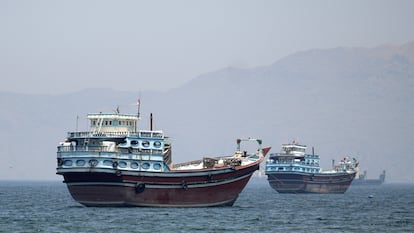

The island of Hormuz is one of the few places in Iran where women wear burkas. Due to the island’s proximity to the Arab countries on the other side of the Persian Gulf, wearing this garment—which covers the entire face and is more common among Sunni Muslims than Shiites—is a deeply ingrained custom. However, instead of fabric, the burkas here are made of colorful masks in various shapes and sizes, adding a spectacular touch to this small volcanic island, rich in salts and minerals, which gives its name to the strait. The island’s unique character has allowed its inhabitants to make a living from tourism, supplementing their traditional source of income: fishing. But the blockade of the strait, a consequence of the U.S.-Israeli war against Iran, has placed the population of around 10,000 inhabitants on the front lines, plunging them into despair. Many have chosen to flee the area due to the collapse of their economy and the threat of attacks.
Talks between the parties during the ceasefire have not prevented the strait from remaining closed with a dual Iranian and American blockade. The geostrategic importance of the islands in the strait is not new, nor is it solely related to the current transportation of goods carried by ships seeking to leave the Gulf for the open sea in the Indian Ocean—around a fifth of the world’s oil and liquefied natural gas, and between 20% and 30% of fertilizers, pass through this area. The reddish-stone ruins of the castle built by the Portuguese in the 16th century, when they sought to wrest control of trade between Europe and Asia from the Arabs, bear witness to this. The products were different then—spices, fabrics, silk, pearls—but the objective was the same: to control this bottleneck.

Hossein runs a small hotel near the Portuguese ruins. He asks to be identified by a pseudonym, takes several days to reply on Instagram, and quickly deletes messages—all due to fear of the consequences of speaking to the international media about the current situation, coupled with the difficulties of accessing the internet after the regime’s imposed shutdown. “Life on this island has always been difficult, with limited infrastructure, high costs for importing goods, and a lack of skilled personnel. But this year is different; I feel like everything has completely collapsed,” he explains in a message exchange.
Hormuz, with an area of only 42 square kilometers (16 sq mi), is one of the islands from which Iran monitors the strait, which in this narrow waterway has a minimum distance of about 39 km (21 m) between its two shores. It is the most popular tourist destination, along with the largest of these islands, Qeshm, while Larak and other smaller islands have a greater presence of naval and military bases. It is through this labyrinthine waterway that ships permitted by Iran pass, and it is there that the country has allegedly been charging tolls for the transit of goods.
“Tourism in Hormuz and Queshm is relatively new. Many of us came years ago because we liked the nature and culture of the place, and over the years we have built a small infrastructure. But the situation has always been very fragile,” Hossein explains about an activity that has a short season, since from spring onwards the temperatures become too hot.
The collapse he sees now in the area is much worse than during the Covid pandemic: “All business has dropped to zero, there is no source of income, and it’s not even possible to make a living from fishing.” This hotel owner explains that, a few days after the conflict began, he left the island due to the risk involved in staying.
Reza (again a pseudonym) is a Hormuz café owner who dares to launch further criticisms and point the finger at those responsible for the current situation. “This didn’t start with the war in March. Ever since the United States killed General [Qasem] Soleimani in Iraq in 2020, just before the pandemic, we lost all our foreign tourists. The island hasn’t recovered,” he explains, adding that no one has been able to experience “a normal life,” especially since the 12-day war between the U.S. and Israel against Iran in June 2025. “During that war, we heard about five or more attacks every day, both near and far,” he notes.
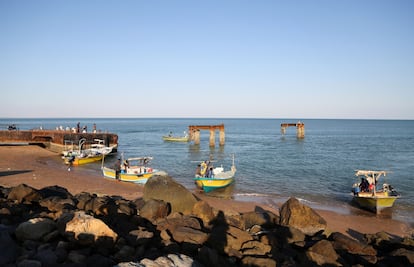
The scene Reza paints is one of a sparsely populated area, with few resources, and the site of intermittent naval warfare. “Fishing, tourism, and freight transport are all shut down, and many people can’t stay, fearing attacks and critical power outages, since the water supply here depends on electricity. Even with the ceasefire, all we can do is survive,” he explains. “We’ve been trying to recover for years, time and time again, but now I fear we’re losing hope,” he laments.
Despite his fear of the consequences, he prefers not to remain silent: “Our country has lost a lot of infrastructure; only a few people have internet access with VPNs, and even then, it’s very expensive. It will take many years to rebuild everything. For many years, we have been unknowingly paying for the government’s ballistic missile programs,” he explains, expressing the population’s anger at the impoverishment of living conditions at the expense of the Iranian military sector, which ignited the recent protests against the regime. “The worst part is that before the war, we protested and had power in the streets. This war supposedly started in the name of the people, but now more than ever, the government has taken control of the streets, and no one even dares to criticize it.”
Sign up for our weekly newsletter to get more English-language news coverage from EL PAÍS USA Edition









































