
War splits Iranian society between fear of new attacks and opposition to any concessions
Uncertainty pervades a population united only by anger over the precarious economic situation
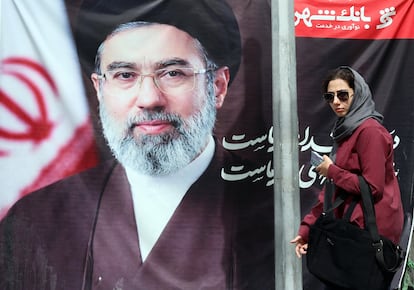

The fragile ceasefire and the enormous uncertainty about what comes next have triggered a wave of contradictory reactions among Iranians. One segment of the population — especially supporters of the Islamic Republic — rejects any concession to Washington, convinced that control of the Strait of Hormuz gives Tehran a position of strength. Many others, however, fear that insisting on keeping the waterway closed and failing to reach an agreement could prompt new attacks by the United States and Israel. What unites them all, however, is concern about the precarious economic situation.
According to the latest figures from the official statistics office, food prices have more than doubled in the past year. Iranians like Behnam, a lathe operator and father of two in Isfahan, in the center of the country, know that poverty — now deepened by the war — not only prevents many families from making ends meet but is also a weapon in the hands of the United States.
This man, around 40 years old, argues that Donald Trump “knows Iran’s economy is in bad shape and is pressuring it to collapse” with his blockade of the Strait of Hormuz, through which Iran also exports a significant portion of its main source of revenue: oil. “Closing the Strait of Hormuz and thinking that Trump and [Israeli President Benjamin] Netanyahu will give in is unrealistic,” this laborer laments in text messages.
The economic impact of the war has become one of Iranians’ main concerns, with runaway inflation and mass layoffs. Iran’s deputy minister of cooperation, labor and social welfare warned on Sunday of the severe impact of the conflict on the Islamic Republic’s labor market. Gholamhossein Mohammadi, who also heads the Technical and Vocational Training Organization, said that preliminary estimates indicate the conflict has caused the loss of more than one million jobs and left around two million people in direct and indirect unemployment.
“Many have lost their jobs, and I haven’t been paid this month,” says Nima, a shop assistant in his thirties in a clothing store in Tehran. He looks to the future with apprehension. Not even the Persian New Year, which began in March with the arrival of spring — a time when Iranian spending traditionally skyrockets — has managed to prevent sales from plummeting. “People don’t have any money,” he laments, and those who do are gripped by “uncertainty,” so they may not be spending it.
Before the war and the massive destruction it is causing, one of the major triggers of the massive protests in January was precisely the economic downturn and the sharp devaluation of the rial, Iran’s national currency. These concerns sparked an uprising of cell phone vendors in Tehran’s Grand Bazaar, a traditionally conservative group who were formerly supportive of the Islamic Republic.
No internet
The already deep economic crisis is now worsening because of the lack of internet access: Iran has been under a digital blackout for 51 days, according to NetBlocks. It is an unprecedented shutdown that has left the country practically disconnected from the global network and is hitting small businesses especially hard.
Such is the case for Sureh, the owner of a Persian‑crafts startup that sold through social media platforms like Instagram. She fits the profile of many women who launch these small projects: often women with higher education — Sureh is an agricultural engineer — who could not find work in their field and turned to these businesses as an alternative livelihood. In her case, it took “seven years of continuous effort” to build a company that, she laments, “is now collapsing.” Her story is marked by frustration and helplessness. “It feels like we’re condemned to survive between bombings and hardship,” she says.
Iranian authorities estimate that digital companies can withstand internet outages for an average of 20 days and that some 10 million direct and indirect jobs are at risk. Deputy Minister Mohammadi put the losses from the digital blackout at “around five trillion tomans per day,” equivalent to $31 million. Given the recent sharp depreciation of the Iranian currency, even the authorities are now using the toman, which is equivalent to 10 rials.
As these official figures indicate, the Islamic Republic is well aware that the internet shutdown is dealing a severe blow to the national economy. However, faced with the choice between controlling the discourse and criticism of Iranians abroad — at the cost of further impoverishing the population — or opening up the internet and losing that control, the authorities have opted for the former, judging by the network blockade.
The lack of clear prospects, the digital shutdown, and the climate of insecurity during the 40 days of bombings before the current fragile ceasefire have led some Iranians to consider emigrating. Tania is one of them.
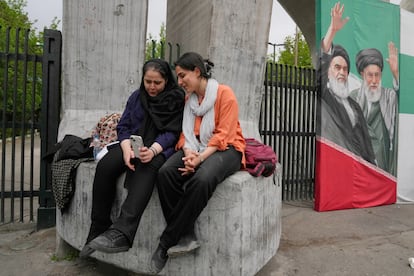
More than herself, this 40-year-old engineering company director is thinking of her 10-year-old daughter. “I don’t believe my daughter has a future in Iran. I love my country, but circumstances are forcing me to leave, and that is profoundly sad,” she says. She cites the frequent school closures, the internet shutdowns, and the risk that the war will drag on. “I always hoped for a change that would guarantee well‑being and security, but the situation gets worse every day,” she laments.
Meanwhile, some government supporters claim they are willing to sacrifice their well-being in the name of resisting an external enemy. They are people like Mohsen, who sees the survival of Iran’s political system as a victory: “The United States and Israel did not expect our resistance,” boasts Mohsen, the owner of a catering service in Tehran, who says Iranians are “ready to endure any hardship” to defeat their enemies.
But that official line is not the dominant one, says Simin, a mechanical‑engineering student in her twenties, who argues that those who defend the slogan “war until victory” are a minority, even if “their voice is amplified through state television.” She then mentions the presence of members of Shiite allied groups of the Islamic Republic at security checkpoints on the streets. “If they had that much support, they wouldn’t need to bring [these militiamen] from other countries like Iraq.”
“If you watch Iranian television, it seems as if Israel has been destroyed and the United States has suffered enormous losses,” says this student who, like many Iranians, relies on Persian-language satellite channels for news. These channels have always been a key source of information, but now they are even more so, given the widespread internet blackout. “Some regime supporters believe its propaganda and don’t even want to negotiate; they don’t watch the satellite channels,” the young woman adds.
Sahar, a 50-year-old woman living in Tehran, echoes a common criticism among Iranians: that the Islamic Republic cares more about supporting its allied militias in the region than the well-being of its citizens. “The precondition for a [peace] agreement with the United States is not the Iranian people, but the survival of Hezbollah,” argues the housewife, alluding to how Iran has conditioned the signing of a definitive ceasefire on its inclusion of Lebanon, where Hezbollah is based.
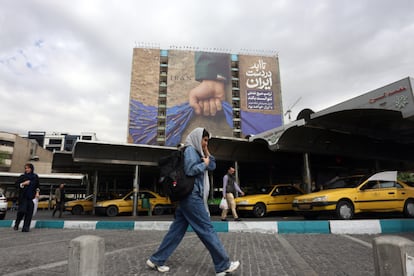
“What good would it do if the missiles reached the United States if we have no future?” the woman asks. She argues that a country’s strength “doesn’t come from missiles, but from the well-being of its people. If there’s another war and they destroy what’s left of our infrastructure, the situation will only get worse,” she adds.
Caught between precarious living conditions and the threat that the war could resume, other Iranians — like Zahra, a teacher at a school in Tehran — wonder “what the war was for,” and why their country endured so much hardship only to now end up agreeing to reopen the Strait of Hormuz, hand over the enriched uranium that Trump is demanding they relinquish, and commit to not enriching the material. The woman, in her fifties, concludes: “If we give in, the enemy won’t leave us in peace.”
Foad Izadi, an associate professor at the Faculty of World Studies at the University of Tehran, also considers it dangerous to accept certain conditions imposed by Washington: “Removing enriched uranium from Iran and limiting control over the Strait of Hormuz will encourage future attacks.” In his view, the United States and Israel are pursuing a long-term plan: “It’s not a one- or two-year plan, but a four-year plan.”
Sign up for our weekly newsletter to get more English-language news coverage from EL PAÍS USA Edition









































